

Metal die casting
Die casting from brass alloys
Die casting of copper and brass materials tends to be a niche activity. Wrongly so, as examples of applications in the automotive industry show. However, there is a lot to consider in the design process and also when choosing the alloy.
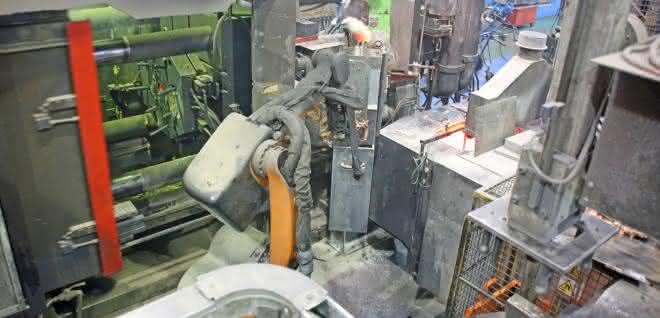
Die casting works with permanent metal molds in which the cast parts cool down quickly. This enables short cycle times and precisely formed contours. The process is therefore used extensively for low-melting metals such as aluminum, magnesium and zinc. However, as the significantly higher melting temperatures of copper and brass materials place much greater stress on the mold material, die casting has a niche existence here. Actually wrongly so, as a visit to the French die-casting foundry Favi shows.
"The economic and technical advantages of the die-casting process for brass components are not sufficiently well known among design engineers," regrets Denis Declerck, Head of Technology and Sales in the relevant department at Favi in Hallencourt, France. His department specializes in the production of high-quality brass die castings in quantities ranging from around 500 to large series of more than 100,000 pieces. The foundry company, which has a total of around 310 employees, is part of the Afica Group, a leading manufacturer of copper alloys, and produces die-cast parts from aluminum, brass and copper materials. The division headed by Declerck forms a separate department within the company, which is primarily focused on the automotive sector, and produces brass die castings for other industrial applications. The focus here is on market segments such as fittings, manufacturers of door, window and furniture fittings, the electrical and electronics industry, agricultural machinery, medical technology and mechatronics.
High productivity
"Die casting is characterized by very good productivity and quality, but requires more expertise than metals with a lower melting point due to the high casting temperatures of brass," adds Declerck. This applies to all parts of the systems that come into contact with the molten metal at around 1,000 °C, but above all to the permanent metal molds, whose material is exposed to extremely intense thermal shocks. Thanks to its own mold construction and decades of experience in the processing of brass alloys, Favi masters all stages of the process to a high standard, which also meets the strict requirements of the automotive industry. The department has a total of seven die casting cells with die holding forces of between 80 and 620 tons. Parts are produced in the weight range between 4 g and 2 kg. All systems are fully automated and can therefore operate largely unmanned. Automated machines or robots perform all handling tasks, finished parts are checked in the robot handle and then separated from the casting system using a punch. Depending on the cast part and surface quality requirements, the molds achieve a service life of between 35,000 and 50,000 production cycles.
The construction process
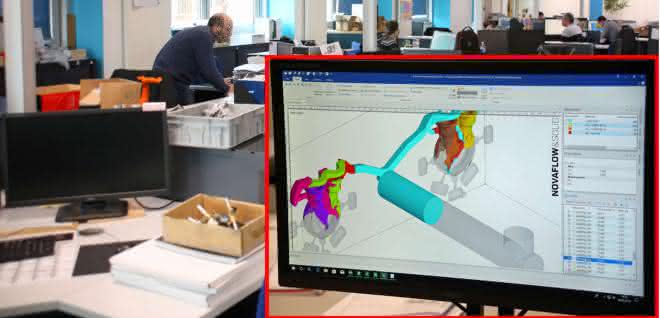
"When developing a new component, it is advisable to consider the possibilities and limitations of the manufacturing process during the design phase," Declerck reveals. Like every manufacturing technology, die casting brass also has its own special features, for example with regard to wall thickness transitions or material accumulations, which should be taken into account in order to achieve optimum results. This should be done as early as possible in the design process. Experience has shown that the later changes or adjustments have to be made during development, the more expensive they become. This is why Favi, with its experienced specialists and comprehensive IT equipment, is ready to support its customers with advice right from the start of the development process. This includes tools such as the CAD/CAM software ProEngineer or the casting simulation program Novacast. If necessary, prototypes can also be produced, for example by machining from solid material or using 3D printing. Thanks to this and the routine of the employees, it is usually possible to achieve a process suitable for series production right from the start.
The alloy
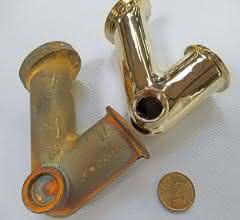
"Favi not only has an exceptionally wide range of alloys, but also develops special alloys that are specially optimized to meet customer requirements if necessary," says Siegfried Glanz, Managing Partner of L+B Metallservice in Olpe. The expert in metallic materials and casting processes supports Favi in looking after its customers in Germany. When developing customer or market-specific alloys, Favi can rely on its parent company Afica, which is one of the largest European producers of refined copper alloys with an annual production of 15,000 tons and corresponding experience. The company also collaborates with research institutes. The most important innovations include several low-lead and dezincification brass alloys according to the UBA list as well as the antibacterial alloy AB+ for applications in medical technology and in hospitals and care facilities. In addition to its antibacterial effect, this alloy, which is manufactured without the addition of lead or nickel, does not trigger allergies or release toxic substances.
A further alloy development led to a particularly wear-resistant and at the same time corrosion-resistant material, which is preferably used in the areas of mechanical engineering and agricultural machinery construction.
Efficient processing
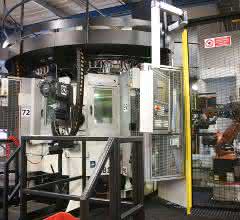
"We also accommodate our customers in terms of processing depth and, on request, supply completely ready-to-install machined and finished components or fully assembled modules," Declerck reveals. The core elements of the equipment include a fully automated and highly flexible production cell in which several robots handle the parts. The special features of the system include a separating and feeding unit for the cast parts fed in as bulk material in boxes. The system empties the fed crate via a lift into a vibrating hopper, from which the parts are fed one after the other onto a conveyor belt. There they are scanned using cameras, which record both the identity of the part and its orientation. If the part is not recognized as correct, it is sorted out. Correct but incorrectly oriented parts are fed back into the hopper. All other parts are gripped by the robot and transferred to the automatic processing machine.
A number of other machine tools are available for other operations. Surface treatments are carried out using sand or shot blasting as well as partly robot-operated vibratory grinding and polishing systems. In addition, a new machine was purchased at the beginning of the year, which produces a glossy effect on the cast surfaces after blasting or vibratory grinding. Proven external partners are available for further surface finishing such as electroplating with silver or other metals.
"As Favi casts to a considerable extent for the automotive industry, the entire quality system naturally meets the strict requirements of the automotive industry," explains Glanz. As mechanical processing takes place within a very short time after casting and parts cleaning, the feedback loop of the quality control loop between the occurrence and detection of production errors is very short, so that malfunctions are quickly rectified. Continuous worker self-monitoring is just as much a part of the quality system as regular recertifications. Certification to IATF 16949 and ISO 9001 is renewed annually, while renewal for ISO 14001 is planned for the current year.
Klaus Vollrath, freelance journalist / ag


You might also be interested in
Basler acquires 76% of Indian image processor
Basler, supplier of image processing components for computer vision solutions, has acquired 76% of the Indian sales partner Alpha TechSys Automation.
 read more...
Process monitoring and fault detection
Cameras ensure quality during laser melting
Powder bed-based laser melting (PBF-LB/M) opens up new possibilities in additive manufacturing. Modern camera systems provide crucial process data to further increase quality and efficiency.
read more...Vision Sensor is three times faster than its predecessor
The 'CS-62' vision sensor from di-soric is around three times faster than its predecessor, the 'CS-60'. In combination with the 'nVision-i 25.1' software, it enables image processing solutions that were previously reserved for smart cameras.
read more...Thermal imaging cameras for quality control
Automated thermal imaging cameras are often suitable for quality control applications where temperature plays a role. However, while there are various solutions on the market for slow processes, it is challenging to select a camera that reliably...
read more...Easy entry into industrial VGA thermography
Reliable temperature measurement is a prerequisite for the success of many industrial processes. Berlin-based manufacturer Optris presents the Xi 640 infrared camera, a new member of its Compact Line, which enables non-contact temperature...
read more...Powder bed-based laser melting optimized
Aconity3D has set itself the goal of optimizing the stability of the manufacturing method of powder bed-based laser melting and thereby promoting its use in a wide range of industries. By using high-speed industrial cameras from SVS-Vistek, the...
read more...INDUSTRIAL Production Products of the year...
2nd place, category handling, assembly and production logistics: SICK
safeVisionary2 is the first 3D time-of-flight camera with Performance Level c safety certification. It enables safe three-dimensional environmental detection and won 2nd place in the competition for Product of the Year 2024 in the handling, assembly...
read more...Nomination Products of the Year 2024
SICK: Camera systems safeVisionary2
safeVisionary2 is the first 3D time-of-flight camera with Performance Level c safety certification. It enables safe three-dimensional environmental detection and has been nominated in the 2024 Product of the Year competition in the handling,...
read more...AI vision brings additional opportunities
The seamless integration of AI into the consumer sector has helped to improve our quality of life and make interactions with technology more efficient. In industry, AI vision with machine learning opens up new possibilities that are not covered by...
read more...