

World Robotics Report 2019
16.5 billion dollars invested in robots worldwide
According to the World Robotics Report 2019, USD 16.5 billion was invested in robots worldwide and 422,000 units were delivered. A pause in growth is expected for 2019, but double-digit growth is forecast for 2020.
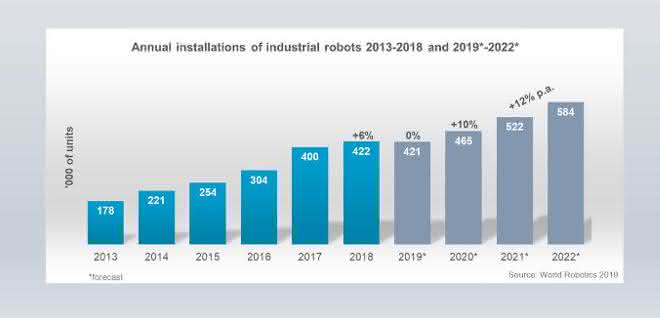
The International Federation of Robotics, or IFR for short, expects a brief pause for breath in 2019, meaning that the robotics market will remain stable at the 2018 sales level, in which USD 16.5 billion was invested in robots. The experts do not expect average annual growth of 12% again until 2020 to 2022. The turnover of 16.5 billion dollars is calculated from the estimates of various national robot associations for their respective domestic markets and relates purely to robots. If software, peripheral devices and system technology are included, global sales are estimated to be around 50 billion US dollars.
The IFR published these figures in its World Robotics Report. According to the report, 422,000 units were delivered worldwide, an increase of 6 percent compared to 2017. "We saw dynamic development in 2018 with a new sales record, even though the main robot customers - the automotive and electronics industries - had a difficult year," says Junji Tsuda, President of the International Federation of Robotics, on the occasion of the publication. "The trade conflict between the US and China brings uncertainty to the global economy - customers tend to postpone investments. It is therefore remarkable that the mark of 400,000 robot installations per year worldwide has been exceeded. The longer-term outlook shows that the continuing automation trend and further technical improvements will lead to double-digit growth - with an estimated 584,000 units in 2022."
China with investment decline
Although Asia is still the world's largest industrial robot market (+ 1%), investment declined in China and the Republic of Korea. In Japan, however, investments increased significantly. Europe is the second largest market, with growth of 14 percent. The increase in America amounted to 20 percent.
In total, 74% of global installations in 2018 were attributable to the five main markets of China, Japan, the USA, the Republic of Korea and Germany. Although around 154,000 units were installed in China, one percent fewer than in the previous year, the Middle Kingdom remains the world's largest industrial robot market, accounting for 36 percent of total installations. Chinese robot manufacturers were also able to increase their market share from 22% to 27%. This development is also due to Chinese policy, which promotes domestic robot manufacturers. As a result of the policy, but also due to the weakening automotive industry, installations by foreign robot suppliers, including units produced in China by non-Chinese suppliers, fell by 7% (around 9,000 units) to around 113,000 units.
Japan and USA with high growth
In Japan, robot sales rose by 21% to around 55,000 units in 2018 - the highest figure ever achieved in the country. On average, the market has grown by 17% per year since 2013. Japan is the world's leading manufacturer of industrial robots: 52% of global sales come from Japan.
With 40,300 newly installed units and year-on-year growth of 22%, the USA reached a record high for the eighth year in a row. The growth driver is the trend towards a higher degree of automation in production, which has been ongoing since 2010. In terms of annual robot installations, the USA has overtaken the Republic of Korea from third place, where robot installations fell by 5%. In Korea, the robot market is heavily dependent on the electronics industry, which had a difficult year. Since 2013, the Republic of Korea has recorded growth of 12%; 2018 is the first year of decline.
Number 1 in Europe and number 5 worldwide is Germany: the number of robots sold rose by 26% to 27,000 units in 2018. The main customer is the automotive industry.
Robot sales by sector
With a share of almost 30% of the total supply (2018), the automotive industry remains the world's largest user of robots. After a very strong year in 2017 with a 21% increase in installations, the level was only slightly increased by 2% in 2018. Investments in new automotive production capacities and modernization have boosted demand for robots. The use of new materials, the development of energy-efficient drive systems and strong competition in all major automotive markets led to investments. 79% of installations of industrial robots took place in five key markets: China (39,351 units), Japan (17,346 units), Germany (15,673 units), the USA (15,246 units) and the Republic of Korea (11,034 units). India, the fourth largest vehicle manufacturing country in the world according to OICA production statistics, has only installed just under 2,100 industrial robots in its automotive industry. Overall, however, India is growing by 39 percent.
The electrical and electronics industry was on the verge of replacing the automotive industry as the most important customer for industrial robots in 2017. However, global demand for electronic devices and components fell significantly in 2018. This industry is probably the most affected by the trade crisis between the US and China, as Asian countries are leaders in the production of electronic products and components. Robot installations in this industry fell by 14 percent from their peak of around 122,000 units in 2017 to 105,000 units in 2018. 79 percent of total installations in the electrical and electronics industry were installed in three countries with large production facilities: China (43 percent), Republic of Korea (19 percent), Japan (17 percent). Vietnam recorded a one-off increase in installations in 2017, driven by some large projects (7,080 units), but declined in 2018 (689 units).
The metal industry and mechanical engineering established themselves as the third-largest customer industry. In 2018, installations accounted for 10 percent of total demand. Both manufacturers of metal products (excluding automotive parts) and manufacturers of industrial machinery have invested heavily in robots in recent years. Installations rose to around 43,500 units in 2018. This is one percent less than in the record year of 2017 (44,191 units). The metal industry was the largest customer industry in Finland (44%), Sweden (42%), Switzerland (40%), Belgium (30%), Austria (27%), Italy (26%) and Denmark (21%).


You might also be interested in
German industry under pressure
Industry association cancels growth forecast
The Federation of German Industries (BDI) believes that German industry remains under pressure and expects stagnation instead of growth. At the same time, the association is emphasizing the industry's innovative strength at the Hannover Messe.
 read more...
Why eleven federal states are calling for the use of low-emission steel in the automotive industry
Heads of federal states put pressure on Brussels: Eleven German federal states appeal to the EU to promote low-emission steel in the automotive industry more strongly. The German Steel Federation supports the initiative as an important lever for...
read more...Setting the course for Germany's technological future
The Federal Cabinet adopted the microelectronics strategy today. Germany wants to become a leader in microelectronics. The Federal Government's new strategy: bundling topics such as research, skilled workers and production in order to strengthen...
read more...European elections FSK 16
Good news: over the past 20 years, voter turnout in European elections in Germany has risen continuously - from 43.0% to just under 64.8% recently. I like the idea of allowing young people aged 16 and over to participate in politics in the form of...
read more...Democracy project
Many people are taking to the streets these days because they are fed up with right-wing hatred and populism. Industry is also aware of its social responsibility. "Transformation as the project of the century" is the title of a paper published...
read more...Artificial intelligence in Germany
Microsoft invests 3.2 billion euros in AI infrastructure
Microsoft has announced the largest investment in its 40-year history in Germany to accelerate the possibilities and benefits of artificial intelligence (AI) in the country.
read more...Plagiarius 2024 negative prize
On January 26, 2024, the Plagiarius campaign awarded its dreaded "Plagiarius" negative prize for the 48th time to manufacturers and retailers of particularly brazen counterfeits and fakes.
read more...100 years of Conrad Electronic
One hundred years of change
Conrad Electronic celebrated its centenary on June 21, 2023 with a gigantic event in the spirit of change. 400 high-ranking guests from business and politics as well as long-time Conrad companions were invited to the logistics center in...
read more...Loss of competitiveness?
The major associations BDI, VDMA and ZVEI are calling for more efforts to ensure that Germany remains competitive on an international level.
read more...