
Special machine construction
Welding robots in continuous use
Metallbau & Schweißtechnologie Zentrum Blankenburg use industrial robots from Yaskawa for their welded constructions. Among other things, they are used to produce special constructions with many material combinations. The Motoman welding robots are in continuous use.
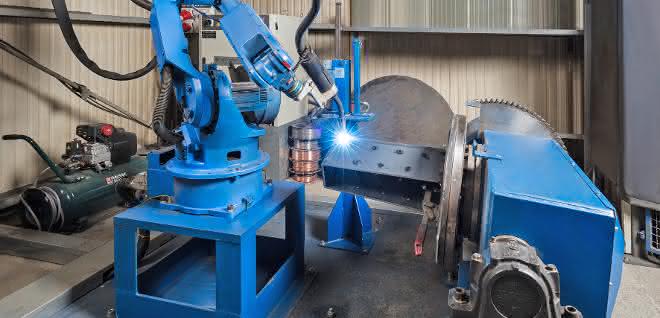
In the field of welding technology, the welding engineers at Metallbau & Schweißtechnologie Zentrum GmbH Blankenburg, or MSZ for short, have mastered many high-tech joining processes: "We focus less on standard tasks and more on the production of high-quality, production-ready assemblies and special designs in many material combinations. Where things get metallurgically tricky, we see the challenge and take on this exciting task," says company founder Wilhelm Krüger Sr. Other special features of the company are its high level of vertical integration and high-tech machinery, which includes more machines than employees. In addition to a welding robot from Yaskawa, there are laser, plasma and flame cutting systems as well as various types of bending machines, press brakes, automatic saws and everything else needed for a metalworking company to be able to produce its own welded constructions.
"Thanks to this equipment, we are now able to offer our customers from the machine, plant and rail vehicle construction sectors complex welded assemblies and system components from a single source," emphasizes Wilhelm Krüger Sr.
No alternative to automated welding
When it comes to demanding welding tasks, the company in Blankenburg sees no alternative to mechanizing the welding machine or using robots. The human anatomy is not sufficient for the production of highly demanding weld seams with maximum precision. For this reason, the company decided to invest in a high-performance robot welding cell from Yaskawa over ten years ago.
The decision was not taken lightly at the time, the performance of all robots was compared and a Motoman HP20 with a two-axis positioner was purchased. With a reach of 1,717 mm, the HP20 is very compact and offers a repeat accuracy of 0.06.
"The HP20 is a jack of all trades and impresses with top performance for all tasks. We use it for all kinds of experiments, metallurgical research tasks, welding tasks on cast parts, welding of individual parts, but also medium-sized series. The system has mastered all of this without a hitch for over ten years. It has already paid for itself ten times over," reveals Krüger.
A standard DK-1500 rotary tilting table from Yaskawa serves as the positioner. While the rotary axis is designed to rotate endlessly, the tilting axis has a freedom of movement of ±90°. The DK-1500 is supported on bearings on both sides and has a maximum load capacity of 1,500 kg. The eight axes - six from the robot and two from the positioner - are controlled by the Yaskawa DX100 controller.
Hundreds of programs are now stored on the system and MSZ usually still has the relevant devices in stock for recurring orders, which are then immediately available. This means that some complex parts that were manufactured ten years ago can be delivered within a few days.
Flexibility without limits
Wilhelm Krüger appreciates the flexibility of the system: "In order to minimize restrictions in our wide range of tasks, we rely on an intelligent TPS/i 5000 pulsed power source from Fronius, which has a high-performance processor and a high-speed bus. This enables us to transfer large amounts of data in a short time and implement fast control loops. In conjunction with our push-pull robotic welding torch, we achieve a very stable arc and are able to weld filler materials with a diameter of more than 0.8 mm."
The Fronius Remote Control Unit RCU 5000i with full text display allows the operator to control the welding process conveniently and safely from outside the cell during operation. He can therefore actively intervene in the process and adjust parameters at any time. The result is increased welding speed, process reliability and outstanding welding results, even under the most demanding conditions.
Weld seam quality is crucial
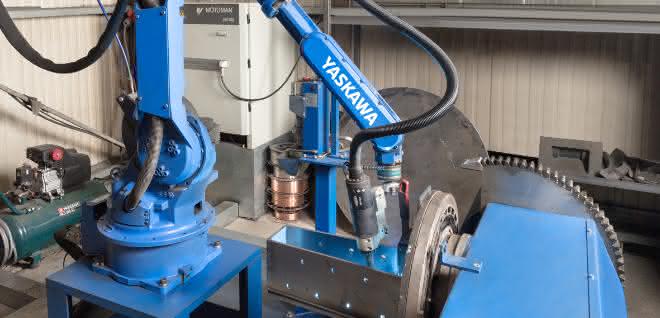
As varied as the range of welding tasks may be, all orders have one thing in common: the high demands placed on weld seam quality. The company has deliberately dedicated itself to the most demanding joining operations, and it is precisely here that quality plays a key role.
Several parameters are responsible for the weld seam quality, as Krüger emphasizes: "The performance of the robot, the quality of the welding equipment and the welding expertise of the programmer are equally important for the welding result. We carry out various weld seam analyses on many parts, from visual to destructive, in order to be able to guarantee the required quality of the weld seams." It goes without saying that the company also has the industry-specific qualifications and certifications in this area.
MSZ is about to invest in another robot welding cell. In order to take flexibility to the extreme, the company intends to make greater use of offline programming options and a multi-axis positioner in future. It is not yet clear exactly which robot will be used. Only one thing is certain, as Krüger reveals: "It will once again be a Motoman six-axis robot from Yaskawa." Ralf Högel, freelance journalist


You might also be interested in
Further simplify assembly processes
In addition to the proven racks with a length of one meter, Wittenstein alpha now offers optional two-meter racks for linear systems. They are particularly suitable for use in short axes, for example, in order to simplify assembly even further.
 read more...
Hiwin manufactures its own shaft gearboxes
Have you ever waited several months for an urgently needed corrugated gearbox? Hiwin has too. That's why the Offenburg-based drive specialist has decided to produce its own space and weight-saving reduction talent.
read more...Human-robot interaction at the trade fair
Sumitomo Drive Technologies is presenting its drive solutions for automation and robotics at Automatica 2023 together with the Lafert Group. The company will be showcasing two different applications of the Tuaka drive system for robot applications...
read more...Partial automation with robots
At Automatica, Promess will be showcasing its modular individual workstations and how these can be partially automated with robot support. The servo press manufacturer will also be providing information about the latest features of its Revolution X...
read more...A new benchmark for collaborative robots
At this year's Automatica, Denso Robotics will be showcasing its innovations in the field of robotics. The collaborative Cobotta Pro product family will be the focus of the presentations. Visitors to the trade fair can see all variants in various...
read more...Clamping system for a new milling machine
Investments in machinery often lead to further purchases - as is the case at Joma-Maschinenbau, whose modern production facility has recently been supplemented by a 5-axis milling machine.
read more...Schunk wants to simplify processes in automated production
The declared aim of automation specialist Schunk is to make its customers' processes comprehensible, simple and efficient. Data transparency plays an important role in this. It enables reliable processes and provides the basis for resource-saving...
read more...Festo and Hahn Automation develop battery tester for greater safety
The success and reputation of electric vehicle manufacturers depend on the safe and flawless functioning of batteries. Hahn Automation has therefore developed a battery tester that performs a fully automated 100% test of mobile energy storage...
read more...SPN Schwaben Präzision presents gearbox solutions for automation and industrial robotics
Short cycle times, robust technology, wear-free surfaces and compact designs have always been relevant for automation and robotics solutions. This year's Automatica trend topics include "Sustainable production" and "Digitalization and AI". SPN aims...
read more...