

Research
Robot tool for more efficient heating systems
Together with the Chair of Production Systems (LPS), Schmöle is developing a new process for manufacturing spiral finned tubes for heat exchangers. In addition to an ergonomic improvement for the employees, the manufacturing process is to become more flexible, allowing the heat exchangers to be adapted more individually to their later place of use.
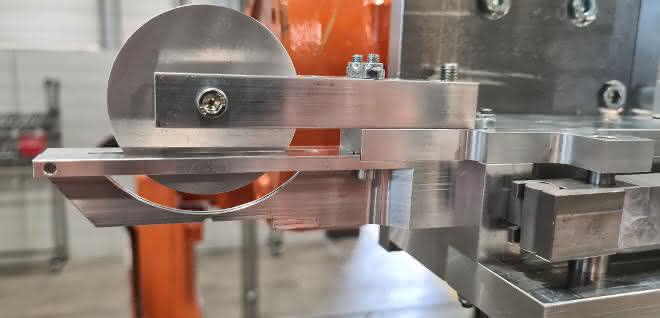
Spiral finned tubes for heat exchangers are manufactured by welding a metal strip, the subsequent cooling fins, along a usually thin-walled tube in a spiral pattern. The research project is currently developing a robot tool to optimize the manufacturing process. This should eliminate some non-ergonomic processes for employees. By using a flexible industrial robot, the spiral fin tube can be manufactured more individually by gradually varying the pitch of the spiral cooling fin along the course of the tube. This allows the properties of the heat exchanger to be improved for later use within a heating system.
Simplified set-up process
The new process should change three activities for employees: the set-up process, post-processing and maintenance. In the current set-up process, the metal strip is laboriously guided through a system of several deflection rollers. In future, the robot will automatically draw the strip into its tool and feed it into the welding process. To ensure that the process runs as efficiently as possible, a spiral finned tube is produced that is as long as possible and then sawn into shorter pieces. Laser welding is briefly interrupted at the sawing points that are not to be ribbed, but the metal strip continues to be wound up.
The employees then have to use pliers to manually cut through the metal strip at the sawing points and pull it off. This process is very unpleasant, especially with thicker metal strips. It also results in waste, which causes unnecessary losses, especially with high-quality alloys. This cutting process is now to be carried out by the robot tool shortly before welding. As a result, the metal strip is cut precisely to size and the sawing points remain free. Maintenance of the system is also simplified. At present, the accessibility of the system for maintenance purposes is not ideal. However, the industrial robot could rotate 180° and present the tool in a convenient maintenance position.
The advantages of high flexibility
The laser-welded spiral finned pipes are used in the heating industry, among others. Here, the exhaust gas heat is transferred to the heating or service water, sometimes in several sections. For this purpose, the spiral finned pipes are bent into a coil and inserted into the combustion chamber of the heating system. With the flexibility gained in adjusting the welding angle, the fin density on the pipe can be ideally optimized to meet the requirements of the respective heat transfer zone in the heating system.
In zones where the flue gas heat would cause the water in the spiral finned tube to boil, the fin density and therefore the transfer surface can be reduced. In zones where the residual heat is to be transferred to the water via the condensation of the flue gas, the new process can be used to increase the fin density and thus the transfer surface.
With the new tool and the additional flexibility in the manufacturing process, Schmöle from Fröndenberg can offer higher efficiency levels by optimizing the fin geometry. This applies to condensing boiler systems, downstream heat recovery systems, but also to many other heat transfer systems in which different heat zones can be served with optimized finned tubes.
The development of the robot tool
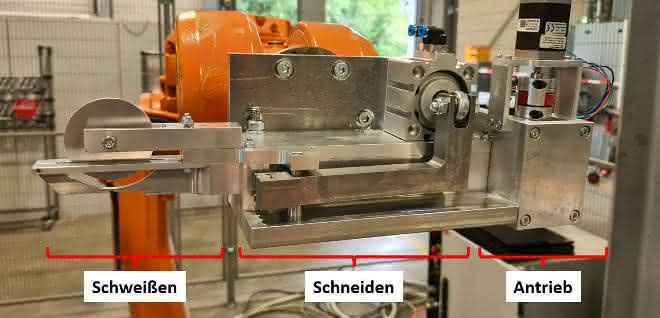
The robot tool is currently in the prototype phase. The particular challenge lies in accommodating the many requirements in the smallest possible space. The structure of the tool train can be divided into the functional modules drive, cutting edge and welding, as shown in the picture. The metal strip is fed from the coil to the tool, the drive picks up the fed metal strip and moves it through the tool to the welding point.
Previously, no drive of the metal strip was required, as the metal strip was continuously pulled by the rotating tube. However, as the metal strip of the new tool is to be cut to size before the welding process, this connection is repeatedly severed and the metal strip has to be advanced to the welding point again. The metal strip is cut by a cutter that works pneumatically and interrupts the metal strip for the subsequent sawing points. This means that the finned tube no longer needs to be stripped at these points before sawing. In the final module, the metal strip is fed into the welding process in a stable, upright position and at the desired angle of inclination.


You might also be interested in
Schunk shows flexible systems for electronics production
Schunk Electronic Solutions will be exhibiting modular, flexible systems for electronics production at Productronica 2025 - from stand-alone depaneling systems to fully integrated inline solutions.
 read more...
Digital and without staff
Kasto promised a world first for its trade fair appearance at the EMO in Hanover. The sawing and storage technology specialist presented a fully automated system for pre-processing.
read more...Digital and without staff
Kasto is promising a world first for its trade fair appearance in Hanover. The sawing and storage technology specialist will be presenting a fully automated system for pre-processing at EMO. The unmanned concept enables 24/7 operation.
read more...Production, machine tools and robots
High-precision welding for perfect sawing
Stihl uses Nimak's portal projection welding systems to manufacture guide rails for chainsaws.
read more...Prevent damage and save energy
CG Drives & Automation presents a new range of Emotron TSA soft starters from 5.5 to 1000 kW (16-960 A and 200-690 V). This includes the new sizes TSA 5 and 6 for high power applications (470-960 A).
read more...MES solutions in mechanical engineering
A medium-sized machine tool manufacturer successfully networked its production facilities with the company software.
read more...Integration of robot-based production cells
Clamping technology for robot processing
The ISW at the University of Stuttgart researches the use of industrial robots for machining tasks and develops automation concepts that support the integration of robot-based production cells in companies.
read more...For use in heavy industry
The KASTObbs block and panel bandsaw from Kasto was specially developed for heavy industry and is used in steelworks and steel trading companies, among others.
read more...Now new at ACE: configure and order oil brakes and hydraulic brake cylinders online
ACE Stoßdämpfer GmbH is expanding its range of online configurators. It is now possible to configure and order oil brakes and hydraulic brake cylinders for a wide range of applications online at any time on the ACE homepage.
read more...