

Surface robotics
Perfect surfaces, quickly programmed
Visomax Coating has found an intelligent solution for its systems for the post-treatment of coated surfaces in order to easily program new robot applications for the force-controlled surface treatment of grinding and polishing processes.
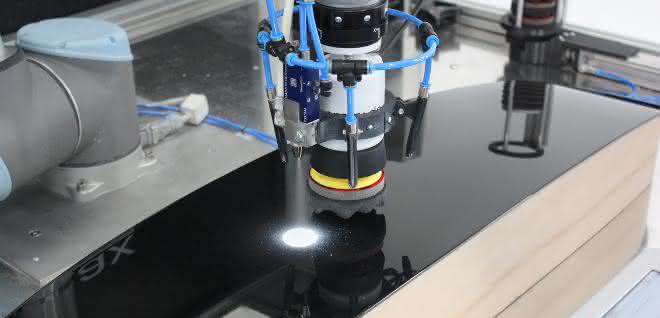
The core competence of Visomax Coating GmbH from Waldbüttelbrunn is the finishing, i.e. sanding and polishing, of painted surfaces. The company offers process solutions for this. Visomax regularly evaluates innovative and new technologies in order to simplify and optimize the surface treatment process. In 2016, Ludwig Kemmer, who is responsible for robot programming, was looking for a way to automate the polishing of imperfections on components and make it more efficient. The complexity of the application presented Kemmer with a difficult task: "Our biggest challenge is imperfections, which are located in different places on each component. This could not be solved with conventional robot programming."
Simple programming
During his research, he came across the ArtiMinds Robot Programming Suite (RPS) software from the manufacturer of the same name and was quickly won over by its simple and flexible handling and wide range of applications: "ArtiMinds makes it easy to integrate new robots into all kinds of applications. Simply select robots and additionally connected components in the RPS and you're ready to go. The integrated CAD2Path function makes it possible to create complex motion paths, for example for polishing a mudguard, quickly and precisely." To avoid having to teach in points manually, a CAD file of an object can be imported and the motion path created using the edges of the CAD model.
Andreas Götz, Managing Director at Visomax Coating, adds: "The solution offered by ArtiMinds was a perfect fit for the applications in our field. That's why we quickly decided to work together."
However, the difficulty of the application lay not only in the handling of components with different defects, but also in the integration of necessary sensor components such as a force-torque sensor and a camera system. This was because the defects first had to be localized by camera and then approached and polished out in a force-controlled manner. Such sensor-adaptive robot movements quickly present the user with a very complex programming task and any amount of effort. "To ensure that the polishing movement always has the perfect contact pressure, we work with the force module of the RPS," explains Kemmer.
With the templates and modules for individual movement sequences stored in ArtiMinds RPS, the programming effort can be significantly reduced compared to conventional programming: The camera system first passes the coordinates of the defects to the robot. The robot, including the force/torque sensor and polishing head, then takes over the actual task by approaching the defects precisely and independently.
Full-surface polish
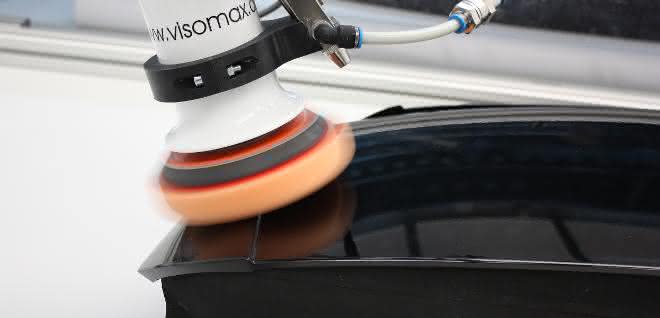
In a second application, painted components are polished over their entire surface. The robot first moves to a reference point in a force-controlled manner so that it can always polish with the same contact pressure, even if the polishing brushes are worn. The polishing movement has been recorded using a path module specially adapted for Visomax, which has considerably reduced the programming effort compared to conventional programming, says Kemmer. "In addition to the templates already available as standard, this option gave us a much more intuitive approach."
Managing Director Andreas Götz is also convinced: "The great advantage of the software lies in its ease of use. In addition, the support from ArtiMinds is more than comprehensive. If required, you always have the right contact person to hand at the right time."
Visomax also usesArtiMinds RPS beyond the actual polishing process: the software allows the company to determine whether a customer project is feasible with the given factors as early as the preparation phase.
Ludwig Kemmer confirms with satisfaction: "In recent years, the software has saved us a lot of programming work. This has allowed us to focus on the actual processes and their optimization in order to take a fresh look at the processing of painted surfaces and break new ground."
Silke Glasstetter, Head of Marketing, ArtiMinds Robotics GmbH


You might also be interested in
Basler acquires 76% of Indian image processor
Basler, supplier of image processing components for computer vision solutions, has acquired 76% of the Indian sales partner Alpha TechSys Automation.
 read more...
Process monitoring and fault detection
Cameras ensure quality during laser melting
Powder bed-based laser melting (PBF-LB/M) opens up new possibilities in additive manufacturing. Modern camera systems provide crucial process data to further increase quality and efficiency.
read more...Vision Sensor is three times faster than its predecessor
The 'CS-62' vision sensor from di-soric is around three times faster than its predecessor, the 'CS-60'. In combination with the 'nVision-i 25.1' software, it enables image processing solutions that were previously reserved for smart cameras.
read more...Thermal imaging cameras for quality control
Automated thermal imaging cameras are often suitable for quality control applications where temperature plays a role. However, while there are various solutions on the market for slow processes, it is challenging to select a camera that reliably...
read more...Easy entry into industrial VGA thermography
Reliable temperature measurement is a prerequisite for the success of many industrial processes. Berlin-based manufacturer Optris presents the Xi 640 infrared camera, a new member of its Compact Line, which enables non-contact temperature...
read more...Powder bed-based laser melting optimized
Aconity3D has set itself the goal of optimizing the stability of the manufacturing method of powder bed-based laser melting and thereby promoting its use in a wide range of industries. By using high-speed industrial cameras from SVS-Vistek, the...
read more...INDUSTRIAL Production Products of the year...
2nd place, category handling, assembly and production logistics: SICK
safeVisionary2 is the first 3D time-of-flight camera with Performance Level c safety certification. It enables safe three-dimensional environmental detection and won 2nd place in the competition for Product of the Year 2024 in the handling, assembly...
read more...Nomination Products of the Year 2024
SICK: Camera systems safeVisionary2
safeVisionary2 is the first 3D time-of-flight camera with Performance Level c safety certification. It enables safe three-dimensional environmental detection and has been nominated in the 2024 Product of the Year competition in the handling,...
read more...AI vision brings additional opportunities
The seamless integration of AI into the consumer sector has helped to improve our quality of life and make interactions with technology more efficient. In industry, AI vision with machine learning opens up new possibilities that are not covered by...
read more...