
Industrial alliances
The benefits of cooperation and common standards
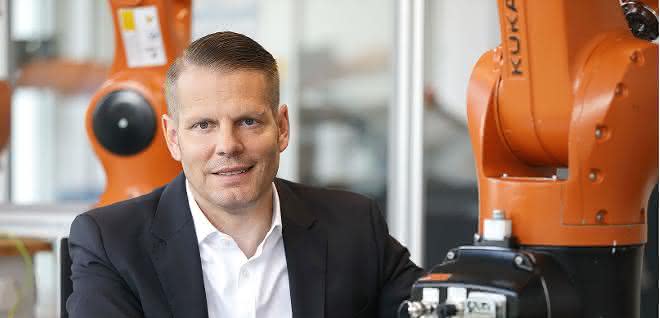
There is no networking without common standards. As Head of Strategic Alliances at Kuka, Dr. Christian Liedtke is responsible for this special form of cooperation. He spoke to Daniel Schilling about partners, standards and why cooperation does not rule out competition.
Mr. Liedtke, you are responsible for strategic alliances at Kuka: why enter into alliances instead of simply buying in know-how or developing your own standards?
Practical experience shows that cooperation is the best way forward. There have been many approaches by companies to proprietary networking platforms, but they have all failed in the end. With the one significant exception of Siemens Mindsphere. It is not enough to just network individual process steps. The entire process chain from start to finish is crucial. There needs to be a rethink in this direction.
How does this benefit the customer in the end?
No customer has yet requested alliances. Some customers don't ask for much in terms of digital networking, but in retrospect we have received very positive feedback.
Who is Kuka looking for as a cooperation partner?
In projects such as the Open Industry 4.0 Alliance, we work with both competitors and companies that complement our own capabilities.
What is your own role in this context?
I have been responsible for the topic of cooperation at Kuka for five years. I come from an operational background and now ensure that information flows into the joint projects as well as the return flow of know-how into our own projects. However, an important task for me is also to drive forward the cooperation projects themselves.
Why don't you give us an example of a project?
Gladly. As part of the Open Industry 4.0 Alliance, which I mentioned earlier and in which we are heavily involved, we carried out a proof of concept with several other participants. As a research partner, the team from Aalborg University connected a Kuka robot to a Microsoft Azure cloud from the Lego Group via an edge interface from the Munich-based IoT specialist Device Insight. The Alliance's open reference architecture was used for this. We are currently continuing this project and expanding it specifically with regard to industrial use.
The Open Industry 4.0 Alliance is currently the most important alliance for Kuka? What other alliances are you involved in?
The question is not quite right: Open Industry builds on OPC UA as the basis of an open sources platform and uses this standard. Both alliances are complementary; this is also reflected in the founding members. Many of those who were already involved in the OPC Foundation are also on board here. Kuka is also involved in Mindsphere. The bottom line is that we see the same partners in different alliances.
I have the impression that the Open Industry 4.0 Alliance is strongly focused on Germany?
At the moment, most of our members do indeed come from Germany. But that is not our intention. We are open worldwide and are looking for interesting cooperation partners worldwide. For example, we have been able to attract several interesting start-ups from Israel to the Alliance. We are also actively working on the Benelux countries. There is now a very active local hub in the Netherlands; we are also actively working on Denmark and next year we want to initiate a hub in the USA. We had some very practical problems with Asia and Oceania: Due to the time difference, joint appointments were difficult. There is also a lack of local organization. However, German standards are generally well accepted on the Asian markets.
Kuka has a Chinese parent organization - doesn't that help?
No, that only plays a minor role. Kuka is just one component of the alliance.
On which topics do the members agree the most and where is the most negotiation required?
Roughly speaking, one line of discussion runs between software companies that rely heavily on the cloud and mechanical engineering companies that rely more on the edge. The weighting is then discussed. It is important to bring the customer perspective into such discussions.
Standardization or individual solutions - which approach is best for which challenge?
In principle, products will continue to be developed in the companies as before, including in competition with each other. The alliances perform various tasks. On the one hand, they are the interfaces at which possible cooperation between members in a development project is negotiated. Secondly, they are particularly valuable when it comes to solutions for special markets, such as the food sector. Finally, they also play an important role in facilitating market access.
What role does security play in networking, especially in view of current political events?
Overall, we have so far seen little reaction to the current political situation. The threat to IT integrity was there long before, which is why all companies are actually already working at the highest security level when it comes to networking. In addition, the robots are not directly connected to the internet. The store floor is encapsulated to protect the systems against external attacks.
And how are the alliances reacting to the issue?
We have our own working group in the Open Industry 4.0 Alliance that is dedicated to the topic of security.
Finally, can you give a few current examples of what Kuka is currently working on with alliance partners?
For example, we are working with SAP on two projects: One is a customer project that we are developing here in Augsburg. A production cell for a customer who wants to integrate store floor and ERP. We implemented the digital twin with the help of SAP. SAP is also our partner for a new topic: outcome-based business or pay-per-use. There are also smaller projects in which we cooperate. For example, we are working with Balluff on "Arena 2036", the "Active Research Environment for the Next generation of Automobiles". To summarize, alliances are an important building block in Kuka's development processes.


You might also be interested in
ESTIA aims to strengthen Europe's cloud
New tech alliance for EU sovereignty
Twelve companies, including Dassault Systèmes, are founding the European Sovereign Tech Industry Alliance (ESTIA). The initiative aims to strengthen Europe's technological independence and define requirements for sovereign cloud services. The start...
 read more...
Deutsche Telekom and Nvidia launch one of Europe's largest AI factories
With the Industrial AI Cloud in Munich, Deutsche Telekom and NVIDIA are creating one of the largest AI factories in Europe. Companies can train AI models, carry out simulations and access 10,000 GPUs.
read more...Leveraging data potential with AI and streaming
Huge data treasures are still lying dormant in many manufacturing companies. And yet it is high time that these treasures were unlocked. There is often a lack of resources and capacity to make data usable in real time. Streaming production data can...
read more...More awareness of noise
Dematic offers solutions that are tailored to different cloud environments and reduce environmental impact through reduced material consumption and improved energy efficiency.
read more...Generative AI in the automation environment
The mechanical engineering and automation industry is undergoing profound change. This transformation is being driven by more volatile global trade, geopolitical crises and increasing market pressure, which demands greater agility, technological...
read more...Rigid data structures have had their day
The traditional data center is no longer the center of data. A hybrid cloud storage approach enables manufacturing companies to both meet the current requirements of data-intensive processes and future-proof their infrastructure.
read more...Software as a service in three stages
CIM Database Cloud is a new out-of-the-box solution from Contact for end-to-end digital product development.
read more...How production can benefit from AI
Together with AI technology, IIoT networking makes it possible to better control machine parameters and optimize quality with predictive quality. Downtimes and set-up times can also be further minimized. Cloud platforms also make these technologies...
read more...More expertise for digital engineering
Altair, a computational science and artificial intelligence (AI) company, has acquired OmniV, a technology from Michigan, USA-based software company XLDyn.
read more...