
Image processing systems
Robots learn to see
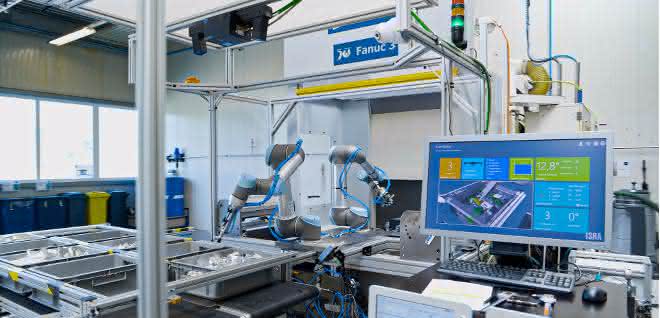
Increasing competition and rising quality standards are prompting many companies to continuously develop their production processes. The worsening shortage of skilled workers in the ageing societies of the West is creating additional pressure to adapt. More and more companies are responding to this by automating parts of their production lines. Modern technologies now make it possible to delegate even more complex tasks to robots, where humans were previously superior to any machine thanks to their five senses. Vision systems combine hardware and software and support devices and systems by capturing and processing images. The strong arm of the robot is supplemented by an artificial eye that is able to recognize objects and structures and handle parts precisely and appropriately depending on their properties. Due to their cost intensity and complexity, such systems were virtually impossible for SMEs to implement in the past. Thanks to the further development of the technology, they now also offer SMEs an affordable and easy-to-implement alternative to manual work.
The basis: a robot arm with peripheral device
The basis of every automated application with a vision system is a robot arm with a suitable peripheral device. The associated image processing system, which is usually software-based, captures images using one or more cameras and digitizes the data. It searches for previously defined features, such as the surface structure of an object, to which the robot responds with a pre-programmed action - for example, by transferring a part to the next work step or rejecting faulty workpieces. An important prerequisite for the functionality of such a system is the right lighting. This ensures that the camera system can correctly detect the key features.
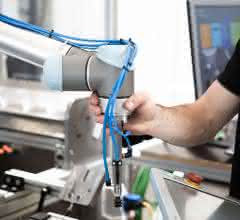
Depending on the application scenario, the image material can be recorded and processed in both 2D and 3D. Vision systems with 2D image processing are able to calculate a two-dimensional data set. Objects are captured on the basis of their contours. In this way, the seeing cobot can recognize the position, size or orientation of a part. This is ideal for applications in which objects, geometries or patterns need to be analyzed. However, more demanding tasks such as assembly work or feeding machines with unsorted parts require more complex 3D images. Appropriate sensors enable robots to see in three dimensions. This capability comes into play, for example, when inspecting surfaces, measuring volumes or in the field of quality assurance.
The Austrian medium-sized company Jenny Waltle, a specialist in aluminum, metal and plastic parts based in Vorarlberg, also relies on collaborative robots that are connected to a 3D image processing system. The 50-man company was particularly struggling with the lack of qualified personnel. "In order to continue growing despite this, we had to automate," explains Daniel Waltle, one of two managing directors. For over a year now, two UR5 cobots from Universal Robots have been loading a CNC milling machine in close proximity to their human colleagues.
Bin picking in teamwork
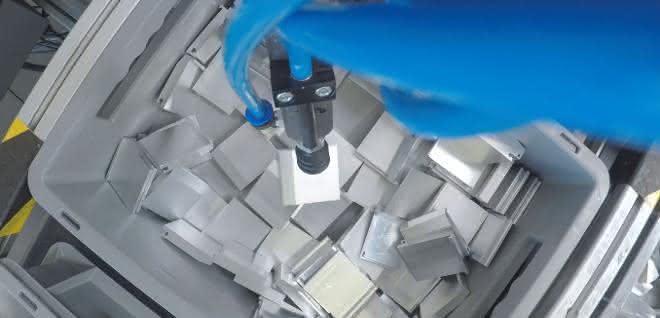
The Austrian company has ventured directly into the supreme discipline of automation: bin picking, in which unsorted parts are removed from a box. An external camera first scans the pre-sawn aluminum parts and generates a 3D data set - the so-called point cloud. This enables the first of the two cobots to recognize the complex surface structures and the exact arrangement of the objects. Equipped with a vacuum gripper, it then removes part by part from the container.
If the cobot has picked up an object upside down, for example, it throws it back into the box and tries again after the next scan. If the part is correctly positioned, the UR5 places it in another tray. This is where the second cobot takes over, placing the components precisely in the hydraulic clamp of the CNC milling machine. After processing by the machine, it picks up the parts and places them in a final tray, from which the first cobot then transports them into an empty box.
Increase output, reduce error rate
The investment in the sighted cobots has paid off for Jenny Waltle in several ways. Since their implementation, the company has been able to increase its output in the application area by 11 percent. The high precision of the application is also reflected in the products: "The increase in quality thanks to the cobots from UR is enormous. Since we've been using them, we haven't had a single bad part. This means we can continue to guarantee our customers top-quality products in the future," says a satisfied Waltle. Due to the many advantages that intelligent image processing offers manufacturing companies, it is to be expected that it will find its way into many other areas of application.

Especially in combination with collaborative robots, vision systems open up enormous savings potential. Increasingly sophisticated technical solutions already come very close to the motor and sensory abilities of humans. Qualified workers can thus be relieved of repetitive tasks and deployed for more demanding activities with higher added value. Machines are thus becoming human colleagues on an equal footing, whose indispensable services will shape the industry of the future.
Helmut Schmid, General Manager Western Europe & Managing Director Universal Robots Germany / am


You might also be interested in
Hamburg Regional Court issues preliminary injunction against Elite Robots Germany
In the copyright dispute between Teradyne Robotics and Elite Robots Germany, the Hamburg Regional Court has issued an interim injunction. The distribution of the software and products concerned is prohibited, and there is also a comprehensive...
 read more...
Schunk founds tech spin-off for humanoid robot hands
Schunk is bundling its activities in humanoid robotics by founding its own spin-off at the beginning of January. The aim of the new company is to develop modular humanoid robot hands for industrial applications.
read more...Partnership for humanoid robotics
Schaeffler and Neura Robotics jointly develop humanoids
Schaeffler and Neura Robotics will work together in the future to develop and supply key components for humanoid robots. The systems will also be integrated into Schaeffler's global production network.
read more...Yaskawa at the Automatica 2025
AI meets robotics
At this year's Automatica, everything at Yaskawa revolves around AI-based robotics solutions for the smart factory and beyond. As a trade fair highlight, the manufacturer is presenting its new Motoman Next product concept.
read more...Kassow Robots at the Automatica
7-axle vehicle in action
At Automatica, Kassow Robots will be presenting a wide range of industrial applications for production and logistics tasks that provide new impetus for efficiency and flexibility in industrial automation.
read more...Robotics and automation in six exhibition halls
From June 24 to 27, 2025, Automatica, the trade fair for intelligent automation and robotics, will bring industry and research together in six exhibition halls. Preparations are in full swing.
read more...Interview with Jörg Rommelfanger
Robotics in 25 years
The annual IFR report shows that the number of industrial robots is steadily increasing worldwide. They have already played an important role in ABB's portfolio for decades. In an interview with INDUSTRIAL Production, Jörg Rommelfanger, Head of...
read more...Reliable end effector for cobots
Collaborative robots are now widely used for a wide range of handling tasks. SMC offers three versions of the RMH pneumatic gripper for this purpose; it is compatible with cobots from a total of twelve companies.
read more...7-axis cobots with controller in robot base
With the Edge Edition, Kassow Robots has launched the world's first 7-axis cobots with a controller integrated into the robot base.
read more...