
International Federation of Robotics
The 3 top trends in robotics
According to the IFR, two million new robots will be installed in production facilities worldwide by 2022. Clear trends can be identified.
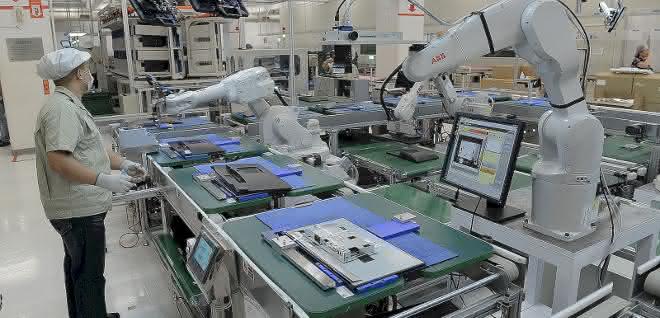
Robots have become an integral part of production. According to a forecast by the International Federation of Robotics (IFR ), two million new industrial robots will be installed in factories worldwide over the next two years. Three drivers are emerging: simplified operability, human-machine collaboration and digitalization.
Trend 1: Smart and simple
One reason for the triumphant advance of industrial robots is that their programming and installation will become much easier. Various factors play a role here: sensors and intelligent software enable teaching methods. This allows robots to be programmed by demonstration. A human first performs the task that the robot arm is to carry out: He moves the robot arm and demonstrates the desired sequence of movements. The recorded data is then converted by the software into the robot arm's digital program. In the future, automatic learning programs will instruct robots to optimize their movements using trial-and-error methods and work with video demonstrations. Cobot manufacturer Universal Robots, among others, is already using this method.
Trend 2: Cooperation between humans and robots
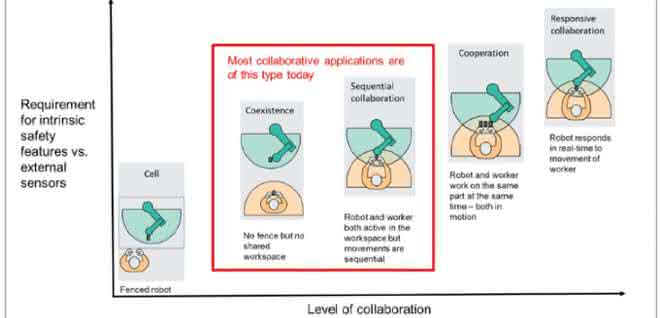
Another trend is the cooperation between humans and robots, from coexistence to cooperation to collaboration (see image). Modern robot systems are able to adapt to a rapidly changing environment. At present, applications with a shared workspace are the most common, in which humans and machines perform tasks one after the other - in other words, sequentially.
In comparison, applications in which humans and robots work on the same part at the same time are more challenging. Research and development (R&D) is currently focusing on methods that allow robots to react with humans in real time. Just as two humans would work together in the factory, the robot should adapt its movements to the environment to ensure truly responsive collaboration. In these solutions, the robot should also be able to recognize and interpret the human voice or gestures. With today's technology, human-robot collaboration already offers enormous potential for companies of all sizes and industries. Investments in collaborative systems will complement traditional industrial robots.
Trend 3: Digital robots
Robots are becoming a central component of networked production. They must therefore be able to communicate with each other, with other machines and with higher-level systems, regardless of the manufacturer. The so-called "OPC Robotics Companion Specification", which was developed by a joint working group of the VDMA and the Open Platform Communications Foundation (OPC), defines a standardized generic interface for industrial robots and enables the connection of industrial robots to the Industrial Internet of Things (IIoT). The connectivity of robots, for example with cloud technology, is also a driver for new business models: robot leasing - known as Robots-as-a-Service - for example, has advantages that could be particularly attractive for small and medium-sized enterprises (SMEs): no capital commitment, fixed running costs, automatic upgrades and no need for qualified personnel for the robots.


You might also be interested in
ESTIA aims to strengthen Europe's cloud
New tech alliance for EU sovereignty
Twelve companies, including Dassault Systèmes, are founding the European Sovereign Tech Industry Alliance (ESTIA). The initiative aims to strengthen Europe's technological independence and define requirements for sovereign cloud services. The start...
 read more...
Deutsche Telekom and Nvidia launch one of Europe's largest AI factories
With the Industrial AI Cloud in Munich, Deutsche Telekom and NVIDIA are creating one of the largest AI factories in Europe. Companies can train AI models, carry out simulations and access 10,000 GPUs.
read more...Leveraging data potential with AI and streaming
Huge data treasures are still lying dormant in many manufacturing companies. And yet it is high time that these treasures were unlocked. There is often a lack of resources and capacity to make data usable in real time. Streaming production data can...
read more...More awareness of noise
Dematic offers solutions that are tailored to different cloud environments and reduce environmental impact through reduced material consumption and improved energy efficiency.
read more...Generative AI in the automation environment
The mechanical engineering and automation industry is undergoing profound change. This transformation is being driven by more volatile global trade, geopolitical crises and increasing market pressure, which demands greater agility, technological...
read more...Rigid data structures have had their day
The traditional data center is no longer the center of data. A hybrid cloud storage approach enables manufacturing companies to both meet the current requirements of data-intensive processes and future-proof their infrastructure.
read more...Software as a service in three stages
CIM Database Cloud is a new out-of-the-box solution from Contact for end-to-end digital product development.
read more...How production can benefit from AI
Together with AI technology, IIoT networking makes it possible to better control machine parameters and optimize quality with predictive quality. Downtimes and set-up times can also be further minimized. Cloud platforms also make these technologies...
read more...More expertise for digital engineering
Altair, a computational science and artificial intelligence (AI) company, has acquired OmniV, a technology from Michigan, USA-based software company XLDyn.
read more...