
Robots
Hofmann Glastechnik relies on Universal Robots
Glass is fragile and its production is difficult. During the manual loading of glass lathes at Hofmann Glastechnik, the machines cooled down even during short interruptions. To prevent this, the team now relies on collaborative robots from Universal Robots. Their use increases productivity by 50 percent.
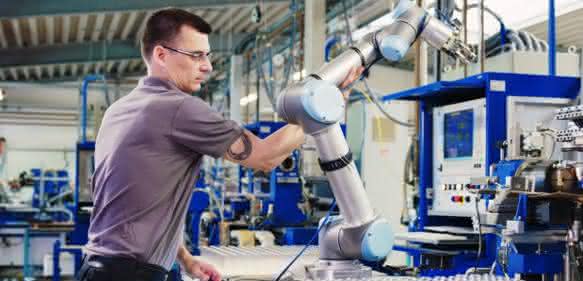
Glass is one of the most sophisticated materials. It is used in a wide variety of forms in German industry, the furniture sector and also in medicine. The particular challenge of this material lies not only in the fragility of the glass, but also in the production and forming of the material. Its processing therefore requires a high degree of process stability.
The forming of glass is only possible in a very narrow time window between the melt and the glass transition, and the cooling process must also be controlled and run through at a certain speed depending on the nature of the glass. When handling glass, even the smallest fluctuations in time and the associated temperature can therefore have an extreme effect on the result - a problem because human workers can hardly perform this task with exactly the same quality over a long period of time. Collaborative lightweight robots are a potential solution to this problem. The robots can carry out repetitive tasks with consistent quality over a very long period of time, thus ensuring the necessary process stability. Robert Hofmann, Managing Director of Hofmann Glastechnik, recognized this potential for improvement and found a suitable solution for his traditional company in the form of lightweight robots from Universal Robots: "Our employees used to load the glass lathes manually. Even short interruptions in the work process naturally caused the machines to cool down again and again. When we used the collaborative UR robots for this task for the first time, we suddenly got top results. That was a quantum leap forward. The quality of our glass components has improved enormously thanks to Universal Robots," emphasizes Robert Hofmann. The automation of the work process even led to a 50 percent increase in productivity in this area.
Flexible use without programming experience
In order to make the most of the advantages of machine colleagues, employees must be able to handle them easily. Simple operation and easy programming are therefore important factors; after all, existing skilled workers should be relieved and not burdened. If robots take over the monotonous tasks in operation, skilled workers can devote themselves to more demanding tasks such as the precise setting of the machines.
The robots are set up using a touchscreen tablet, allowing the required movement sequences of the UR robot to be defined quickly and intuitively. In "free-running mode", the user can simply grab the robot's arm and teach it new tasks by physically guiding it from waypoint to waypoint.
Grippers for every application
Once the robot has been set up for one task, this does not mean that it can now only be used for that task. Thanks to their lightweight and space-saving design, the collaborative robots can be quickly and easily converted for different applications.
In addition to glass, there are many other materials with very specific requirements for manufacturers. A fast-moving market environment and ever shorter product life cycles mean that electronics manufacturers have no room for error. Electronic components such as LEDs or printed circuit boards must be assembled with absolutely consistent precision and even the smallest impurities must be avoided. Otherwise, dust or organic residues such as grease can severely impair the service life of the products.
Regardless of the material, the gripper is always an important factor for successful automation, as it represents the interface between the robot arm and the material. The robot manufacturer lists all certified end effectors in its virtual showroom called Universal Robots+. Here you can select the respective robot and the task assigned to it and are presented with suitable solutions. From simple two-finger grippers to vacuum grippers and various sensor-supported solutions, the right end effector can be found here for every material. With the right gripper, lightweight robots can then easily automate even the handling of fragile parts and help to maintain competitive production through increased process stability, productivity and efficiency. ee


You might also be interested in
Plagiarius 2024 negative prize
On January 26, 2024, the Plagiarius campaign awarded its dreaded "Plagiarius" negative prize for the 48th time to manufacturers and retailers of particularly brazen counterfeits and fakes.
 read more...
Ivalua honors winners of the Generative AI...
AI-supported "add-ons" for buyers within 48 hours
Ivalua, provider of cloud-based spend management solutions, announced the winners and innovations of the first Generative AI Innovation Cup. The competition took place in December 2023. It was open to all Ivalua partners and employees - more than...
read more...Efaflex celebrates 50 years of high-speed...
The emphasis is on "fast"
Since day one, Efaflex has wanted to use new technologies as early as possible and drive progress in the industry. This year, the family business is celebrating its 50th anniversary under the motto "Fast Forward".
read more...Security of supply even during power outages
In the winter of 2022, Germany was worried about energy shortages. The drugstore retailer dm did not paint any horror scenarios, but nevertheless saw the possibility of controlled, temporary, regional power cuts (brownouts).
read more...Safety technology in mechanical engineering
Modules with new functions
Euchner's product highlights at EMO 2023 include the communication-capable solenoid interlocks.
read more...Transforming the paper industry towards climate neutrality
Together with partners from industry and research, Voith is developing a project for the optimization of energy and material flows in paper production. The aim of the research project is to develop a digital framework that enables effective process...
read more...Up to 95 percent less flue gas thanks to direct extraction
The requirements for occupational safety measures and safety technology are also constantly increasing in welding technology. The Technical Rules for Hazardous Substances (TRGS) stipulate that welding fumes and harmful substances must be extracted...
read more...Competitive advantages with large machines
Whether 3D-printed components for machines and systems, prototypes or aids for design: additive manufacturing is almost indispensable for modern companies in mechanical and plant engineering and automation if they want to play in the premier league.
read more...Transport technology from the modular system
Many transport tasks can be realized with the help of linear technology. Pre-configured solutions are available to simplify the interaction between the linear unit, motor, gearbox and controller. This minimizes the effort required for research and...
read more...