
High-precision robot
Robotics in woodworking
French kitchen manufacturer Schmidt produces individual furniture parts in batch size 1 without set-up times and with high precision thanks to a new robot processing cell.
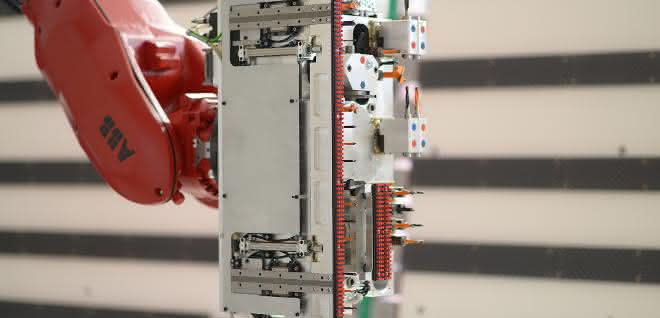
More and more consumers want personalized products that are precisely tailored to their needs - from custom-made bicycles and self-mixed muesli to individually printed cola bottles and unique suitcases. The trend does not stop at the home either. Kitchen equipment should also be as individual as possible. It is precisely this trend towards individualization that French kitchen manufacturer Schmidt is responding to, perfectly complementing its existing batch size 1 concept with an innovative robot processing cell for drilling and fitting kitchen furniture parts. The cell is part of a production line with which complete kitchen fittings are manufactured in batch size 1.
Robot cell
The robot processing cell is located in Sélestat, Alsace. Sélestat is currently home to two production facilities of the internationally active kitchen furniture manufacturer Schmidt. Since 1934 (founded in Türkismühle, Saarland) and with over 1,500 employees, the name Schmidt has stood for particularly modern production technology and perfect quality. German perfection and French design guarantee affordable furniture for the highest demands. The robot processing cell is manufactured by the Zimmer Group from Rheinau in Baden. On the way to Industry 4.0, the Zimmer Group has developed from a classic component supplier to a system supplier and has thus produced an entire robot cell.
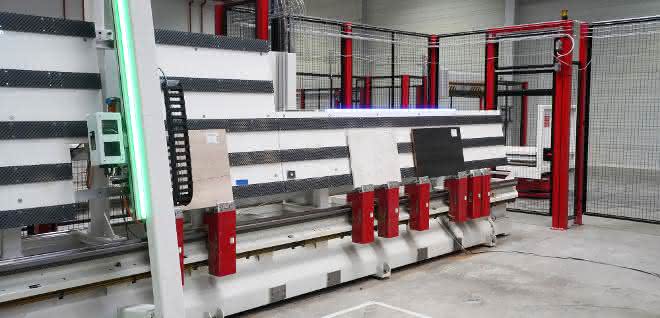
At the heart of the system are five fully-fledged ABB robots in a row, which are connected by a flexible transport system in which the workpieces are clamped and moved by up to four freely programmable shuttles, depending on their size. Incidentally, this circulating shuttle system won a German Innovation Award in 2019.
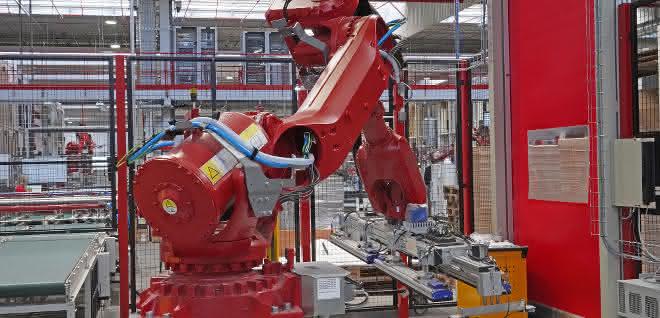
The robots provide furniture parts with holes, grooves and fittings in a tight cycle with workpiece intervals of less than two seconds. A two-metre high side panel of a tall cupboard can be immediately followed by the shelf of a shelving unit measuring just 15 x 20 centimetres. Without set-up time.
High-precision furniture parts
"When we first discussed our plans for such a cell, we were quickly told: don't do it, it can't be done with sufficient precision using robots," recalls Managing Director Achim Gauß, who is responsible for technology and sales at the Zimmer Group. "And that was the case at first. We had to invest a lot in hardware and software," continues Gauß. The special feature of this robot solution, for which the Zimmer Group also draws on its own pool of grippers and tool changers, is the drilling process, which is carried out by ABB industrial robots and can process the furniture parts with an accuracy of two tenths of a millimeter in batch size 1 on the robot. A self-developed compensation algorithm based on a laser tracker measurement of the robots in the machining area was used for this. The accuracy hurdle was also one of the sticking points in the entire process: the individual furniture parts are clamped into the shuttles by a loading robot and then their dimensions and position are measured. The parts are then guided along the various processing stations in a single set-up and finally removed from the shuttles by the unloading robot. This ensures that there is no loss of accuracy due to reclamping.
"Our customer Schmidt wanted a system that had 100 percent availability wherever possible, i.e. whose maintenance did not have to lead to complete machine downtime. This is only possible with a modular system. There was also the desire for flexibility, accuracy, expandability and a quantity 1 production without predefined machining programs," explains Gauß. The Zimmer Group experts solved the availability problem by ensuring perfect accessibility to all parts. For example, when changing the drill head on conventional machines, the casing first has to be laboriously removed. Individual shuttles can also be removed or replaced without bringing the system to a complete standstill. In extreme cases, it is also possible to "simply" replace an entire processing robot.
Two processing robots
In order to achieve the desired production output, the machining operations are automatically divided between two processing robots and typical machining operations - such as hinges and row drilling - are combined in one drilling stroke. For this purpose, the two machining robots each carry a multifunctional head with 41 tools, so that all necessary machining operations can be carried out without changing tools.
The desire for the greatest possible flexibility was met by special software - the so-called optimizer - which generates the machining program from the workpiece description in the customer's central database when the system is loaded. This direct connection of the control system to the higher-level Manufacturing Execution System (MES) means that production is fully networked. The kitchen manufacturer was provided with a helpful tool: the Zimmer Group's human-machine interface enables intuitive operation and extended diagnostic options for the entire robot processing cell.
Digital twin
"In order to be able to reliably organize such a complex system during planning, but also later during operation, you need a 100% real-time simulation," explains Achim Gauß. "A digital twin like this makes the system highly flexible, but also exciting for work preparation and for planning at the customer's site. We have learned a great deal in this project and have been able to transfer this expertise to all our components with the digital twin." With the help of the digital twin in the HIL system, the cell can be set up virtually so that the system performance and functionality can be checked before implementation. The Zimmer Group's robot processing cell thus consistently implements the approaches of Industry 4.0.
Low investment costs
The client, Schmidt, is very satisfied with the implementation, as the cell offers considerable economic advantages in addition to extremely high system availability. The use of industrial robots instead of conventional processing machines and the much simpler design result in significantly lower investment costs. The rotating shuttles of the innovative transport system can be individually controlled in terms of speed, cycle time and positions to be approached and can be operated individually or in combination. In conjunction with the processing stations, significantly higher production efficiency can be achieved than with conventionally cycled machines. Over the entire life cycle, the new machine concept also offers a high level of investment security, as the modular design allows for subsequent expansions with new processing modules.
Gregor Neumann, Media & Communications at the Zimmer Group


You might also be interested in
Soft grippers for delicate foods
Irregularly shaped, fragile, and varying in size and weight: products such as potatoes, baked goods, and dairy products push mechanical grippers to their limits.
 read more...
Development Collaboration for Humanoid Robotic Hands Launched
Schunk is entering into a new development partnership with Robert Bosch Robotics. Their shared goal is to develop an industrial-grade robotic hand that can be integrated into various humanoid robot systems.
read more...Robot-controlled packaging of rolls
Koch Robotersysteme, a company specializing in the integration of robotic systems, has developed a complete, automated packaging line for packaging rolls based on Tentoma’s RoRo StretchPack packaging machine.
read more...Robotics and autonomous order picking
Locus Robotics acquires Nexera Robotics and expands autonomous warehouse logistics
Locus Robotics takes over Nexera Robotics and may have taken a decisive step towards truly universal warehouse automation. A new gripping technology should now make possible what was previously considered difficult to automate.
read more...Gentle wheel handling
The newly founded Eisenmann Robotics division develops new robotics concepts to increase the level of automation in modern production facilities.
read more...Gripping systems and vacuum generators
Schmalz is presenting new gripping systems and vacuum generators at Automatica. Exoskeletons, which allow employees to move heavy workpieces effortlessly, will also be on display.
read more...Smart universal gripper for power electronics
The power electronics manufacturer Semikron Danfoss uses the EGU 50 mechatronic parallel gripper from Schunk in a robotic cell. It handles different components and feeds them to a measuring line. With its functionalities, it meets all requirements...
read more...Schmalz takes over finger gripper from Soft Robotics
The vacuum specialist Schmalz is expanding its gripper portfolio and acquiring the mGrip product family from the US company Soft Robotics (SRI), including all finger gripper configurations, patents and the associated know-how.
read more...Soldering with special gripper
In order to make the mini wave soldering of large panels stable and reproducible, Eutect developed a special gripper that prevents the panel from bending, among other things.
read more...