
Gripper technology
Grippers in the spotlight
Robots have become an integral part of our everyday working lives. According to industry associations, they will continue their triumphant advance beyond industry. Some people are becoming increasingly skeptical. The play "Liliom" shows how robots can fit into our lives and interact with us. Including: industrial robots from Kawasaki and grippers from the Zimmer Group.
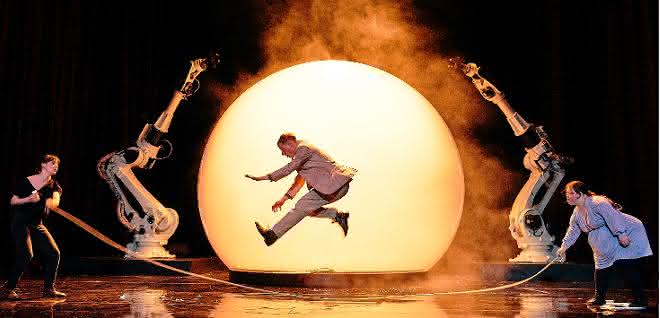
While the actors tell the story of "Liliom", two industrial robots come to life on the theater stage: They create a small forest with great precision.
For the new interpretation of the play "Liliom" by Ferenc Molnár, the creators around director Kornél Mundruczó and set designer Monika Pormale of the Hamburg Thalia Theater have come up with something special: In addition to the actors, two Kawasaki BX200X industrial robots with grippers from the Zimmer Group 's GPP5000 series play a leading role.
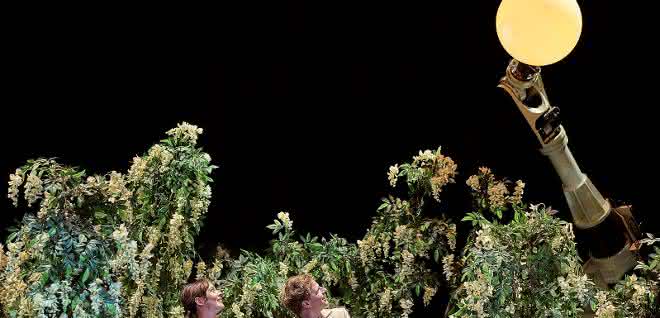
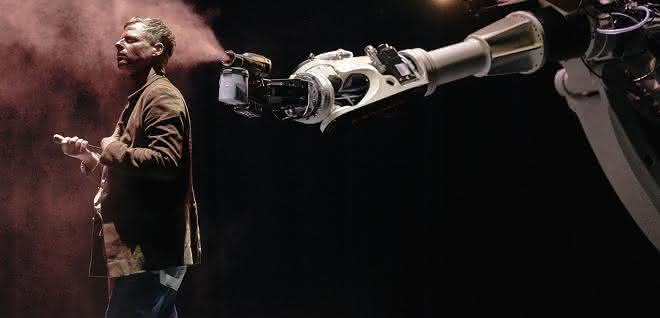
Since the first performance of Liliom, the two Kawasaki robots with the room grippers have captivated the audience. In addition to small stage tasks such as building a small forest or hanging up a moon dummy, the two steel stage helpers also intervene directly in the theater action: During the suicide scene, the robots spray the protagonist all around with a kind of fake blood in order to depict Liliom's death in a particularly dramatic way. Their spotlights and red position lights look like eyes staring at him. And at the end, as the ensemble bows to the audience, the robots proudly lower their grippers and celebrate.
The plot of the play was reinterpreted not only because of the robots and is quickly told: The rogue and heartthrob Liliom is known as a barker at a fairground in Budapest and lover of the carousel owner Muskat, until he meets the love of his life, Julie. Together with the maid, he throws everything away and runs away. But Julie is soon pregnant and the couple are faced with huge problems. Without a job, money and an apartment, Liliom begins to beat Julie in his frustration and starts drinking. A robbery, in which his shady friend Ficsur gets him involved, goes disastrously wrong and Liliom commits suicide. But even when he is allowed to return to the world after many years in purgatory, the ruffian is not reformed. In times of #metoo, "no means no" and domestic violence, the viewer is faced with the question of how to deal with a brutal daredevil like Liliom. In contrast to the original Hungarian play, director Kornél Mundruczó rolls up the story from the back: Liliom is already dead and has to answer for his actions at the Last Judgement and stand trial. It is a flashback to another, distant time. While Ferenc Molnár gives him a second chance in 1909 through a heavenly judgment in the world and Julie herself absolves him at the end of the play, in Mundruczó's play it is the "safe space" and a group of queer people (gays, lesbians, transgender people, etc.) whom he meets in the afterlife and to whom he must answer.
Safety first - from production to the stage
For the new stage design, the technical director of the Thalia Theater, Hajo Krause, and his team turned to two experts in the field of automation: Kawasaki Robotics from Neuss provided two BX200X welding robots on loan. The 1.5 t BX200X model was developed for spot welding, for example in car manufacturing or for handling tasks. A load capacity of 200 kg, internal guidance of hose packages and a reach of 3.412 m are among the features of the industrial robots. The two grippers were sponsored by the Zimmer Group from Rheinau.
To match the Kawasaki robot, the gripper specialist supplied two 9 kg GPP5030N pneumatic large-stroke grippers, which, with their gripping force of 5 kN, are particularly suitable for the special tasks that arise on the platform. They also offer the necessary robustness and high flexibility in terms of force and torque absorption.
"We didn't know what we were doing at the beginning, because it was the first time," Hajo Krause admitted with a grin in conversation with the director Joachim Lux of the Thalia Theater at a reception for the Hamburg premiere of the play. It was a risk the team took that should not be underestimated. Especially in terms of the potential danger posed by the robots and their grippers. The two behemoths could easily crush a human being and, for aesthetic reasons, no grids were provided to protect the actors on stage. This situation was solved using various approaches.
Temporal separation: The Cubic-S hardware module from Kawasaki was used as the controller. It reduces the maximum speed to 0.3 m/s in learning mode (teach mode). This is important in order to be able to operate close to the robot during set-up mode. The individual programs, for example "Tree 1" to "Tree 17" for setting up the small forest, were created and saved in this way. This means that minimal changes resulting from the construction and dismantling can be quickly corrected later in the respective programs.
Speed limit: Those responsible have also stipulated that the speed of the robots in automatic mode is limited to a maximum of 1.2 m/s and that robot movements only take place when there are no people in the working circle. Markings were placed on the stage for the performers.
Spatial separation: Cubic-S also defines areas that the robot can never approach. This ensures that the robots can never touch each other in their radius of action. Or an area at the back center of the stage, because the performers wait behind the velvet curtain for their performance.
Access control: In addition, a monitored access control system was installed behind each side of the velvet slope with fixed walls and access gates with safety contacts. The robots can only access these areas when the gates are closed. This ensures that the robots can operate on the visible scenery within the three-sided velvet display and that new decorative elements can be provided at the sides behind the velvet.
Safety equipment: As humans are not infallible despite all agreements, four cameras were installed that also record in the infrared range. An employee uses them to monitor all movements inside and outside the playing area. Additional emergency stop buttons were installed here and at the gates, which form a safety chain with the three existing emergency stop devices.
Risk analysis: As part of the risk assessment, all expected trips and movements were considered individually and organizational requirements were defined together with the TÜV authorized expert and the Thalia Theater's occupational safety specialist. These journeys cannot be changed and have been approved.
Bringing industry know-how to the stage
At the beginning, the team also lacked the necessary programming expertise. Event technician Emilie Piech had to acquire this in a two-day basic training course at Kawasaki Robotics. A particular challenge in implementing what she had learned was the constant repositioning of the two robots and the gripping objects used, as these have to be completely dismantled again after almost every performance on stage. To overcome this difficulty, small control points for the objects and the robots were set up on a dance floor so that it could be used as a template for further performances.
Hajo Krause and the director of the Thalia Theater, Joachim Lux, were delighted with the good cooperation with the two industrial companies. "We took a risk in full knowledge that we didn't know whether it would pay off in the end and whether it would work at all," said director Lux. "We understand artistic work by saying that we always take risks. Only if we take these risks can we fail or gain something new," emphasized Artistic Director Lux.
And the risk was worth it, because it shows that there is still no end to the possible applications of industrial robots and grippers.
The author: Gregor Neumann, Zimmer Group


You might also be interested in
From risk to resilience
NIS2 significantly increases the requirements for industrial security concepts. In addition to cyber resilience, physical access protection is becoming increasingly important.
 read more...
Security Operations Center module
When cyber attacks reach production
Adlon is further developing its Security Operations Center and adding another module to the existing Managed SOC for Microsoft 365 environments (based on Managed XDR): Managed SOC Advanced.
read more...Lifecycle management and safe IO-Link communication
At SPS, Pilz will be presenting solutions that combine safety and security in production. The focus is on the digital Myzel Lifecycle Platform, a SaaS offering for the management of machinery and personnel over the entire lifecycle.
read more...The basics of warehouse safety
Safety in the warehouse primarily relates to the employees. However, goods must also be transported safely and transport equipment must not be damaged.
read more...Environmental containers and fire protection
Companies can choose from a wide range of environmental containers for storing chemicals and other hazardous substances.
read more...Secure focus on access
To ensure comprehensive safety, holistic safety concepts for safety and industrial security on machines are required. Authorizations and access must be clearly regulated.
read more...Added value through safety and productivity
Machine malfunctions can have serious consequences and put people's health at risk. Functional safety therefore plays a central role in industry. With control and inverter technology including integrated safety functions from ABB, plant operators...
read more...Protect Ethernet interfaces
Pilz is expanding its portfolio of operating and signaling devices with the control element PIT oe ETH. It is equipped with an Ethernet port that can be activated and protects freely accessible Ethernet interfaces in industry against unauthorized...
read more...Protective tool in everyday life
Cybershield is a company founded in 2021 with a focus on operational technologies and has set itself the goal of significantly advancing IT security in the OT sector and supporting customers.
read more...