
Electric gripper for bottle handling
Individualized grippers
The trend towards individualization and personalization of mass products is developing rapidly. In addition to the automotive and pharmaceutical industries, this is also increasingly finding its way into food production. Although there are already individual personalized foods on the market, the production and process control structures used to date are quickly reaching their limits, particularly in the beverage industry.
Industry 4.0 opens up a wide range of opportunities to manufacture customized mass products flexibly and economically. The Chairs of Brewing and Beverage Technology and Food Packaging Technology at the Technical University of Munich have therefore developed an innovative automation concept together with the Fraunhofer IGCV and industrial partners Krones, Beckhoff, ProLeiT, Siemens, Dekron, Yaskawa Europe and the Weihenstephan state brewery as well as infoteam Software. RoboFill 4.0, as the project is called, is a new, flexible and modular concept for the industrial provision of customized beverage bottles and containers for filling and beverage technology. The focus is on batch sizes ranging from small batches to one-offs. According to the project specifications, all system components were to be designed as cyber-physical system components - a core element of Industry 4.0 - that communicate continuously with each other and with higher-level systems using network and cloud technologies. This enables autonomous production control and also forms the basis for optimization processes in production technology, such as predictive maintenance.
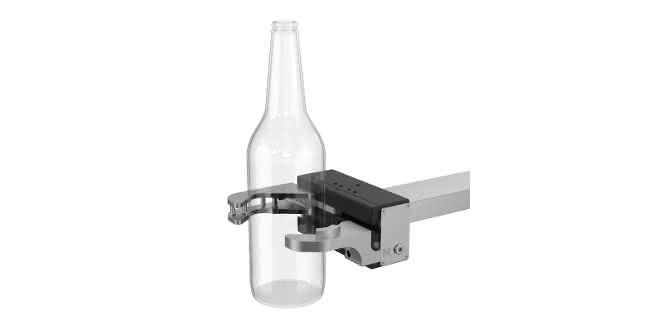
Sealed special servo gripper for bottle handling
When the Zimmer Group 's gripper specialists were asked to take part in the Bavarian Research Foundation's project, they didn't think twice. Without further ado, the Rheinau-based company took part in the project. As the project work progressed, the complexity of the task became apparent: the list of challenges grew longer and longer the more the subject matter was dealt with, and the requirements of the partners also grew steadily during the first year of the project.
The development of a suitable gripper for handling a wide variety of glass bottles with robots proved to be very complex and time-consuming, as a wide range of issues had to be addressed and taken into account during implementation. These included force-controlled gripping, sealed components, the exclusive use of food-safe materials or lubricants (NSF-H1) and communication between the gripper and the robot controller. When handling the bottles, it also had to be ensured that no bottle could break in the event of an emergency stop or a power failure on the system. The development of special gripper jaws, which had to be able to safely handle all the envisaged bottle types from 0.33 l to 0.75 l on the bottle neck and also on the bottle belly, also presented the development team at the Zimmer Group with a major challenge.
It quickly became clear that only an electric gripper of the current generation, the GEH6000 series with servo drive, could be suitable for this task. However, this was only available as a prototype at the time and had not even been designed for many of the requirements mentioned. For example, it was extremely time-consuming to seal an electric and compactly designed large lifting gripper in such a way that it could be cleaned with caustic spray water when stationary or that there was no risk of failure due to a short circuit in the event of a bottle bursting. This was followed by several development loops in which the knowledge gained in tests on the component geometry and its coating process and the materials used for the various seals and wipers installed were implemented.
Development of a gripper control interface
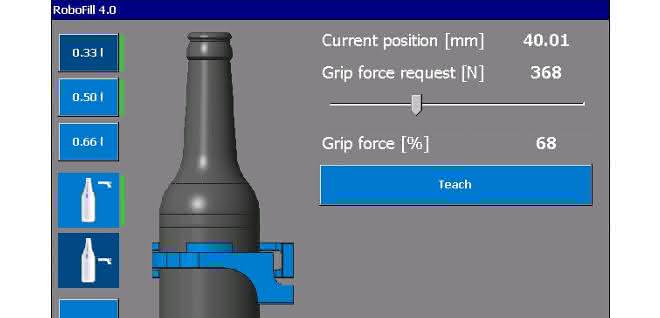
The solution that eliminated the problem with communication with the robot controller can be described as a noteworthy innovation. Instead of setting up a second, parallel controller for the grippers operating with IO-Link, as is generally the case, a special gripper control interface (HMI) was developed and implemented in the robot controller. Erik Bauhaus, project manager and M-TB developer at the Zimmer Group, praised the excellent cooperation with the robot manufacturer Yaskawa in particular. This is also bearing fruit beyond the project: "By implementing the Zimmer HMI in the robot controller, it is now possible to control up to four electrically or pneumatically driven Zimmer grippers on many industrial robots," explains Bauhaus.
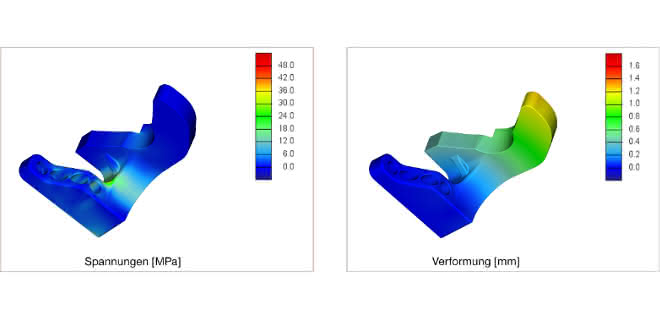
In order to keep the development time and costs for the gripper jaws as low as possible, they were designed in advance using finite element analyses and then additively manufactured using a 3D printing process. In-house prototype production and the ability to carry out complex tests in advance in the testing department contributed significantly to the success of the project.
A similar approach was taken when developing the bottle carriers for the Beckhoff XTS system. The test system was put into operation at the Weihenstephan research brewery at the end of the project and will be tested for market maturity and suitability for everyday use over the next few years. This could also make it possible to sell the complete system in the future. There have already been inquiries about this in the past.


You might also be interested in
ESTIA aims to strengthen Europe's cloud
New tech alliance for EU sovereignty
Twelve companies, including Dassault Systèmes, are founding the European Sovereign Tech Industry Alliance (ESTIA). The initiative aims to strengthen Europe's technological independence and define requirements for sovereign cloud services. The start...
 read more...
Deutsche Telekom and Nvidia launch one of Europe's largest AI factories
With the Industrial AI Cloud in Munich, Deutsche Telekom and NVIDIA are creating one of the largest AI factories in Europe. Companies can train AI models, carry out simulations and access 10,000 GPUs.
read more...Leveraging data potential with AI and streaming
Huge data treasures are still lying dormant in many manufacturing companies. And yet it is high time that these treasures were unlocked. There is often a lack of resources and capacity to make data usable in real time. Streaming production data can...
read more...More awareness of noise
Dematic offers solutions that are tailored to different cloud environments and reduce environmental impact through reduced material consumption and improved energy efficiency.
read more...Generative AI in the automation environment
The mechanical engineering and automation industry is undergoing profound change. This transformation is being driven by more volatile global trade, geopolitical crises and increasing market pressure, which demands greater agility, technological...
read more...Rigid data structures have had their day
The traditional data center is no longer the center of data. A hybrid cloud storage approach enables manufacturing companies to both meet the current requirements of data-intensive processes and future-proof their infrastructure.
read more...Software as a service in three stages
CIM Database Cloud is a new out-of-the-box solution from Contact for end-to-end digital product development.
read more...How production can benefit from AI
Together with AI technology, IIoT networking makes it possible to better control machine parameters and optimize quality with predictive quality. Downtimes and set-up times can also be further minimized. Cloud platforms also make these technologies...
read more...More expertise for digital engineering
Altair, a computational science and artificial intelligence (AI) company, has acquired OmniV, a technology from Michigan, USA-based software company XLDyn.
read more...