

Automation in food production
Delta robots pack sausages
Jack Link's has been a pioneer in the automation of BiFi sausage production since 2006. The meat snack manufacturer continues to invest millions of euros every year in state-of-the-art automation solutions for food production. Efficient sorting and packaging is carried out with ABB IRB 360 FlexPicker delta robots in an industry with specific hygiene requirements that was previously less automated.
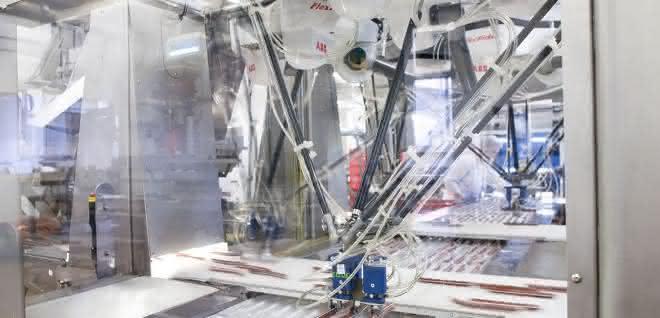
Until the turn of the millennium, many sorting processes in the meat industry were still carried out by hand. At BiFi manufacturer Jack Link's, employees were still manually sorting sausages on the line and placing them in the trays of the thermoforming machine in the early 2000s. While the confectionery industry had already started to automate its production and packaging processes earlier, the meat industry was more cautious - not least because of the specific hygiene requirements for automation equipment. The commissioning of the robot sorting system in 2006 was therefore a significant foray of automation into hygienic areas of application.
At the heart of this application was the question: How can the sausages be gripped and packaged as efficiently as possible in an automated process? With this in mind, the then young company Robomotion was commissioned to design a suitable robot cell for the packaging system. At the time, the Stuttgart-based start-up with its three founders Steffen Mayer, Jan Binder and Dr. Andreas Wolf was working on the integration of robots into series machines in the meat industry. Steffen Mayer and Andreas Wolf had already been working on sorting recyclable materials with SCARA robots at the Fraunhofer Institute in the mid-1990s. The principle of using image processing, control technology, sensors and sophisticated gripper technology to quickly grip products according to specific criteria was also of interest for applications in the food industry.
As part of a collaboration, ABB provided the start-up with an IRB 340 FlexPicker delta robot. Due to their parallel kinematics, robots of this type are ideally suited for handling tasks with high demands on speed and precision, for example from a conveyor belt into a packaging machine. With the ABB robots as the centerpiece, Robomotion, in its role as system integrator, was asked to develop and validate a robot system. Preliminary tests in the laboratory demonstrated that the ABB robots were capable of reliably feeding up to 150 BiFi sausages per minute into the thermoforming packaging process using mechanical grippers. ABB in turn assumed responsibility for service and maintenance of the robot system during operation.
Sorting sausages in piecework
Following a successful test phase, a total of four IRB 340 FlexPickers from ABB were installed in the first system. They formed the heart of a fast-paced, automated process: with the help of the connected feeding technology, the BiFi sausages are placed on Robomotion vibratory conveyors and distributed by four FlexPickers into the trays in the prepared thermoforming film for sealing. Cameras installed along the conveyor line not only check the quality, but also analyze the position and orientation of the sausages. Based on this information, the ABB robots know exactly how to "pick" the sausages thanks to ABB's PickMaster software for camera-supported picking and packing applications. Behind this is a sophisticated image processing system that is able to recognize the sausages as such despite their different curvatures. For the sake of efficiency, the robot has to pick up not just one, but three sausages at a time. To ensure this precision and process reliability at the same time, the opening and closing of the grippers is timed to the millisecond. The robot system is tailored to the special requirements of the meat industry down to the last detail: The grippers can be cleaned in accordance with the applicable hygiene standards and a food-compatible lubricant is used.
In the event of maintenance, quick-change couplings enable the hoses and grippers to be replaced smoothly, helping to maintain the high availability of the robot systems. This is also ensured by modular software that enables the conveyor belts to be controlled remotely. This significantly speeds up the maintenance process and thus increases system availability, which is particularly essential for 24/7 production such as at Jack Link's. "The automation solutions that we have been able to implement in collaboration with Robomotion and ABB over the past few years have fully met our expectations. The systems are reliable, low-maintenance and offer high availability," emphasizes Alfred Gehr, Operations Manager at Jack Link's. "This also has a positive effect on the total cost of ownership," adds Gehr.
New generation of robots at the start
The successful commissioning of the first robot system in BiFi production was just the beginning of an ongoing research and optimization process. For example, as part of the BiFi project, the team worked with Fraunhofer IPA to develop a 3D-printed gripper for the robots in order to save weight and thus make the handling process even more efficient. Since 2009, the triple grippers used in production have come from the 3D printer. The BiFi brand has since been sold to the American company Jack Link's. What remains is the loyalty to ABB delta robots - from now on in the current IRB 360 generation. Jack Link's now has four systems with four ABB robots each, which are entrusted with packaging different BiFi variations. BiFi XXL, BiFi Mini, BiFi Roll, BiFi Carazza - the range of meat snacks at Jack Link's has grown noticeably over the years. The different BiFi varieties differ not only in their composition, but in some cases also in their size and shape. This is no problem for the flexible ABB robots equipped with the PickMaster software: by making small adjustments to the program and the image processing software, they are able to adapt to product variants. Only the packaging machine itself requires a tool change.
The final packaging process at Jack Link's is also automated. Once the sausages have been sorted and thermoformed, the outer packaging is then sealed (primary packaging) and the sausages are placed in cartons (secondary packaging). For this purpose, a FlexPicker robot from ABB groups the sealed sausages on a conveyor belt into a formation, which a second robot equipped with suitable grippers picks up and distributes in groups onto cartons. As the cartons for the different BiFi products vary in size, the flexibility of the robots is required when sorting. With a quick gripper change and adaptation of the robot software, the system can be adapted to a new product in no time at all. The secondary packaging system is also the product of the proven cooperation between ABB Robotics and Robomotion.


You might also be interested in
Basler acquires 76% of Indian image processor
Basler, supplier of image processing components for computer vision solutions, has acquired 76% of the Indian sales partner Alpha TechSys Automation.
 read more...
Process monitoring and fault detection
Cameras ensure quality during laser melting
Powder bed-based laser melting (PBF-LB/M) opens up new possibilities in additive manufacturing. Modern camera systems provide crucial process data to further increase quality and efficiency.
read more...Vision Sensor is three times faster than its predecessor
The 'CS-62' vision sensor from di-soric is around three times faster than its predecessor, the 'CS-60'. In combination with the 'nVision-i 25.1' software, it enables image processing solutions that were previously reserved for smart cameras.
read more...Thermal imaging cameras for quality control
Automated thermal imaging cameras are often suitable for quality control applications where temperature plays a role. However, while there are various solutions on the market for slow processes, it is challenging to select a camera that reliably...
read more...Easy entry into industrial VGA thermography
Reliable temperature measurement is a prerequisite for the success of many industrial processes. Berlin-based manufacturer Optris presents the Xi 640 infrared camera, a new member of its Compact Line, which enables non-contact temperature...
read more...Powder bed-based laser melting optimized
Aconity3D has set itself the goal of optimizing the stability of the manufacturing method of powder bed-based laser melting and thereby promoting its use in a wide range of industries. By using high-speed industrial cameras from SVS-Vistek, the...
read more...INDUSTRIAL Production Products of the year...
2nd place, category handling, assembly and production logistics: SICK
safeVisionary2 is the first 3D time-of-flight camera with Performance Level c safety certification. It enables safe three-dimensional environmental detection and won 2nd place in the competition for Product of the Year 2024 in the handling, assembly...
read more...Nomination Products of the Year 2024
SICK: Camera systems safeVisionary2
safeVisionary2 is the first 3D time-of-flight camera with Performance Level c safety certification. It enables safe three-dimensional environmental detection and has been nominated in the 2024 Product of the Year competition in the handling,...
read more...AI vision brings additional opportunities
The seamless integration of AI into the consumer sector has helped to improve our quality of life and make interactions with technology more efficient. In industry, AI vision with machine learning opens up new possibilities that are not covered by...
read more...