
EMO Hannover 2019
Success with cobots
Robotics and automation are key technologies for companies to remain successful internationally. Cobots interact directly with humans and help manufacturing companies to remain productive in the market. At EMO Hannover 2019, trade visitors will find countless automation solutions and collaborative robots to increase their productivity. By Dag Heidecker
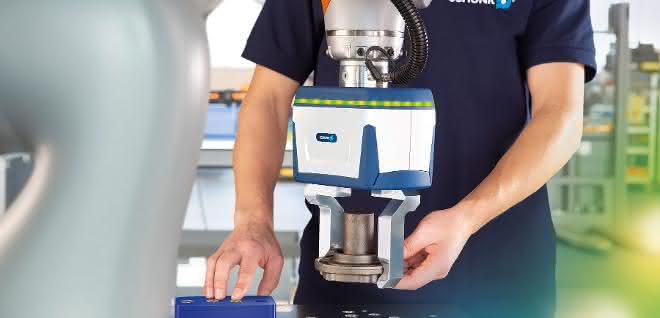
Manufacturing processes can be made more efficient with the help of automation and digitalization. Cobots are of particular interest in this area - collaborative industrial robots work together with humans without special protective equipment such as fences or demarcated areas. In which processes are cobots already being used? How can collisions and thus possible risks of injury be avoided? Robotics manufacturers, suppliers of various peripheral components for automation solutions as well as safety and scientific experts provide an up-to-date insight and forecasts for future developments.
Ergonomic relief for employees
"Humans are essential for intelligent production," says Jochen Vetter, Manager Robot Safety at Pilz GmbH & Co. "Robots take over physically demanding or monotonous tasks, for example, while humans perform higher-value tasks. Automation can therefore also provide answers to questions raised by demographic change." Different methods must be used for the validation of human-robot collaboration (HRC). For example, it is essential to use a measurement procedure to determine whether potential collisions are harmless in terms of safety. Pilz has developed its own methodology for this. Among other things, a system measures the forces acting on the human body and compares them with the limit values in accordance with the standard for collaborative robots ISO/TS 15066.
"The challenge is that the boundaries between the working areas of humans and machines are dissolving. In addition to the dangers posed by the robot, the movements of humans must also be taken into account," says the robotics safety expert. "These are not always calculable in terms of speed, reflexes or the sudden entry of additional people. However, collisions must not lead to injuries." The prerequisites for this are more reliable control systems and intelligent, dynamic sensors on the robot. It is also important to set reliable safety standards through normative principles.
"Interaction will develop in a 'natural' direction, for example in terms of language and gestures," Vetter is convinced. "This will take HRC to a new level of quality for a different way of working. In the future, HRC solutions will also be connected to the factory control system via OPC UA or the Industry 4.0 RAMI standards. Sensible areas of application tend not to be in large-scale production, but in medium and small series. HRC makes sense when the ergonomic burden on employees is reduced, for example during maintenance work."
Grip workpieces up to 8 kg thanks to safety intelligence
"Due to the biomechanical limits - specified by ISO/TS 15066 - the use of cobots has so far concentrated on the handling of small parts, for example in assembly applications in the electronics industry or in the pick & place of housings, turned and milled parts, etc.," says Prof. Markus Glück, Managing Director Research & Development, Chief Innovation Officer at Schunk GmbH & Co."With our large lifting gripper EGL-C, however, we are now opening up a new component dimension: for the first time, it is possible to safely handle positively gripped workpieces weighing up to 8 kg. This opens up great potential, even for machine tools or in assembly." Thanks to integrated and patent-pending safety intelligence, the EGL-C co-act (collaborative actuator) has succeeded in achieving gripping forces of up to 450 N in collaborative applications. This is around three times as much as before and represents a world first - also on show at EMO Hannover 2019. "HRC will radically change the world of work," predicts Prof. Glück. "The focus is on improving ergonomics, making work processes more flexible, increasing efficiency and optimizing processes. With the help of intelligent gripping systems, it will also be possible to handle heavier components in the future. In addition, applications on mobile platforms will become increasingly important thanks to 24V technology. Assembly assistance using lightweight robots also has great growth potential."
A new era in the loading of machine tools
"Collaborative and mobile robot systems offer new possibilities for the automation of machine tools. For the first time, automation can break free from its rigid corset and achieve unprecedented levels of flexibility and productivity thanks to innovative robotic solutions," reports Peter Pühringer, Division Manager at Stäubli Robotics in Bayreuth. In order to take this flexibility to the extreme, Stäubli has designed the new TX2 six-axis generation to be as universal as possible. The new version of these robots is suitable for direct cooperation with humans. They are also available as mobile and collaborative robot systems. "This heralds a new era in the feeding of machine tools," Pühringer is convinced. The robots work both in stand-alone operation and directly with machine operators. In a mobile version, they can easily link different machine tools and take over the entire workflow in Industry 4.0 environments. "With this incredible flexibility, completely new, digitally networked production processes can be created," says Pühringer. "These will lead to a significant increase in productivity and take the competitiveness of innovative companies to a new level. We will be presenting these solutions to a wide audience at EMO Hannover."
Sensors avoid possible collisions
"Cobots are currently often used for simple handling processes, such as loading machines. Although they are often used without safety fences, they are equipped with additional safety devices and are used less in direct human-robot cooperation," says Prof. Gunther Reinhart, Chair of Industrial Management and Assembly Technology at the iwb (Institute for Machine Tools and Industrial Management) at the Technical University of Munich. "Current work is focusing on planning support for HRC, safety and robot instruction. In terms of safety, innovations are being made to ensure that potential collisions are detected before contact by various sensors - such as capacitive or ultrasonic sensors - or by cameras." Many companies are currently unclear about how to deal with the current standards. "In particular, how the values in ISO/TS15066 should be handled," says Reinhart. "Once the legal issues of occupational safety have been clarified, collaborative robots will probably mainly be used in assembly," Reinhart ventures a look into the future. "Other use cases relate in particular to ergonomic support. However, this will first require more robots for HRC with higher payloads. The Institute for Machine Tools and Industrial Management will be happy to provide trade visitors to EMO Hannover 2019 with more detailed explanations."
The author: Dag Heidecker, daxTR - Technik + Redaktion, Wermelskirchen


You might also be interested in
Protection against electrostatic discharge
StoFloor ESD KU 614 from StoCretec: dissipative flooring with the latest technology meets all ESD standards, is economical, extremely durable, mechanically and chemically resistant. The surface can be adjusted to be slip-resistant. The system is...
 read more...
Cables and wires from Helukabel
Food cultivation on a new level
Vertical farming - cultivation in multi-storey greenhouses - is considered one of the most exciting trends in food production. One of the pioneers in this field is the Romanian start-up Ultragreens. The company relies on solutions from Helukabel to...
read more...Further training for specialists to become security experts
With the "CESA - Certified Expert for Security in Automation" qualification, automation expert Pilz offers a two-day expert course designed to provide participants with compact security knowledge in line with the latest standards.
read more...Meaningful data on the service life of the seal
Seals prevent substances from penetrating or entering technical components. The intelligent seals from Freudenberg Sealing Technologies can significantly expand this core task in the future: the seal itself is also a sensor and becomes a "smart...
read more...Online stud configurator according to drawing
For standard bolts, with head, thread or hole
For standard bolts, with head, thread, bore or as a version with recess, mbo Osswald configurators map the standard specifications, are very easy to use, take a lot of work off the user's hands and save a lot of time.
read more...Safe palletizing with the Cobot
Verla-Pharm's medicinal products and food supplements have been available for decades. Ever-increasing throughputs result in ever-increasing logistics costs, whereby optimum utilization of the available production space is necessary.
read more...The tiger among processors
Since the move towards the Industrial Internet of Things (IIoT) and Industry 4.0 has picked up speed, processor boards and modules must be able to process exponentially growing amounts of data.
read more...VDWF publishes "Sustainability Compendium"
Nowadays, nobody can avoid "sustainability": In addition to a far-reaching presence in the media, it is also becoming increasingly important for companies in the tool and mold making industry to develop and implement appropriate concepts.
read more...More transparency and synergies with QM software
Weber, manufacturer of wood and metal sanding machines and extruders, has reorganized its quality management with ConSense IMS Professional. The software solution enables transparent documentation and more efficient processes.
read more...