
From customer project to robotics lab
Automation technology in the service of research
In order for robots to operate as efficiently and precisely as possible in production, many adjustments need to be made. The Fraunhofer Institute for Engineering Design IEM is researching these on behalf of its customers.
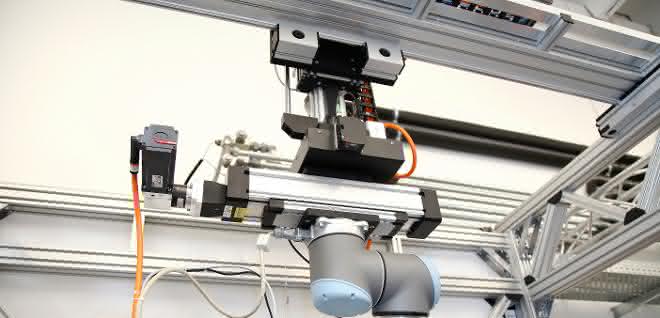
Applications can be demonstrated, designed and tested in the in-house Robotics Lab. The lab was developed in close cooperation with RK Rose+Krieger. The automation technology specialist supplied the necessary gantry systems and linear technology, among other things. An initial research project carried out by the two partners on behalf of a medium-sized customer proves that these components are ideal for use.
The Fraunhofer IEM's Scientific Automation research department deals with the challenges resulting from the increasing complexity of mechatronic systems. The aim is to control, automate and optimize intelligent technical systems using model-based design methods. One of the focal points within this research area is the intelligent automation of systems and plants. "We use innovative methods and technologies to create individual, industry-compatible solutions," explains Arne Rüting, research associate at the IEM. "The focus is on increasing the efficiency of development processes, resource-saving and self-optimizing machines and systems as well as system networking."
Customized system for robot-based machining
Robotics is a way to automate manufacturing processes and thus make them more efficient. This is exactly what a medium-sized company wanted to achieve when it approached the Fraunhofer IEM with an individual task: The aim was to create a customized system for robot-based machining, including intelligent networking of all components - i.e. the room gantry, robot, tool and additional sensors. Depending on the component, the machining system needed to be quick and easy to adapt without the user having to carry out any programming tasks. "This task could not be realized with standard systems available on the market," says Arne Rüting. "That's why the customer commissioned us to develop an individual and exclusive solution."
In the first step, Fraunhofer IEM determined the requirements for the system in close cooperation with the customer. Based on a structured process analysis and documentation, the second step involved the selection of components and the construction and design of the room portal. Arne Rüting and his colleagues used the resulting CAD model in a multi-body simulation to check the requirements in terms of working space and other parameters. On the other hand, the control code could be checked at an early stage in the project on the basis of the model using virtual commissioning.
System solutions in automation technology
The experts had a professional partner at their side for the design and implementation of the room portal: RK Rose+Krieger. The Fraunhofer IEM has been working successfully with the leading supplier of components and system solutions for automation technology for many years. "The portal from RK Rose+Krieger is a decisive factor for the functionality of the overall system," emphasizes Rüting. "It enables the desired size of the working area, and the rigidity is also crucial for the accuracy that can be achieved with the tool." In addition to the actual design of the gantry, RK Rose+Krieger also calculated the dimensions of the linear axes and drives with regard to the static and dynamic torque as well as the maximum required speed.
"Projects of this kind are the specialty of our RK System Solutions division," explains André Horst, Key Account Manager at RK Rose+Krieger. "With our modular system of almost 50,000 components, we can realize almost any vision. In addition to multi-axis handling systems, we also supply individual workstation systems, machine frames, work platforms and machine enclosures." The multi-axis gantry created in this case is made up of various linear axes, heavy-duty aluminum profiles (see info box) and connecting elements, among other things; the solution is optimally matched to the drives and control technology used. "The overall system developed as part of the project fully meets the predefined requirements in productive use," says Arne Rüting happily. "The room gantry also proves its worth in demanding ambient conditions with a high dust load. The axes used impress with their very good running behavior and high robustness."
Demonstrate possibilities and realize ideas
Before the complete solution was used by the customer, it was first set up and tested as a prototype on the premises of the Fraunhofer IEM. This approach proved so successful that an idea emerged: why not create a laboratory environment in which similar projects could be carried out? The idea for the institute's own Robotics Lab was born. "Here, customers can first implement their applications as prototypes before investing in their own expensive hardware," explains Arne Rüting. "If a certain amount of basic equipment is available, the initial outlay is also eliminated and the preliminary tests can begin straight away - this saves the customer valuable time in the development process."
No sooner said than done: in partnership with RK Rose+Krieger, the Robotics Lab was created over the course of 2018: a modern infrastructure consisting of robots of different performance classes, driverless transport systems, high-performance axis gantries, advanced production and handling systems as well as high-performance control and measurement technology. RK Rose+Krieger supplied numerous components that were needed to equip the approximately 80 square meter laboratory, including a three-axis room gantry, a two-axis surface gantry, individual axes for moving robots as well as monitor and sensor mounts. In addition, the entire Robotics Lab is separated from the laboratory hall by opaque partition walls and viewing windows made of laminated safety glass.
A partnership with a future
In addition to optimum functionality, the components and systems from RK Rose+Krieger are particularly impressive due to their scalability: applications tested on a smaller scale in the Robotics Lab can be transferred to much larger systems with relatively little effort and integrated into the customer's production accordingly. For Arne Rüting, however, this is not the only advantage: "The collaboration with RK Rose+Krieger is always goal-oriented and is characterized by a high degree of professionalism and flexibility," says the research assistant. "Our contacts always respond promptly to requirements or change requests and work out solutions in close consultation." The partnership is particularly uncomplicated, not least due to the close proximity: Both companies are located in the Ostwestfalen-Lippe region - one of the strongest business locations in Germany. These are ideal conditions for further successful collaboration, in which the Robotics Lab will certainly play a key role: Although the lab only went into operation at the beginning of 2019, the first customer inquiries are already being processed there.
Bernd Klöpper, Head of Marketing, RK Rose+Krieger


You might also be interested in
Further simplify assembly processes
In addition to the proven racks with a length of one meter, Wittenstein alpha now offers optional two-meter racks for linear systems. They are particularly suitable for use in short axes, for example, in order to simplify assembly even further.
 read more...
Hiwin manufactures its own shaft gearboxes
Have you ever waited several months for an urgently needed corrugated gearbox? Hiwin has too. That's why the Offenburg-based drive specialist has decided to produce its own space and weight-saving reduction talent.
read more...Human-robot interaction at the trade fair
Sumitomo Drive Technologies is presenting its drive solutions for automation and robotics at Automatica 2023 together with the Lafert Group. The company will be showcasing two different applications of the Tuaka drive system for robot applications...
read more...Partial automation with robots
At Automatica, Promess will be showcasing its modular individual workstations and how these can be partially automated with robot support. The servo press manufacturer will also be providing information about the latest features of its Revolution X...
read more...A new benchmark for collaborative robots
At this year's Automatica, Denso Robotics will be showcasing its innovations in the field of robotics. The collaborative Cobotta Pro product family will be the focus of the presentations. Visitors to the trade fair can see all variants in various...
read more...Clamping system for a new milling machine
Investments in machinery often lead to further purchases - as is the case at Joma-Maschinenbau, whose modern production facility has recently been supplemented by a 5-axis milling machine.
read more...Schunk wants to simplify processes in automated production
The declared aim of automation specialist Schunk is to make its customers' processes comprehensible, simple and efficient. Data transparency plays an important role in this. It enables reliable processes and provides the basis for resource-saving...
read more...Festo and Hahn Automation develop battery tester for greater safety
The success and reputation of electric vehicle manufacturers depend on the safe and flawless functioning of batteries. Hahn Automation has therefore developed a battery tester that performs a fully automated 100% test of mobile energy storage...
read more...SPN Schwaben Präzision presents gearbox solutions for automation and industrial robotics
Short cycle times, robust technology, wear-free surfaces and compact designs have always been relevant for automation and robotics solutions. This year's Automatica trend topics include "Sustainable production" and "Digitalization and AI". SPN aims...
read more...