
Robots for intralogistics
Attachment modules for mobile robots
Intralogistics remains one of the last areas of Industry 4.0 to be automated. Mobile transport robots help to integrate the internal material flow into networked production conditions. The necessary flexibility is provided by a growing number of add-on modules: they are the only way to expand the mobile robot into a functional automation solution. By Thomas Visti
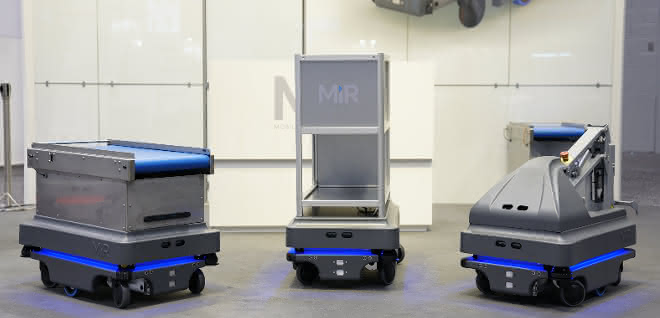
The digital networking of industrial production has long since become a megatrend. Collaborating robots make companies more productive and help them to cope with the challenges of volatile market conditions. But cutting-edge manufacturing technologies are only one aspect of institutional value creation: on the road to Industry 4.0, it is also important to keep an eye on the material flow.
In many companies, very little attention is usually paid to this area. Those responsible fail to recognize the optimization potential that is actually hidden in intralogistics. Countless man-hours are lost when employees take on time-consuming journeys and put a lot of effort into transporting goods. This is not only laborious for the individual. At an operational level, the manual handling of such processes unnecessarily slows down workflows and ties up capacity that would be urgently needed elsewhere. In an increasingly networked production environment, the efficiency of the entire production process ultimately suffers as a result.
Mobile transport robots provide a remedy. The Danish company Mobile Industrial Robots (MiR) produces autonomously navigating transport robots that streamline the internal material flow. They are already in use in a wide range of industries. With a payload of up to 500 kg, transport robots relieve factory employees of the task of lifting and carrying heavy goods. They also move faster than a human can walk. In this way, they relieve employees of physically demanding tasks and give them time to deal with more challenging activities. They can be used around the clock, helping companies to fully utilize their production capacities.
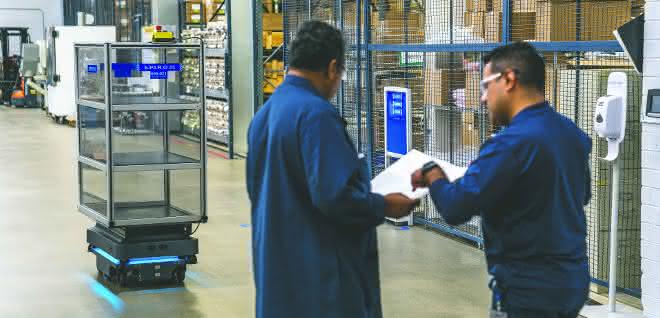
Compared to floor-bound transport systems, robots from Mobile Industrial Robots fit into dynamic production layouts. There is no need to adapt the infrastructure, as they navigate autonomously thanks to special sensor technology and safety algorithms. This allows them to find their way independently and safely in places where people go about their daily work.
Robot and add-on module - the combination makes the difference
All these advantages mean that robot colleagues are increasingly becoming part of the standard repertoire of factory halls. As a result, the focus is shifting from mobile robots and their technology to their role as a holistic application: the transport robot itself is an open platform that only becomes a functional automation solution when equipped with attachments. In this form, it can meet the specific needs of the end user and offer economic benefits. To this end, more and more manufacturers are developing individual modules to expand the usability of mobile robots.
In production, robots are often fitted with shelf attachments. These have proven to be particularly practical for transporting semi-finished products between the individual production steps or bringing finished products to the warehouse. Employees call the robot at the touch of a button, load its shelf with the relevant materials and then send it on its way again. Ergonomically designed shelf loading surfaces make loading and unloading even easier. If the robot is equipped with a shelf lifter, it can even "set up" shelves with rollers on its own.
The American medical technology company Argon Medical Devices, for example, uses a MiR200, named after its load capacity in kilograms, with a shelf attachment in production, where it carries out errands between production and the warehouse. Before each transport, employees load it with up to eight transport boxes, each weighing around 20 kg. The internal material flow runs more smoothly as a result. Queues at the production lines and raw materials lying around are a thing of the past. The mobile robot saves Argon Medical the resources of a full-time employee, which are much more urgently needed in materials planning.
Conveyor belt modules are also among the most frequently used add-on solutions for mobile robots. They usually bridge the material flow between fixed conveyor belts or production cells. They are also used for full automation, i.e. the realization of almost automatic transport processes in which human intervention is limited to monitoring and controlling activities such as starting up, feeding raw materials or removing products.
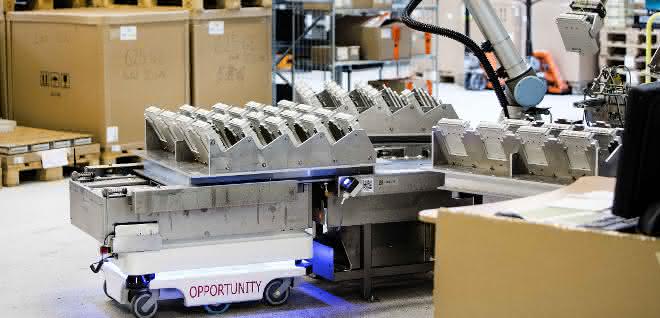
This is the case, for example, at Danish electronics manufacturer Kamstrup. Here, three MiR100s transport semi-finished products independently between different production lines and manufacturing cells. When an employee enters a new order into the ERP system, the robots receive a list of routes that they then follow. They then deliver items to a production cell, for example, and unload them there using the attached conveyor belt module. Once the item has been further processed, they pick it up again and take it to the next production step.
Automated pallet transport
In industrial environments, the transportation of heavy goods such as pallets is often an issue. Special attachments for automation are also available for this purpose. The MiR500 mobile robot, for example, is the size of a Euro pallet and has a load capacity of 500 kg. In combination with the MiR Pallet Lift, it can automatically pick up and unload pallets from the MiR Pallet Rack pick-up device. With this combination, the application extends the performance spectrum of mobile robots towards the automation of intralogistics.
Applications with robot arms are also opening up new fields of use. This type of installation is particularly suitable for pick-and-place tasks in warehouses: The transport robot provides the robotic arm with the necessary mobility, while the latter provides the manual dexterity. In combination, they can support the user in a variety of conceivable tasks. This also underlines the trend towards networking within the robotics industry.
Transport robots as a basis
The large number of available solutions makes systematic overviews necessary. Manufacturers are beginning to present the installation options provided by distributors in online exhibition portals. One example can be found in Mobile Industrial Robots' TradeForum, where the manufacturer offers its customers an overview of the various modules available on the market. Innovative approaches such as this show that the growing range of assembly solutions is becoming increasingly individualized: The range of applications for mobile robots is expanding in perspective.
So one thing is certain: the attachment module used defines the function of a transport robot to a large extent. It acts as the key to its flexibility. Only the combination of module and robot guarantees individual scalability of the automation solution: it gives the user the freedom to use the robot precisely for their specific application. A medium-sized company with a single production line may only need a single robot and equip it with different modules for different applications. A larger industrial company, on the other hand, has a whole fleet of robots with the same attachments in use, which in their mass increase the efficiency of the processes. This in no way means that the transport robot itself is becoming less important: Rather, its substantial role as a necessary platform that serves as a basis for the functional extensions becomes clear. Only in this way can automation deliver the competitive advantage it promises.
Thomas Visti, CEO at Mobile Industrial Robots / ag


You might also be interested in
Plagiarius 2024 negative prize
On January 26, 2024, the Plagiarius campaign awarded its dreaded "Plagiarius" negative prize for the 48th time to manufacturers and retailers of particularly brazen counterfeits and fakes.
 read more...
Ivalua honors winners of the Generative AI...
AI-supported "add-ons" for buyers within 48 hours
Ivalua, provider of cloud-based spend management solutions, announced the winners and innovations of the first Generative AI Innovation Cup. The competition took place in December 2023. It was open to all Ivalua partners and employees - more than...
read more...Efaflex celebrates 50 years of high-speed...
The emphasis is on "fast"
Since day one, Efaflex has wanted to use new technologies as early as possible and drive progress in the industry. This year, the family business is celebrating its 50th anniversary under the motto "Fast Forward".
read more...Security of supply even during power outages
In the winter of 2022, Germany was worried about energy shortages. The drugstore retailer dm did not paint any horror scenarios, but nevertheless saw the possibility of controlled, temporary, regional power cuts (brownouts).
read more...Safety technology in mechanical engineering
Modules with new functions
Euchner's product highlights at EMO 2023 include the communication-capable solenoid interlocks.
read more...Transforming the paper industry towards climate neutrality
Together with partners from industry and research, Voith is developing a project for the optimization of energy and material flows in paper production. The aim of the research project is to develop a digital framework that enables effective process...
read more...Up to 95 percent less flue gas thanks to direct extraction
The requirements for occupational safety measures and safety technology are also constantly increasing in welding technology. The Technical Rules for Hazardous Substances (TRGS) stipulate that welding fumes and harmful substances must be extracted...
read more...Competitive advantages with large machines
Whether 3D-printed components for machines and systems, prototypes or aids for design: additive manufacturing is almost indispensable for modern companies in mechanical and plant engineering and automation if they want to play in the premier league.
read more...Transport technology from the modular system
Many transport tasks can be realized with the help of linear technology. Pre-configured solutions are available to simplify the interaction between the linear unit, motor, gearbox and controller. This minimizes the effort required for research and...
read more...