

Semi-automated handling system
With the wizard for door removal
What happens when Swabian inventiveness and Baden pioneering spirit meet? The result is a top-class handling project for the automotive industry.
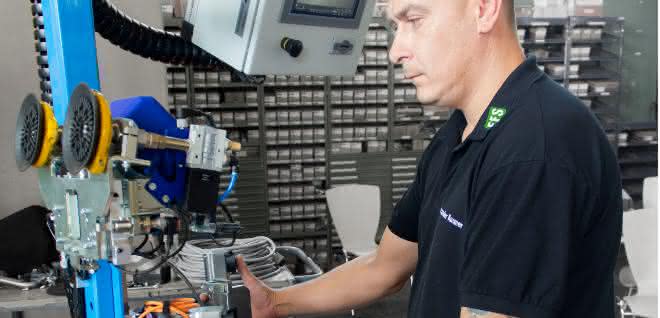
EFS Gesellschaft für Hebe- und Handhabungstechnik is a globally active company in the field of handling technology and sees itself as a technology driver for partially and fully automated handling equipment in the automotive industry, among others. From the suspended transportation of components to partially and fully automated assembly systems, EFS has been offering its customers innovative turnkey solutions on site for more than 20 years.
The clamping element specialist Zimmer Group from Rheinau has also often demonstrated a pioneering spirit: most recently, the company demonstrated this with its LKE product used in this project - currently the only electrical clamping element for profile rail guides available on the market.
From pneumatics to an electrical system
EFS developed a customized, semi-automated handling device for installing and removing car doors based on an electrical system in line with the specifications of renowned German car manufacturers.
Pneumatics has dominated this handling technology for decades. Against the backdrop of an increasing number of variants in the assembly line and sustainability, car manufacturers want to break new ground in the direction of electrification/electromobility and the digitalization of process sequences. Another focus of this new development is the use of resources and, above all, their flexibility. Due to increased requirements with regard to rapidly changing production processes and new product series that could not previously be defined in terms of scope or size, a system was created that meets the system requirements and is future-proof. "The requirement to map variants and vehicles in the plants that were previously unknown is increasing. Here we need to think in terms of electrification, where the targeted use of sensor technology can play back the assembly processes and thus accelerate the commissioning strategy. It is important for us that the customer can also adapt our systems to changing vehicle doors themselves," says Aaron Geenen, Head of Development at EFS, underlining his approach.
Integrated status monitoring, holding force in the event of a power failure
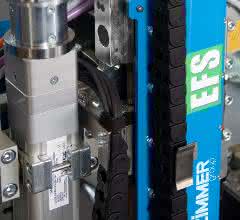
Several Zimmer Group LKE clamping units, which are mounted on a linear guide, are installed in the new handling system. In contrast to a pneumatic solution, these fast electrical clamping elements are particularly impressive with their integrated status monitoring (open/closed), which is output via safety-related digital status signals.
The kinematics are achieved via an eccentric shaft with mechanical self-locking (bistable). Due to the self-locking functional principle, the full holding force is maintained in the closed state even in the event of a power failure or in a de-energized state (when the system is switched off) and the exact position is ensured. Due to their electrical function, they can be used wherever electricity is available and are therefore not dependent on an additional pneumatic or hydraulic supply.
EFS deliberately opts for a semi-automated system. According to Geenen, this enables a "skill-based division of tasks". Thanks to their cognitive abilities, humans are superior to fully automated, robot-supported handling devices in many areas. For example, in a joining process with all its tolerances and deviations or when inserting a door, humans perform highly efficient work. However, automation makes sense for cycle time-relevant processes with overlapping motion sequences. "Other advantages compared to full automation are the fewer adjustment processes and the relatively lower operating costs," continues Geenen.
Flexible operation
The newly developed door installation device is flexible and can simply be pushed onto the bodywork by hand - similar to a workshop trolley. The device is then driven up to the door in question. A suction unit with gripper mechanism lifts the door (semi-automatically) out of the door frame. The Zimmer Group clamping element holds the door in a secure position, allowing the operator to perform various functions on the gripper. In this way, different travel paths can be realized and a worker-specific approach to the movement sequences within the assembly of a car door can be made possible.
The electric clamping element absorbs increased forces compared to the electric actuator in the closed state and secures the position without energy and without displacement. The drive is thus relieved and can be switched off in the positioned state. This results in advantages in the design of the drives and the energy balance, explains Stefan Heiland, Product Manager at the Zimmer Group.
The operator can use the XY rail to transport the door to the vehicle via the handling system and install it there. All degrees of freedom are implemented and can therefore cover a large number of variants (compared to conventional handling devices). A touchpad on the handling device allows each step to be selected individually and adjusted accordingly, for example the pick-up and removal position and other process parameters.
"The flexibility of the Zimmer clamping elements and the fact that they can be easily controlled via digital signals thanks to their integrated electronics were a great advantage for our new system," says Geenen. "Also, thanks to the integrated logic, the status of the LKE series can be transmitted to the control system in a safety-oriented manner via a simple communication interface," he adds.
The handling system is fully adaptable, it is able to adjust to each door variant individually. It receives the relevant values from the master control system and can therefore set itself up or adjust accordingly. A further benefit of the semi-automated system is that the assembly process itself is less prone to errors and faults due to the parameters being stored in the control system and the workload of the assembly staff is reduced by the large number of variants. as


You might also be interested in
Soft grippers for delicate foods
Irregularly shaped, fragile, and varying in size and weight: products such as potatoes, baked goods, and dairy products push mechanical grippers to their limits.
 read more...
Development Collaboration for Humanoid Robotic Hands Launched
Schunk is entering into a new development partnership with Robert Bosch Robotics. Their shared goal is to develop an industrial-grade robotic hand that can be integrated into various humanoid robot systems.
read more...Robot-controlled packaging of rolls
Koch Robotersysteme, a company specializing in the integration of robotic systems, has developed a complete, automated packaging line for packaging rolls based on Tentoma’s RoRo StretchPack packaging machine.
read more...Robotics and autonomous order picking
Locus Robotics acquires Nexera Robotics and expands autonomous warehouse logistics
Locus Robotics takes over Nexera Robotics and may have taken a decisive step towards truly universal warehouse automation. A new gripping technology should now make possible what was previously considered difficult to automate.
read more...Gentle wheel handling
The newly founded Eisenmann Robotics division develops new robotics concepts to increase the level of automation in modern production facilities.
read more...Gripping systems and vacuum generators
Schmalz is presenting new gripping systems and vacuum generators at Automatica. Exoskeletons, which allow employees to move heavy workpieces effortlessly, will also be on display.
read more...Smart universal gripper for power electronics
The power electronics manufacturer Semikron Danfoss uses the EGU 50 mechatronic parallel gripper from Schunk in a robotic cell. It handles different components and feeds them to a measuring line. With its functionalities, it meets all requirements...
read more...Schmalz takes over finger gripper from Soft Robotics
The vacuum specialist Schmalz is expanding its gripper portfolio and acquiring the mGrip product family from the US company Soft Robotics (SRI), including all finger gripper configurations, patents and the associated know-how.
read more...Soldering with special gripper
In order to make the mini wave soldering of large panels stable and reproducible, Eutect developed a special gripper that prevents the panel from bending, among other things.
read more...