
Grippers for collaborative applications
With AI for autonomous gripping
Grippers for collaborative applications. In future, robots and handling systems should be able to recognize, inspect and ultimately handle objects autonomously.
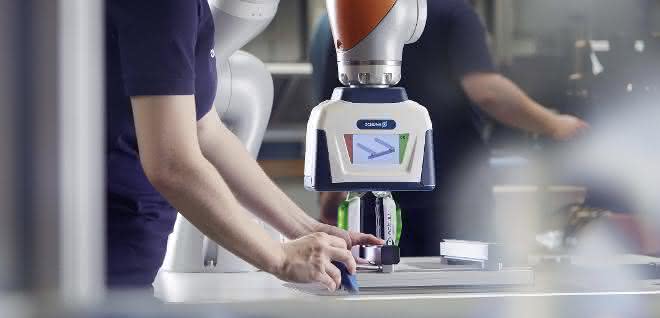
At the Hannover Messe, Schunk will be demonstrating the possibilities and opportunities offered by intelligent gripping system solutions for the smart scenarios of Industry 4.0.
"In the coming years, industrial handling will be reinvented," says Prof. Dr. Markus Glück, Managing Director Research & Development, CINO at Schunk, with conviction. Whereas in the past every single step was laboriously programmed, tomorrow's handling solutions will operate much more independently. "The market is already demanding gripping systems that can be put into operation quickly and intuitively and adapt automatically to varying gripping situations. In addition, collaboration between humans and robots and communication between the components involved in the production process will rapidly gain in importance," emphasizes Glück.
Schunk is not simply throwing proven technologies overboard. On the contrary: the range of the pneumatic flagship PGN-plus-P, for example, will be expanded once again at the Hannover Messe. At the same time, the gripper specialist is stepping up its activities in the mechatronics segment. The challenge of merging electrical control systems with gripping tools leads to mechatronic component networking. Ultimately, the aim is to combine the power requirements of the pneumatic world with the networking options and control landscapes of a smart and collaborative factory in the best possible way.
For the first time in Hanover, Schunk will be presenting a DGUV-certified gripper for collaborative applications that has a gripping force of 450 newtons - far more than was previously possible. The company is thus opening up the collaborative market for handling weights beyond small parts assembly. The automotive supply industry and car manufacturers themselves will certainly take a closer look at this development. In addition, a flexible mechatronic gripper with a large stroke for a wide range of industrial applications will be presented, which is controlled via Profinet.
Networking, machine learning and autonomy
With the help of machine learning, handling solutions should in future be able to recognize regularities based on existing data and algorithms and derive appropriate reactions. With smart gripping, for example, Schunk uses data from several sensors to obtain new information through data correlation and make intelligent decisions. In the medium and long term, the gripping system specialist believes that the trend will be towards autonomous gripping. In conjunction with 2D and 3D cameras, grippers will be able to avoid collisions, they will know how to grip workpieces and develop the optimum gripping strategy together with the higher-level handling system. Ultimately, gripping systems will be able to handle parts independently and refine the underlying algorithms on their own. as
Hall 17, Stand B40


You might also be interested in
Basler acquires 76% of Indian image processor
Basler, supplier of image processing components for computer vision solutions, has acquired 76% of the Indian sales partner Alpha TechSys Automation.
 read more...
Process monitoring and fault detection
Cameras ensure quality during laser melting
Powder bed-based laser melting (PBF-LB/M) opens up new possibilities in additive manufacturing. Modern camera systems provide crucial process data to further increase quality and efficiency.
read more...Vision Sensor is three times faster than its predecessor
The 'CS-62' vision sensor from di-soric is around three times faster than its predecessor, the 'CS-60'. In combination with the 'nVision-i 25.1' software, it enables image processing solutions that were previously reserved for smart cameras.
read more...Thermal imaging cameras for quality control
Automated thermal imaging cameras are often suitable for quality control applications where temperature plays a role. However, while there are various solutions on the market for slow processes, it is challenging to select a camera that reliably...
read more...Easy entry into industrial VGA thermography
Reliable temperature measurement is a prerequisite for the success of many industrial processes. Berlin-based manufacturer Optris presents the Xi 640 infrared camera, a new member of its Compact Line, which enables non-contact temperature...
read more...Powder bed-based laser melting optimized
Aconity3D has set itself the goal of optimizing the stability of the manufacturing method of powder bed-based laser melting and thereby promoting its use in a wide range of industries. By using high-speed industrial cameras from SVS-Vistek, the...
read more...INDUSTRIAL Production Products of the year...
2nd place, category handling, assembly and production logistics: SICK
safeVisionary2 is the first 3D time-of-flight camera with Performance Level c safety certification. It enables safe three-dimensional environmental detection and won 2nd place in the competition for Product of the Year 2024 in the handling, assembly...
read more...Nomination Products of the Year 2024
SICK: Camera systems safeVisionary2
safeVisionary2 is the first 3D time-of-flight camera with Performance Level c safety certification. It enables safe three-dimensional environmental detection and has been nominated in the 2024 Product of the Year competition in the handling,...
read more...AI vision brings additional opportunities
The seamless integration of AI into the consumer sector has helped to improve our quality of life and make interactions with technology more efficient. In industry, AI vision with machine learning opens up new possibilities that are not covered by...
read more...