
Bionic Soft Hand and Soft Arm
Where pneumatics meets AI
In everyday life, we naturally use our hands for various tasks. It makes sense to equip robots in collaborative workspaces with a gripper that is based on this natural model and can learn through artificial intelligence.
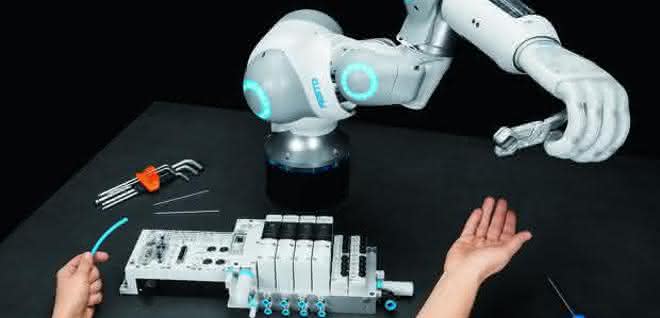
The Bionic Soft Hand from Festo is pneumatically operated so that it can interact safely and directly with people. Its fingers consist of flexible bellows structures with air chambers. The bellows in the fingers are enclosed by a special 3D textile sheath, which is knitted from both elastic and high-strength threads. This allows the textile to determine exactly where the structure expands and thus develops force and where it is prevented from expanding. This makes it light, flexible, adaptable and sensitive, but still able to exert strong forces.
To minimize the amount of tubing required for the hand, the developers have designed a small, digitally controlled valve terminal that is attached directly underneath the hand. This means that the hoses for controlling the fingers do not have to be pulled through the entire robotic arm. This means that the hand can be quickly and easily connected and put into operation with just one hose each for supply air and exhaust air.
The learning methods of machines are also comparable to those of humans: whether positive or negative - they need feedback on their actions in order to be able to classify them and learn from them. The Bionic Soft Hand uses the reinforcement learning method. This means that instead of a specific action that it has to imitate, the hand is simply given a goal. It tries to achieve this by trial and error. Based on the feedback it receives, it gradually optimizes its actions until it finally solves the task successfully.
One robot arm, many possibilities
The Bionic Soft Arm is a compact further development of the Motion Robot from Festo, whose range of applications has been extended. This is made possible by its modular design: it can be combined with up to seven pneumatic bellows segments and rotary drives. This gives it maximum flexibility in terms of reach and mobility and allows it to work around obstacles in the tightest of spaces if required. At the same time, it is inherently compliant and can work safely with humans. Direct human-robot collaboration is just as possible with the Bionic Soft Arm as its use in classic Scara applications, such as pick-and-place tasks.
The modular robot arm can be used for different applications, depending on the structure and mounted gripper. Its flexible kinematics make it easier to adapt to different tasks at different locations: the elimination of complex safety devices such as cages or light barriers shortens conversion times. as


You might also be interested in
Soft grippers for delicate foods
Irregularly shaped, fragile, and varying in size and weight: products such as potatoes, baked goods, and dairy products push mechanical grippers to their limits.
 read more...
Development Collaboration for Humanoid Robotic Hands Launched
Schunk is entering into a new development partnership with Robert Bosch Robotics. Their shared goal is to develop an industrial-grade robotic hand that can be integrated into various humanoid robot systems.
read more...Robot-controlled packaging of rolls
Koch Robotersysteme, a company specializing in the integration of robotic systems, has developed a complete, automated packaging line for packaging rolls based on Tentoma’s RoRo StretchPack packaging machine.
read more...Robotics and autonomous order picking
Locus Robotics acquires Nexera Robotics and expands autonomous warehouse logistics
Locus Robotics takes over Nexera Robotics and may have taken a decisive step towards truly universal warehouse automation. A new gripping technology should now make possible what was previously considered difficult to automate.
read more...Gentle wheel handling
The newly founded Eisenmann Robotics division develops new robotics concepts to increase the level of automation in modern production facilities.
read more...Gripping systems and vacuum generators
Schmalz is presenting new gripping systems and vacuum generators at Automatica. Exoskeletons, which allow employees to move heavy workpieces effortlessly, will also be on display.
read more...Smart universal gripper for power electronics
The power electronics manufacturer Semikron Danfoss uses the EGU 50 mechatronic parallel gripper from Schunk in a robotic cell. It handles different components and feeds them to a measuring line. With its functionalities, it meets all requirements...
read more...Schmalz takes over finger gripper from Soft Robotics
The vacuum specialist Schmalz is expanding its gripper portfolio and acquiring the mGrip product family from the US company Soft Robotics (SRI), including all finger gripper configurations, patents and the associated know-how.
read more...Soldering with special gripper
In order to make the mini wave soldering of large panels stable and reproducible, Eutect developed a special gripper that prevents the panel from bending, among other things.
read more...