
Area gripper
No rough edges
Area gripper with patented valve technology. Fluidtechnik Bückeburg presents a surface gripper specially designed for robots with low payloads and for collaborative robots. To minimize the risk of injury, the manufacturer has rounded all corners.
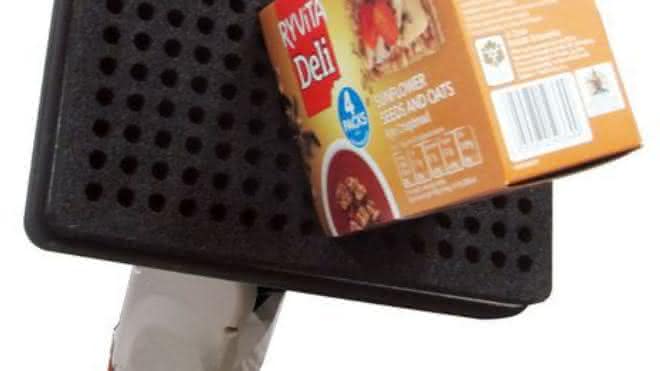
When humans and machines work together, companies have to meet strict safety requirements. At the same time, they can gain advantages from human-robot collaboration (HRC), such as ergonomics and relief for employees. If robots are used in strategically clever places where workers can be relieved, the number of sick days can be reduced, which, among other things, increases productivity. This is where Fluidtechnik Bückeburg comes in and introduces the Unigripper Co-Light: The vacuum area gripper was developed by the Swedish company Tepro Machine & Pac System and is distributed in German-speaking countries by Fluidtechnik Bückeburg.
Predecessor versions of the area gripper have been proving their worth for years in various applications. The valve technology was patented back in 1997: The vacuum is generated by means of an ejector or side channel blower. It is then fed to the product via individual suction holes in the gripper, allowing it to be sucked in. The system automatically recognizes the areas in which a product is located under the gripper; the full vacuum flow is only released at these points. This means that the area gripper can be used to handle goods of different sizes - even products made of porous materials such as cardboard or wood.
Now, with the Unigripper Co-Light, a variant is on the market that is particularly suitable for cooperation between man and machine with a low payload. The additional installation of a vacuum regulator with improved vacuum flow ensures that the risk of crushing for the worker is reduced. This allows the vacuum to be regulated depending on the respective requirements. This contributes to a lower risk of injury and also results in lower compressed air and energy consumption.
In order to meet safety requirements for HRC, the manufacturer has rounded all corners of the gripper. As it is manufactured from a plastic-metal-sinter mixture using an additive printing process, the Unigripper Co-Light is 30 percent lighter than its predecessor model, the Light Weight Gripper. The low weight offers advantages at high cycle rates. The integrated tool change function makes it possible to remove the module within a very short time and replace it with another robot attachment so that there is no downtime during the production process. Installation is also simple: in addition to being connected to the robot, the area gripper only needs to be supplied with compressed air. pb


You might also be interested in
Soft grippers for delicate foods
Irregularly shaped, fragile, and varying in size and weight: products such as potatoes, baked goods, and dairy products push mechanical grippers to their limits.
 read more...
Development Collaboration for Humanoid Robotic Hands Launched
Schunk is entering into a new development partnership with Robert Bosch Robotics. Their shared goal is to develop an industrial-grade robotic hand that can be integrated into various humanoid robot systems.
read more...Robot-controlled packaging of rolls
Koch Robotersysteme, a company specializing in the integration of robotic systems, has developed a complete, automated packaging line for packaging rolls based on Tentoma’s RoRo StretchPack packaging machine.
read more...Robotics and autonomous order picking
Locus Robotics acquires Nexera Robotics and expands autonomous warehouse logistics
Locus Robotics takes over Nexera Robotics and may have taken a decisive step towards truly universal warehouse automation. A new gripping technology should now make possible what was previously considered difficult to automate.
read more...Gentle wheel handling
The newly founded Eisenmann Robotics division develops new robotics concepts to increase the level of automation in modern production facilities.
read more...Gripping systems and vacuum generators
Schmalz is presenting new gripping systems and vacuum generators at Automatica. Exoskeletons, which allow employees to move heavy workpieces effortlessly, will also be on display.
read more...Smart universal gripper for power electronics
The power electronics manufacturer Semikron Danfoss uses the EGU 50 mechatronic parallel gripper from Schunk in a robotic cell. It handles different components and feeds them to a measuring line. With its functionalities, it meets all requirements...
read more...Schmalz takes over finger gripper from Soft Robotics
The vacuum specialist Schmalz is expanding its gripper portfolio and acquiring the mGrip product family from the US company Soft Robotics (SRI), including all finger gripper configurations, patents and the associated know-how.
read more...Soldering with special gripper
In order to make the mini wave soldering of large panels stable and reproducible, Eutect developed a special gripper that prevents the panel from bending, among other things.
read more...