
Smart Gripping
Intelligent, connective, sensitive
Smart gripping as the future of gripping technology. The wbk Institute of Production Engineering at the Karlsruhe Institute of Technology is developing approaches to increase the degree of autonomy of grippers.
Digitalization describes a disruptive change in process structures in production, which poses new challenges for production - such as high flexibility in production volumes, increasing individualization of products and growing complexity of products and processes. In order to meet these challenges, the production of tomorrow will be based on intelligent, decentrally controlled components and systems that dynamically adapt to changing external conditions in real time through continuous self-optimization. This adaptation can only take place after the changed circumstances have been perceived - i.e. by recording and processing sensory data and aggregating it into information.
Gripping systems as an important interface
Gripping systems are of particular importance in the handling process: their position as an interface between the workpiece and the process allows them to collect information about the workpiece directly and thus make processes more flexible. To do this, they must be able to collect as much information as possible about their general condition, the workpiece and the process.
The wbk Institute of Production Engineering at the Karlsruhe Institute of Technology, with its many years of experience in the conception and design of handling systems, is developing approaches to increase the degree of autonomy of grippers. The focus here is on data acquisition, data transmission and data processing into knowledge. Together with Schunk from Lauffen, possibilities are being developed to make gripping systems in industrial use intelligent through the consistent recording and processing of data.
Sensor technology makes grippers more flexible
Schunk's most intelligent series product to date, the EGL, is a servo-electric two-finger parallel gripper with control and power electronics integrated in the housing, which communicates with the controller via Profinet. This allows information such as the position of the gripper jaws, their travel speed or the applied motor current to be transmitted to the controller. Statements can be made about the current status of the gripper, but little about the workpiece to be gripped or the process. Knowledge can only be extracted from the gripped object through the targeted processing and evaluation of the data. The information from the integrated sensors can also be used in combination with data from external sensors to make the gripper more flexible and intelligent. For example, digital distance sensors are used to detect the workpiece at an early stage and reduce the speed accordingly. The lower travel speed means that objects can be gripped much more sensitively and more information about the workpiece can be recorded.
AI opens up new possibilities
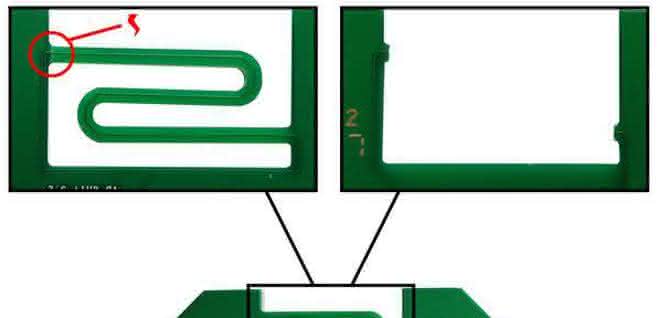
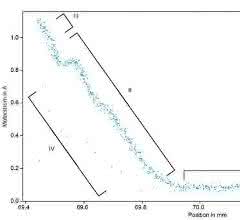
Additional sensor technology and sensor data fusion enable greater flexibility, albeit with increasing complexity. The algorithms currently emerging in the field of artificial intelligence (AI) make it possible to make this complexity manageable. As part of the research work, various algorithms and approaches are being investigated in order to answer complex questions: When is a grip successful, for example, and which variables have an influence on this? How can workpieces be clearly classified in order to select the gripping parameters for specific workpieces? Figure 2 shows a simple example: A conductor track runs along the S-shaped structure of the circuit board. If this is broken at one point, as shown, the board must be rejected. Such a defect could be detected by visual inspection using industrial image processing. However, this would be complex, time-consuming and, depending on the breakage, not always successful. It is therefore being investigated whether the gripper can detect such a defect by minimally deforming the component. The variables considered here are the motor current as an indicator of the force acting on the component and the distance between the two gripping surfaces of the gripper fingers. The diagram (Fig. 1) shows the relationship between the two variables.
The illustration shows the grip of a defect-free flexible circuit board, which can be divided into four areas. The gripping process starts from an initial position of 70.6 millimeters (right side of the picture). In area I, the gripper jaws can move towards each other without any major resistance. The transition to area II takes place through initial contact with the workpiece. The boundary between areas I and II is the initial length of the blank. At II, the workpiece is deformed. It can be seen that the current increases while the distance between the gripper jaws continues to decrease. When the gripper reaches the specified maximum current, the transition to III takes place. Here, the current and position stagnate, as the specified current limit has been reached. When the gripper jaws are released, the gripper transitions to area IV, which indicates the opening of the gripper.
The recorded data points can be approximated using a non-linear regression. The result makes it possible to calculate the limit position at which initial contact is made between the gripper fingers and the workpiece. All data points smaller than the limit position therefore describe the deformation curve of the object, from which important characteristic values can be extracted. This results in a list of characteristics representing the workpiece for each gripping process. Information on the gripped objects can then be collected during production; the individual features can be grouped into clusters using a clustering algorithm. The gripper can make intelligent decisions based on the knowledge it has learned about the workpieces. For example, a cluster of good parts can be learned by gripping good parts and each additional grip whose characteristic values cannot be assigned to this cluster is interpreted as faulty and the corresponding workpiece is rejected during production.
M.Friedmann, H. Nguyen Duc, S. Coutandin, J. Fleischer, M. May/pb


You might also be interested in
Housing and inserts for plenty of power
Lapp presented the expansion of its Epic Power series at SPS 2023: four new M23 circular connector inserts and three new M23 housings. The special feature: all housings can be combined with any of the four inserts.
 read more...
News and product updates from Smartgas
Portable gas analyzers for outdoor use
Smartgas is starting the second half of the year with a series of updates to existing products and a number of new products. Portable analyzers expand the range of applications, while new accessories such as protective housings and heating modules...
read more...Everything accurate in switch cabinet construction
To ensure smooth work processes, tools for processing enclosures and housings must function flawlessly and reliably. Häwa rounds off its punching range with the Multi-Press 500.
read more...Shafts and conversion parts
The Rodriguez range includes ball bushings including matching housings, shaft brackets, crossbars and supports.
read more...Cooling and temperature control units
Hygienic packaging sells safely
In few industries are the requirements for hygiene in the production process as strict as in the food sector - the health of consumers has top priority. This results in enormous challenges for all machines and components involved, especially in...
read more...Simple tool change in seconds
With the CMS, Schunk is launching a user-friendly, manual change system for quick component replacement. In addition to its simple and convenient operation, the CMS also stands out with its extensive range of optional modules and complementary end...
read more...Motion controller for small drives
Medium power range covered
Faulhaber has another housing-less and compact motion controller in its range, which is particularly suitable for integration in device construction and medical technology applications.
read more...Welding solutions in the name of resource efficiency
At the Welding & Cutting trade fair in Essen (September 11-15), Fronius will be focusing on the major drivers in welding technology. Quality requirements are increasing in all industries, but the required welding specialists are scarce. In...
read more...Safe solutions for cable installations
From thick power cables to thin sensor lines, cables and lines must be routed safely through systems and machines. A challenge that should not be underestimated, explains Jörg Sokat, Head of Product Management at Pflitsch.
read more...