
Safe MRK
Schmalz develops smart grippers for cobots
Humans and robots are also moving closer together in logistics. Schmalz has therefore developed a gripper solution that ensures safe human-robot collaboration thanks to its product design.
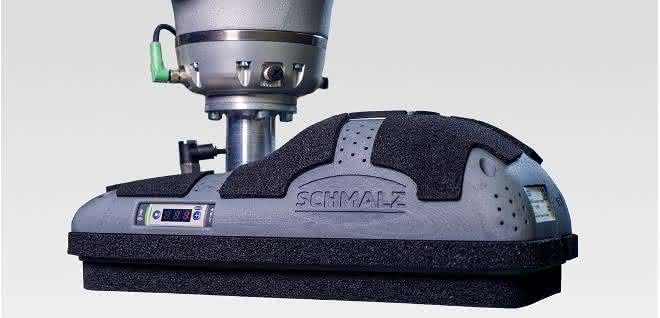
The cobot gripper is designed for numerous applications in intralogistics such as end-of-line packaging or pick & place applications. With flexible foam as a gripping surface, it can securely hold cardboard packaging, boxes and components with structures, recesses and three-dimensional external shapes weighing up to eight kilograms. It can also be easily integrated into automation environments thanks to its communication technology.
Collaborative robots pose new challenges for their system components: they must be lightweight because they often have lower payloads and must not pose a danger to humans. Schmalz has already taken this into account when designing the new cobot gripper. By increasing the contact surface and reducing the impact forces, it complies with ISO TS 15066 - a standard for cooperation between humans and collaborative industrial robots. Additive manufacturing processes allow a weight-optimized and dynamic geometry of the Schmalz gripper. This enables it to be connected to small robots with low payloads.
The gripper has a modular design so that it can be supplemented with energy-saving ejector modules or intelligent vacuum switches for process monitoring, for example. Different applications can be implemented with one and the same gripper, and partial configuration is also possible. The vacuum can be generated both internally and externally - depending on the conditions at the user's site.
In general, flexible and plug-and-play solutions such as the Cobot gripper from Schmalz are becoming increasingly important. Even unskilled people should be able to install the components quickly and easily in order to grip products that have often not been defined more precisely in advance. One crucial aspect is the issue of safety, because the boundaries between manual work and robots are becoming increasingly blurred. as


You might also be interested in
Hamburg Regional Court issues preliminary injunction against Elite Robots Germany
In the copyright dispute between Teradyne Robotics and Elite Robots Germany, the Hamburg Regional Court has issued an interim injunction. The distribution of the software and products concerned is prohibited, and there is also a comprehensive...
 read more...
Schunk founds tech spin-off for humanoid robot hands
Schunk is bundling its activities in humanoid robotics by founding its own spin-off at the beginning of January. The aim of the new company is to develop modular humanoid robot hands for industrial applications.
read more...Partnership for humanoid robotics
Schaeffler and Neura Robotics jointly develop humanoids
Schaeffler and Neura Robotics will work together in the future to develop and supply key components for humanoid robots. The systems will also be integrated into Schaeffler's global production network.
read more...Yaskawa at the Automatica 2025
AI meets robotics
At this year's Automatica, everything at Yaskawa revolves around AI-based robotics solutions for the smart factory and beyond. As a trade fair highlight, the manufacturer is presenting its new Motoman Next product concept.
read more...Kassow Robots at the Automatica
7-axle vehicle in action
At Automatica, Kassow Robots will be presenting a wide range of industrial applications for production and logistics tasks that provide new impetus for efficiency and flexibility in industrial automation.
read more...Robotics and automation in six exhibition halls
From June 24 to 27, 2025, Automatica, the trade fair for intelligent automation and robotics, will bring industry and research together in six exhibition halls. Preparations are in full swing.
read more...Interview with Jörg Rommelfanger
Robotics in 25 years
The annual IFR report shows that the number of industrial robots is steadily increasing worldwide. They have already played an important role in ABB's portfolio for decades. In an interview with INDUSTRIAL Production, Jörg Rommelfanger, Head of...
read more...Reliable end effector for cobots
Collaborative robots are now widely used for a wide range of handling tasks. SMC offers three versions of the RMH pneumatic gripper for this purpose; it is compatible with cobots from a total of twelve companies.
read more...7-axis cobots with controller in robot base
With the Edge Edition, Kassow Robots has launched the world's first 7-axis cobots with a controller integrated into the robot base.
read more...