
Robot-guided palletizing systems
Perfect interaction
Robot-guided palletizing systems are one way of making machine tools more flexible. They minimize downtimes in the production of individual parts and enable unmanned production in three-shift operation. The interaction of the gripping system and clamping technology components is important here.

The growing variety of sizes and product variants as well as increasing cost pressure increasingly require automated process design in production. What used to apply only to large quantities, namely maximizing lead times while minimizing personnel costs, is now also possible for small batch sizes. In this context, robots in particular are seen as a flexible way of increasing efficiency, provided that their peripherals are adapted to the respective requirements.
There are two basic variants of automated machine loading:
For large series and long machining times, the workpieces are changed directly into stationary clamping devices such as power-operated multi-jaw chucks or power chucks, for example into the compact, high-performance Schunk tandem plus power clamping blocks.
For medium and small series, on the other hand, automated clamping device changing is becoming increasingly popular. Here, the complete clamping devices, including the previously manually clamped workpieces, are handled on workpiece carrier pallets. In this context, robot-supported palletizing systems enable fast, flexible and at the same time process-stable clamping device changes. For this purpose, the workpieces and clamping fixtures are set up on the pallets, stored and successively changed from the pallet magazine to the machining center by robot. The central element in the machine is a zero-point clamping system, with the help of which the workpiece carrier pallets are fixed, positioned and clamped on the machine table with fully automatic reference accuracy. The actual set-up process takes place parallel to machining time and therefore economically outside the machine.
Automated cleaning of the interfaces
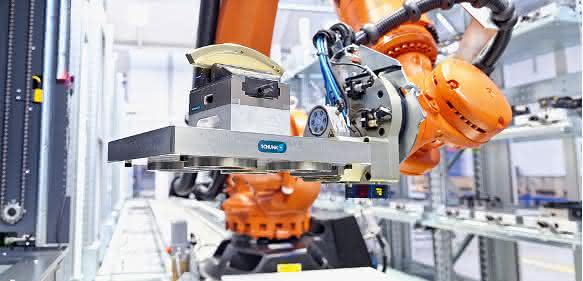
The individual pallets are each equipped with an interface to the zero-point clamping system on the underside, via which they are connected to the machine. Special components, such as the Vero-S NSA plus palletizing module, were developed specifically for robot-assisted machine loading. They are extremely flat, can be integrated directly into the machine table and leave plenty of space in the machine room for the workpiece and axis movements.
With the help of a patented rapid and clamping stroke, they achieve pull-in forces of up to 20,000 newtons and holding forces of over 100,000 newtons. The robust modules ensure a precise hold even during demanding volume machining. To prevent chips and dirt from jeopardizing the process when changing pallets, a forced air flow cleans the flat surfaces and the short taper. This ensures that the pallet is flattened without chips. Insertion radii on the clamping module enable fast and reliable joining even if the pallet is offset in the middle or slightly inclined. In this way, tolerances of the handling system can be optimally compensated. Centring rings then ensure accurate positioning before clamping slides ensure positive, self-locking clamping with a repeat accuracy of < 0.005 millimetres.
Excavation bolts facilitate removal
After processing, a lifting pin lifts the pallet by up to five millimetres to change the workpiece, simplifying the changeover process. All process steps, i.e. the "module open", "module closed" and "pallet present" states, are monitored via a dynamic pressure monitor. Unlike other clamping systems, the Vero-S NSA plus palletizing module does not consume any energy during processing.
The workpieces remain securely clamped even if the pressure in the air system suddenly drops. A pneumatic system pressure of six bar is sufficient to open the modules. This saves on expensive hydraulic systems and complex piping. To ensure a long service life, all functional parts such as the base body, clamping slide and clamping rings are made of hardened stainless steel and are therefore absolutely corrosion-resistant.
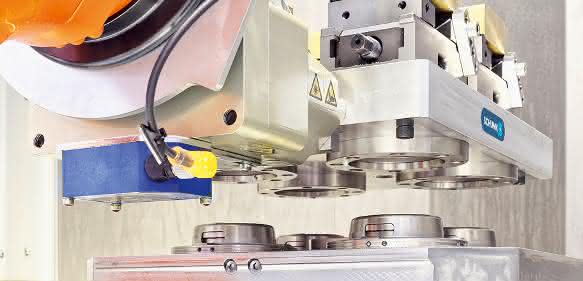
To ensure process-stable pallet changing in fully automated operation, the use of special handling modules such as the slim, lightweight Vero-S NSR coupling with minimized interfering contours is recommended. This can also be used in confined spaces and enables pallets to be loaded extremely close to the machine table. It can be used to create particularly low superstructures consisting of a clamping station and pallet. With a dead weight of just 1,600 grams (NSR 160), the module allows a high torque absorption of up to 1,600 Newton meters (Mz) or 600 Newton meters (Mx).
There is also the Vero-S NSR mini miniature clutch with a robot-friendly weight of just 400 grams (Mx maximum 75 Newton meters, Mz maximum 200 Newton meters) and, at the other end of the weight scale, the Vero-S NSR maxi heavy-duty robot clutch for heavy pallets and clamping towers (Mx maximum 4,000 Newton meters, My maximum 4,000 Newton meters). The couplings are completely sealed against chips and cooling lubricants to ensure reliable operation in demanding environments. In addition, a standard cleaning function ensures chip-free flat contact between the pallet and the robot coupling. Steel inlays at the contact points make the couplings extremely wear-resistant.
The clamping pallets can be equipped with various clamping devices from Schunk's modular system for stationary workpiece clamping. For example, the manually operated Kontec KSC basic clamps are efficient all-rounders for raw and finished part machining on pallet systems. They combine high clamping forces, convenient operation and short set-up times. Even with a comparatively low torque, they achieve high clamping forces of up to 50 kilonewtons (size 160), so that a separate embossing station can be completely dispensed with for positive clamping.
As the clamping is tensile, the bending load on the base body and thus the rearing of the clamps is minimized, which benefits the accuracy and rigidity of the clamping. A preloaded center bearing without spindle backlash and specially fitted sliders ensure excellent repeat accuracy of plus/minus 0.015 millimeters. The fully encapsulated drive and an integrated chip drain ensure particularly high process stability and minimal wear.
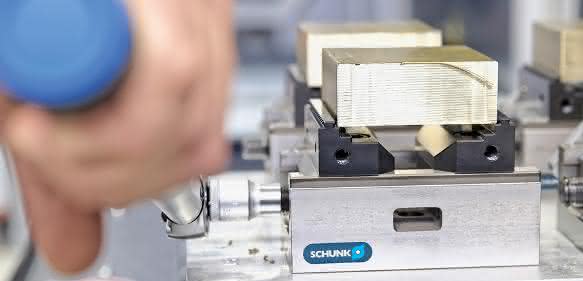
The basic clamps are available as centric clamps or as single clamps with fixed jaws. With quick adjustment of the clamping range, a flat design and low weight, they offer perfect conditions for unmanned workpiece handling. If several workpieces are to be clamped next to each other in a confined space, Kontec multiple clamps are the ideal solution. A single clamping key is all that is needed to clamp the parts, remove the clamping jaws completely with a quick change or quickly and flexibly convert the clamping system to other workpieces.
Spring-loaded tandem clamping force blocks, on the other hand, enable particularly compact setups. Rota-S-plus-2.0 three-jaw chucks can be used to clamp cylindrical parts. Clamping towers with interfaces to the Vero-S zero-point clamping system can now also be handled by robots. as


You might also be interested in
Friction stir welding as a key technology for future industrial joining solutions?
At the DMG MORI in-house exhibition, Hufschmied Zerspanungssysteme presented friction stir welding with process-optimized tools and series production potential for the industry.
 read more...
Tox Pressotechnik at the Blechexpo
Connecting sheet metal and electrically conductive components safely
Joining sheets of different thicknesses easily and reliably without additional elements - Tox Pressotechnik will be demonstrating how this can be achieved at Blechexpo with its clinching and eClinch technology.
read more...Production, machine tools and robots
High-precision welding for perfect sawing
Stihl uses Nimak's portal projection welding systems to manufacture guide rails for chainsaws.
read more...Tox servo press for clean room
The coast is clear here now
In sensitive sectors such as medical technology, the optical industry or electronics, cleanroom-compatible components are required for all processes. This also includes drives. With the servo presses from the Electricdrive Core series, Tox...
read more...Air purity class 5 according to ISO achieved
Tox has servo press certified for the cleanroom
In sensitive sectors such as medical technology, the optical industry or electronics, cleanroom-compatible components are required for all processes. This also includes drives. With the servo presses from the Electricdrive Core series, Tox...
read more...Manufacture of metal bellows couplings
Joining instead of gluing
When manufacturing metal bellows couplings, the connections between the bellows and hub are a critical point. The flared press-fit process can be used here.
read more...ArtiMinds presents automation solutions at automatica
ArtiMinds Robotics is presenting automation solutions from the field of advanced robotics at Automatica in Munich. The applications were programmed using the in-house software solutions ArtiMinds Robot Programming Suite (RPS) and ArtiMinds Learning...
read more...Plug-and-produce with smart subsystem
The mechanical engineering company KMS Automation standardizes pressing and joining applications with the Smart Function Kit from Bosch Rexroth. The mechatronic subsystem simplifies machine design, increases process quality and shortens...
read more...Integrated ERP system for watertight processes
Rubber-based seals are used in window frames and escalators. They are also a must in tunnel projects to prevent water damage. Sealable, a specialist in sealing and insulation solutions, relies on an ERP system from Pro Alpha, which covers everything...
read more...