
Vision system for robots
Pick & place to make yourself
With Eligopart, Attentra has developed a camera system with an autonomous setup assistant that makes it easy to implement pick & place applications without expert knowledge.
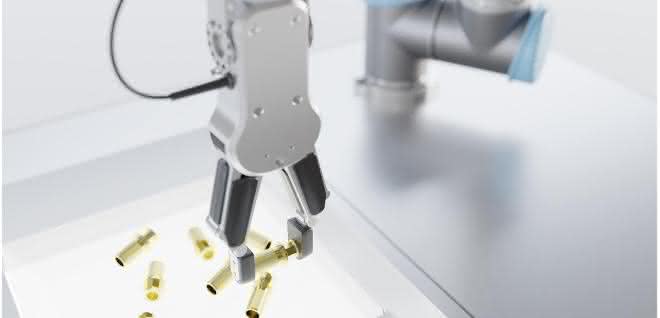
When planning automation solutions, the same question comes up again and again: How do the parts actually get into the machine at the start of the production chain? In many production facilities, this question is answered with the use of classic conveyor systems such as spiral conveyors, inclined conveyors or complex conveyor belt arrangements. These are usually designed and manufactured for specific products. If changes are made to the components, the machine has to be modified, which is time-consuming and costly.
More flexible approaches are required for feeding systems in modern production facilities with a wide variety of parts and small batch sizes. Feeding solutions must be developed that can process components with different shapes, materials or weights.
Robot vision applications
A key technology for such flexible feeding solutions is image processing with its ability to reliably detect the position of components. In combination with industrial robots, modern robot vision applications for flexible production can be realized. Attentra from Tübingen has developed the Robot Vision Center image processing solution for this purpose and has already used it in many projects.
This software makes it possible to identify and handle objects and even complex assemblies. According to the manufacturer, it combines the ability of image processing to precisely recognize objects with the flexibility of an industrial robot. It can also be connected to almost all control and production systems.
As a consistent further development, Attentra is launching a standardized complete package for pick & place, which is intended to make people's work easier and increase the quality of production. The primary goal in the development of Eligopart was to radically simplify a complex technology and make it accessible to a large target group.
Flexible feeding solution
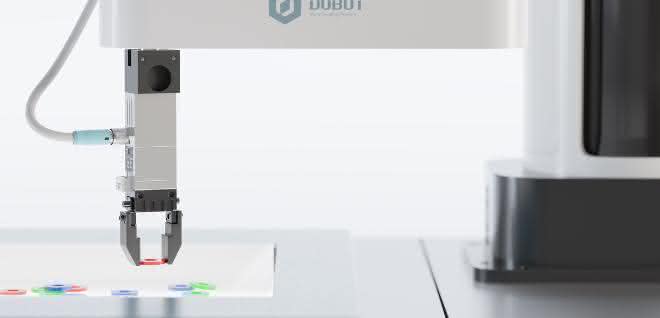
With Eligopart, Attentra provides a system that enables flexible feeding solutions to be implemented quickly and cost-effectively. This is achieved by the simple, fast and automatic camera and component set-up and the automatic hand-eye calibration of camera and robot. With Eligopart, hurdles for the use and setup of image processing and robotics in pick & place applications can be minimized. No additional training in image processing and robotics is required, no additional purchase of image processing and robotics services is necessary and new components can be set up and managed by the user himself.
The pick & place task itself on the one hand and ensuring easy handling and configuration on the other require an intelligent combination of hardware and software. This is why Eligopart contains a camera, a controller with the Robot Vision Center software as a control system and a setup wizard. This allows even complex tasks such as the translation of image coordinates to world coordinates and the conversion of camera coordinates to robot coordinates during hand-eye calibration to be implemented. The setup wizard enables the configuration of the camera, robot and gripper as well as the automatic recognition of components.
In order to exploit the full potential of a flexible feeding solution, the highest possible precision must be obtained from the image processing. Eligopart achieves this with the standardized and highly accurate calibration tool, among other things. This fits every industrial robot and is also included in the scope of delivery. The robot programs required for the supported robots from Stäubli, Universal Robots, Epson and Dobot are included so that the user can get started immediately. These allow the respective robot to be set up and operated immediately in combination with Eligopart.
Attentra's web monitor can be used to monitor component detection at any time - both during setup and in live operation. Any commercially available notebook or mobile device is suitable for this purpose: it simply needs to be connected and the corresponding web address called up in the browser. as
Hall 7, Stand 7409


You might also be interested in
Basler acquires 76% of Indian image processor
Basler, supplier of image processing components for computer vision solutions, has acquired 76% of the Indian sales partner Alpha TechSys Automation.
 read more...
Process monitoring and fault detection
Cameras ensure quality during laser melting
Powder bed-based laser melting (PBF-LB/M) opens up new possibilities in additive manufacturing. Modern camera systems provide crucial process data to further increase quality and efficiency.
read more...Vision Sensor is three times faster than its predecessor
The 'CS-62' vision sensor from di-soric is around three times faster than its predecessor, the 'CS-60'. In combination with the 'nVision-i 25.1' software, it enables image processing solutions that were previously reserved for smart cameras.
read more...Thermal imaging cameras for quality control
Automated thermal imaging cameras are often suitable for quality control applications where temperature plays a role. However, while there are various solutions on the market for slow processes, it is challenging to select a camera that reliably...
read more...Easy entry into industrial VGA thermography
Reliable temperature measurement is a prerequisite for the success of many industrial processes. Berlin-based manufacturer Optris presents the Xi 640 infrared camera, a new member of its Compact Line, which enables non-contact temperature...
read more...Powder bed-based laser melting optimized
Aconity3D has set itself the goal of optimizing the stability of the manufacturing method of powder bed-based laser melting and thereby promoting its use in a wide range of industries. By using high-speed industrial cameras from SVS-Vistek, the...
read more...INDUSTRIAL Production Products of the year...
2nd place, category handling, assembly and production logistics: SICK
safeVisionary2 is the first 3D time-of-flight camera with Performance Level c safety certification. It enables safe three-dimensional environmental detection and won 2nd place in the competition for Product of the Year 2024 in the handling, assembly...
read more...Nomination Products of the Year 2024
SICK: Camera systems safeVisionary2
safeVisionary2 is the first 3D time-of-flight camera with Performance Level c safety certification. It enables safe three-dimensional environmental detection and has been nominated in the 2024 Product of the Year competition in the handling,...
read more...AI vision brings additional opportunities
The seamless integration of AI into the consumer sector has helped to improve our quality of life and make interactions with technology more efficient. In industry, AI vision with machine learning opens up new possibilities that are not covered by...
read more...