

Direct drives
Pick & place as fast as lightning
Machine manufacturer Paro has developed a pick & place system that works with electric direct drives. It is more efficient and requires less assembly and maintenance than systems with pneumatic or cam drives.
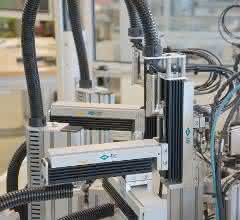
"The usual cycle time required for assembly systems has almost halved in just a few years and is now approaching one second," says Gregory Kyd, Technical Director at Paro. "Correspondingly fast pick & place solutions can still be realized with pneumatics or cams. However, direct drives are much more efficient, space-saving and flexible, as our Paro-Blitz shows."
The Blitz is a compact pick & place system consisting of a horizontally and vertically arranged linear motor that moves a maximum load of five kilograms and achieves up to 60 cycles per minute, depending on the required stroke and dynamics. A simple mounting option (dovetail fixing) ensures quick and precise adaptation of grippers and other handling units. Positions can be approached with a repeat accuracy of plus/minus 0.05 millimetres thanks to fine adjustment on the fixing and the precision of the linear drives.
More flexible thanks to direct drive technology
One of the advantages over pneumatically driven pick & place systems is the greater flexibility that the Blitz owes to its direct drive technology. As the movements are generated and controlled purely electrically, the machine operator can be provided with functions on the human-machine interface that allow him to call up and start previously programmed movement sequences at the touch of a button. This also makes it easy to implement variant production.
If the movement or position of the pneumatic cylinder is to be monitored or used as a command or control variable, separate sensors must be taken into account. In contrast, the measuring system is already integrated in linear motors so that the servo controller can provide data such as stroke or force values for each pick & place operation for further use. This data can be used, for example, to automatically compensate for temperature-dependent changes in the mechanical components of the pick & place system.
As a linear motor is contactless and therefore maintenance-free, maintenance work is reduced to a minimum. Even the guide rails, which are integrated to support the linear movement, do not need to be relubricated. And even if a flash needs to be replaced at some point, this is quicker than with a pneumatic system with its many compressed air hoses or a cam disk system with its mechanical couplings. In addition, a direct drive only requires one electric cable. This has advantages in terms of installation and space requirements.
Variants for strokes from 50 to 190 millimetres
The fact that the engineers at Paro were able to design the Blitz so compactly is also largely due to the fact that the special machine and plant manufacturer opted for linear motor components from Linmot. According to the company's Technical Director, Linmot was quickly shortlisted because of the space-saving design of its solutions. Linmot also offers a wide range of products, including a variety of different sliders and stators as well as complete linear motors with matching controllers and "magnetic springs" (Magspring) for weight compensation as well as linear-rotary motors. Based on this range, Paro has developed several variants of the Blitz for strokes from 50 to 190 millimeters.
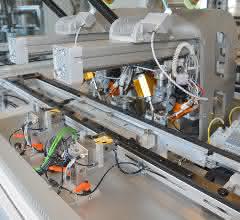
In a current system for the assembly of an electronic module for a building services application in 31 assembly, processing and testing stations, the number of installed flashes adds up to 30. There are also three linear motor axes for other positioning tasks. The system is controlled via 33 Linmot servo controllers with a Profinet interface. The system consists of a total of three assembly cells, each with a footprint of two by two meters, which are linked via the Paromat double belt transfer system.
The most demanding task, which also forms the core process of the system and which is performed by a flash in the assembly line, is gripping and positioning the two connection lugs of a sensor with which the PCB of the assembly has to be fitted. The position of the 0.2 millimeter thin connecting wires is recorded by an image processing system. From this, a three-dimensional movement of the flash and the gantry on which it is placed is calculated individually for each wire and sensor to capture the wires. The wire is captured with a gripper, guided to the circuit board and soldered there. "This would simply not have been possible with pneumatic or cam-based pick & place solutions, as they do not support precise, numerical positioning," adds Gregory Kyd. "In addition, the required cycle time could not be met."
Other examples of the pick & place module carry out assembly steps such as inserting an LCD display, a rubber contact strip, the circuit board into a housing base, a battery, a safety seal and the positioning of components in test stations distributed throughout the system. In addition, fast feeders, which are based on the principle of flashes, perform the task of quick workpiece carrier changeover. This allows the workpiece carrier to be pulled from the double-belt conveyor into a soldering station in a fraction of a second or to skip a station in order to extend the available processing time or to meet the required cycle time. A further linear motor provides the necessary dynamics when stacking and destacking the finished assemblies. A Magspring component compensates for the weight of the vertically installed axis and guarantees a safe position in the event of a machine stop. F. J. Roßmann/as
Hall 3, Stand 3411


You might also be interested in
E-scooter with customizable damping
The startup Scuddy has significantly improved the flexibility, performance, customizability and ergonomics of its second-generation foldable e-scooter of the same name - thanks in part to damping technology from ACE.
 read more...
Hurdles on the road to success
Welding is one of the most complicated processes in the manufacturing process, and it is becoming increasingly difficult to find suitable personnel. Can this problem be solved by automating processes? Can or should the robot colleague replace the...
read more...New plug-and-play solutions for the warehouse
Exotec announces a new Skypath conveyor system, the optimized Skypicker picking robot and Deepsky, another proprietary storage software. All three products can be seamlessly integrated into the manufacturer's Skypod system.
read more...Production automation
At Motek, Weiss will be presenting solutions for the linear and rotary movement of workpieces that can be easily integrated into the overall system of hardware and software.
read more...Solutions for surface hardening
Many industrially used components require a combination of a tough core and a hard surface layer so that they can better withstand the stresses of use. Hardening is achieved by rapidly heating the surface and then cooling it quickly.
read more...Wheel bearings and wheel bearing sets
Low-friction rolling behavior
Hecht Kugellager offers a wide range of bearing technology for use in the automotive industry, commercial vehicles and mobile machinery.
read more...Simulation in product development
The Munich-based start-up Spyra significantly shortens the development time of its production by using Solidworks simulation solutions.
read more...Doubling production capacity by 2026
Nabtesco is investing in a third production site, doubling its production capacity to two million precision gearboxes per year by 2026.
read more...Counterbalance trucks with lithium-ion technology
Clark has relaunched the GEX and GTX series.
read more...