
Vacuum technology
Painting doors with vacuum area grippers
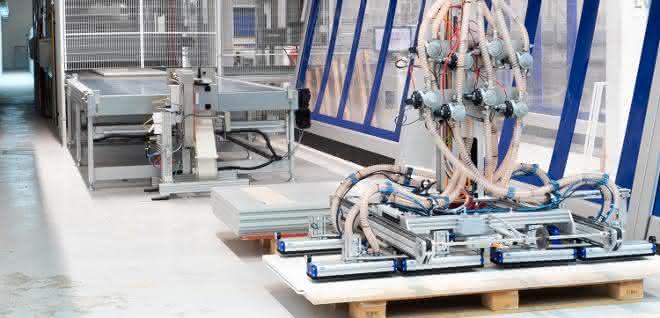
The Swiss company Riwag Türen has put a new spray painting system into operation. The FMP area gripping system from Schmalz ensures that the doors are handled reliably and reduces process costs.
Founded in 1943, the Rickenbach and Wiget joinery initially specialized in veneer work. The first front door was produced in the mid-1970s - the foundation stone for the company's later success was laid. A series of expansions followed and the portfolio was continuously expanded. Riwag has been family-run in the third generation since 2014. The company acts as a reliable partner that supports its customers from planning to door installation. External and internal doors, wood-metal door fronts, fire, smoke protection and sound insulation doors as well as frames and glazed partition walls are produced in Arth in the canton of Schwyz.
Riwag employs 75 people and has over 100 approvals for the various types of protection (fire protection, burglary protection). The door systems are tested and certified for various properties. Central data provision takes place in the work preparation department using RIWAG's own PPS system. This data is used to run the doors through all production stages (quantity 1 production). One challenge is the large number of variants, which is why the Swiss company is constantly striving to further automate processes.
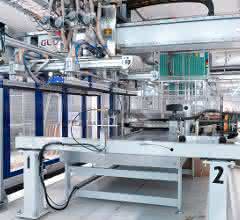
There was a need for action when it came to sanding and painting the doors. This had previously been done manually, with an external painting company carrying out the work. "We were looking for a way to automate these steps and commissioned the system builders R. Wick and Robert Bürkle to design a system according to our ideas," explains Remo Albisser, Project Manager Machines at Riwag.
Schmalz supplies the vacuum technology
The doors were to be handled using vacuum technology. Schmalz has enjoyed a good reputation at Riwag for many years. The vacuum expert's components are used in various machines and work to the satisfaction of the Swiss company. "Schmalz is now the supplier for all vacuum technology in the company," says Albisser. The sealing foam of the gripper is silicone-free and therefore fulfills a key requirement of the door specialists. It is also important for RIWAG to keep the number of suppliers to a minimum in order to maintain uniformity and simplify communication. Accordingly, the project partners quickly reached an agreement and the specialists from Schmalz in Switzerland designed the system on the basis of the FMP flat grippers.
Energy used efficiently
Schmalz has developed this as a universal gripper for handling workpieces regardless of size and geometry, material and surface. Tests have shown that the FMP series generates an average 86 percent higher suction force than comparable grippers on the market. Riwag uses 16 FMP grippers including valves and corresponding spring plungers. Thanks to flow optimization, the energy used is utilized efficiently, which reduces operating costs in the long term.
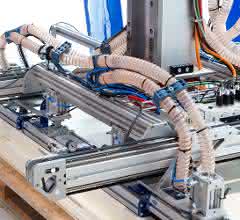
Because Riwag produces doors in different variants with different dimensions, the vacuum technology also had to be designed flexibly: Instead of a few large suction points, many small ones work on the gripper. This enables the gripper to reliably grip the different geometries. The valves only switch the vacuum as required at the required points. This makes the solution particularly energy-efficient.
Productivity increased
The doors are delivered to the system on pallets and measured there. The gripper system then lifts them into the machine, where they are sanded, painted, dried, labeled and sorted. Another gripper returns the doors to the pallets at the end of the system. The decision to automate this processing using vacuum technology has paid off. "Door handling is absolutely reliable. This enables us to process the workpieces in a structured manner and to achieve a continuous weekly output. We have become more productive as a result," explains Remo Albisser.
Thanks to the automation solution, Riwag now uses fewer solvents and paints, which has reduced process costs and protected the environment. The employees also get on well with the system. Initially, they had to get used to working with vacuum technology. "After a test phase, confidence in Schmalz is very high on all sides," says Albisser. as


You might also be interested in
Soft grippers for delicate foods
Irregularly shaped, fragile, and varying in size and weight: products such as potatoes, baked goods, and dairy products push mechanical grippers to their limits.
 read more...
Development Collaboration for Humanoid Robotic Hands Launched
Schunk is entering into a new development partnership with Robert Bosch Robotics. Their shared goal is to develop an industrial-grade robotic hand that can be integrated into various humanoid robot systems.
read more...Robot-controlled packaging of rolls
Koch Robotersysteme, a company specializing in the integration of robotic systems, has developed a complete, automated packaging line for packaging rolls based on Tentoma’s RoRo StretchPack packaging machine.
read more...Robotics and autonomous order picking
Locus Robotics acquires Nexera Robotics and expands autonomous warehouse logistics
Locus Robotics takes over Nexera Robotics and may have taken a decisive step towards truly universal warehouse automation. A new gripping technology should now make possible what was previously considered difficult to automate.
read more...Gentle wheel handling
The newly founded Eisenmann Robotics division develops new robotics concepts to increase the level of automation in modern production facilities.
read more...Gripping systems and vacuum generators
Schmalz is presenting new gripping systems and vacuum generators at Automatica. Exoskeletons, which allow employees to move heavy workpieces effortlessly, will also be on display.
read more...Smart universal gripper for power electronics
The power electronics manufacturer Semikron Danfoss uses the EGU 50 mechatronic parallel gripper from Schunk in a robotic cell. It handles different components and feeds them to a measuring line. With its functionalities, it meets all requirements...
read more...Schmalz takes over finger gripper from Soft Robotics
The vacuum specialist Schmalz is expanding its gripper portfolio and acquiring the mGrip product family from the US company Soft Robotics (SRI), including all finger gripper configurations, patents and the associated know-how.
read more...Soldering with special gripper
In order to make the mini wave soldering of large panels stable and reproducible, Eutect developed a special gripper that prevents the panel from bending, among other things.
read more...