
Gripping systems
How skillful hands change gripping
The human hand is considered the benchmark when it comes to the flexibility of gripping tools. In service and assistance robotics in particular, humanoid manipulators that enable a wide range of gripping variants will be increasingly in demand in the future. The cost-effectiveness factor is also becoming increasingly important.
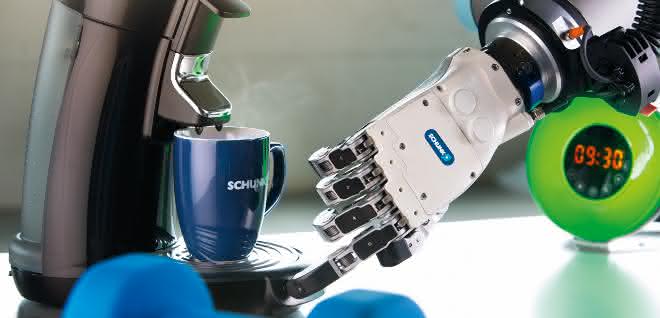
While grippers for industrial automation have so far been designed primarily for robustness, durability and performance, the focus with gripper hands is on the aspect of flexibility of movement. The closer humans and robots work together, the greater the relevance of humanoid five-fingered hands. "In extreme cases, humans and service robots will share one and the same workplace, including all tools and aids," says Dr. Martin May, Head of Research/Advanced Technologies at Schunk, with conviction.
For this reason, Schunk had the SVH five-finger hand certified by the DGUV for collaborative operation back in 2017 as the world's first gripper. With the help of a total of nine drives, its five fingers can perform different gripping operations. In addition, numerous gestures can be displayed, which facilitates visual communication between humans and service robots and can also increase acceptance for use in a human environment.
Desksharing with the robot
"In our research projects, we found that the human hand is much more than a highly flexible instrument for manipulation. In contrast to industrial grippers, users always associate emotional aspects with humanoid gripping hands," explains May. "Gripper hands are always in demand when a robot needs to imitate human behavior."
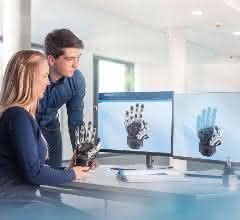
This applies to manipulation as well as gestures. Schunk's research projects focus primarily on household-related applications of service robotics as well as assembly-related applications of industrial assistance robotics. "Gripping hands make sense wherever an activity environment is designed for humans to be supported by a robot, for example in the kitchen at home, but also at industrial assembly workstations or in order picking and logistics applications."
Different variants
The company has different gripper hands in its portfolio to suit the respective application, ranging from a two-finger hand for service robotics that is reduced to the basic functions of gripping to the industrial three-finger hand SDH and the complex SVH five-finger hand. The latest model, the SIH, also has five human-like fingers, but differs fundamentally from the SVH in terms of drive and kinematics.
While the SVH, which is driven by nine motors, fulfills the typical aspects of a precisely working robotic hand, the SIH, which is equipped with five motors and operated by cable pulls, is more closely based on its human model with its tendons and muscles. Three of its fingers can be moved independently of each other, while the two smallest can be moved together as a team. According to Schunk, this makes the SIH more flexible to use than other gripping hands with cable pull mechanisms on the market, and it is also more robust and attractively priced. According to Martin May, the latter aspect in particular was a key requirement in the research project, as service robotics applications in the domestic environment in particular require strict cost management if they are to be successful on the market.
Autonomous gripping
In its Smart Labs, Schunk is devoting itself to the gripping process as a whole and is looking for ways to complete handling tasks autonomously. The complex programming of the robot, which has so far been carried out manually by the user or integrator, is to be replaced in future by a learning, autonomous component network.
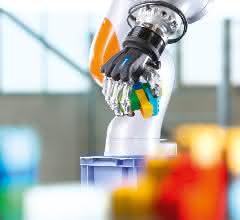
Instead of individually defining positions, speeds and gripping forces step by step, intelligent gripping systems will in future detect their target objects via cameras and take over the gripping planning independently. Based on data sets and algorithms, gripping systems will be able to recognize regularities and derive appropriate reactions. Researchers are also working on algorithms to classify different geometries and arrangements and develop optimal gripping strategies. The aim is to enable gripping systems to handle parts independently and to continually refine the underlying gripping processes.
Independent evaluation of gripping quality
The greater the variance of the parts to be gripped and the more complex the task, the more likely it is that gripper hands will be used. Using appropriate sensors in the gripper fingers, the motor current and intelligence integrated into the gripper hand, it should be possible to record and evaluate the quality of a grip and readjust it if necessary. In addition, object characteristics such as geometry, size or flexibility can be recorded via the gripper alone and transmitted to higher-level systems or upstream or downstream stations.
"With the help of artificial intelligence methods, it will also be possible to train service and assistance robots intuitively and to create and enrich individual libraries for gripping planning," Martin May is convinced. "Flexible gripping hands in particular will no longer be used only for repetitive tasks, but will be able to continuously adapt to new objects and contexts and constantly optimize their gripping strategies." as


You might also be interested in
Basler acquires 76% of Indian image processor
Basler, supplier of image processing components for computer vision solutions, has acquired 76% of the Indian sales partner Alpha TechSys Automation.
 read more...
Process monitoring and fault detection
Cameras ensure quality during laser melting
Powder bed-based laser melting (PBF-LB/M) opens up new possibilities in additive manufacturing. Modern camera systems provide crucial process data to further increase quality and efficiency.
read more...Vision Sensor is three times faster than its predecessor
The 'CS-62' vision sensor from di-soric is around three times faster than its predecessor, the 'CS-60'. In combination with the 'nVision-i 25.1' software, it enables image processing solutions that were previously reserved for smart cameras.
read more...Thermal imaging cameras for quality control
Automated thermal imaging cameras are often suitable for quality control applications where temperature plays a role. However, while there are various solutions on the market for slow processes, it is challenging to select a camera that reliably...
read more...Easy entry into industrial VGA thermography
Reliable temperature measurement is a prerequisite for the success of many industrial processes. Berlin-based manufacturer Optris presents the Xi 640 infrared camera, a new member of its Compact Line, which enables non-contact temperature...
read more...Powder bed-based laser melting optimized
Aconity3D has set itself the goal of optimizing the stability of the manufacturing method of powder bed-based laser melting and thereby promoting its use in a wide range of industries. By using high-speed industrial cameras from SVS-Vistek, the...
read more...INDUSTRIAL Production Products of the year...
2nd place, category handling, assembly and production logistics: SICK
safeVisionary2 is the first 3D time-of-flight camera with Performance Level c safety certification. It enables safe three-dimensional environmental detection and won 2nd place in the competition for Product of the Year 2024 in the handling, assembly...
read more...Nomination Products of the Year 2024
SICK: Camera systems safeVisionary2
safeVisionary2 is the first 3D time-of-flight camera with Performance Level c safety certification. It enables safe three-dimensional environmental detection and has been nominated in the 2024 Product of the Year competition in the handling,...
read more...AI vision brings additional opportunities
The seamless integration of AI into the consumer sector has helped to improve our quality of life and make interactions with technology more efficient. In industry, AI vision with machine learning opens up new possibilities that are not covered by...
read more...