
Mobile robotics
Handling technology brought to life
The Chemnitz Training and Application Center (SchAz for short) makes human-robot collaboration tangible with demonstrators. The Zimmer Group provides support with gripper technology.
There is a wide range of solutions in the fields of automation, robotics and handling technology. Developments in the automation of small batches - down to batch size 1 - are currently particularly innovative and promising. Mobile robotic systems and human-robot collaboration could become part of the development solution here. Unfortunately, such approaches are not so easy to implement, as the research and development costs involved are still immensely high. However, at the Chemnitz Training and Application Center (SchAz for short) of the Chemnitz Institute of Mechanical and Plant Engineering (ICM), appropriate demonstrators are available for viewing and further investigations. These make it possible to test the latest technologies and check the potential applications for your own company. The automation and handling specialist Zimmer Group, a long-standing partner of the ICM, is on hand to help the experts at the institute and ICM GmbH with all gripping-related issues.
The training and application center concentrates on three main areas with regard to the extensive subject matter. In addition to automation for batch size 1, the Chemnitz-based company focuses primarily on mobile robotics and human-robot collaboration. The latter two focal points will be discussed in more detail here.
Mobile robotics
Traditional industrial robots are installed in a fixed position - but increasing system flexibility requires mobile robot solutions. In the SchAz, two variants of mobile robotics are compared as examples - a classic industrial robot on a mobile frame (mobile robot) and the combination of an HRC robot with an automated guided vehicle system (mobile HRC robot).
The "mobile robot" consists of a classic 6-axis robot from Kawasaki Robotics, which is mounted on a manually movable frame. It is equipped with a tool changing station and several Zimmer Group GPP5008 and GEP2010 grippers for parts handling as well as an FT sensor for investigating force-controlled processes for further feasibility studies. The mobile robot is designed so that the assembly can also be removed from the cell and used as a stand-alone unit in a different environment.
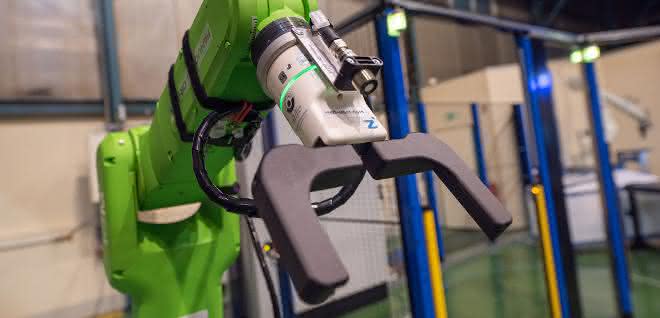
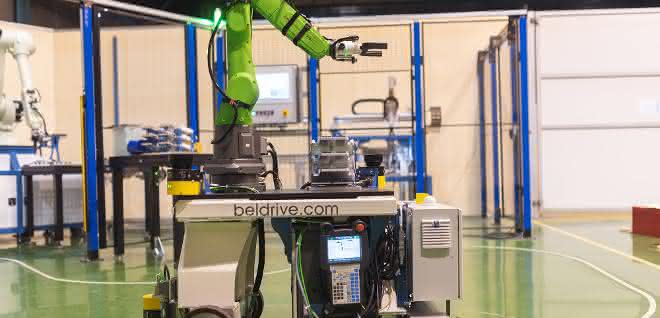
In addition to the sensors, the "mobile HRC robot" demonstrator mainly consists of a collaborative robot CR-7iaL from Fanuc, a track-guided autonomous driverless transport system Beldrive AGV and an HRC gripper HRC-04-072810 from the Zimmer Group. The mobile HRC robot carries out the sub-processes of transporting and handling perforated plates and filling a vibratory bowl feeder at SchAz. The HRC gripper picks up the empty perforated plates, transports them to the robot, picks up the loaded perforated plates and transports them to the manual workstation. A worker then carries out the final assembly of the assembled perforated panels in a collaborative process with the robot.
Human-robot collaboration in practice
In robotics, the term human-robot collaboration (HRC) refers to cooperation on a component between humans and robots at a shared workstation without separating protective devices. With a view to safety aspects, the SchAz application center examines the various stages of interaction between humans and robots using practical processes - from the classic robot cell to pure collaboration.
The demonstrator here is a system that ICM e.V. has largely designed and assembled itself. A Stäubli robot type TX2-90L with a tactile sensor skin from Airskin, which has a maximum load capacity of 20 kilograms, was placed on the base frame. The sensor skin acts as a kind of air cushion in which the internal pressure is permanently monitored. If the pressure changes, for example in the event of a collision, the system reacts and stops safely. Safety is also a top priority for the gripper. For example, the Zimmer Group's HRC03-072844 electric gripper, specially designed for HRC applications, has no sharp edges and is constructed in such a way that its rounded shape on all sides practically prevents it from accidentally getting caught. This feature, combined with mechanical self-locking of the gripper jaws - the gripper does not lose the workpiece even in the event of an emergency stop or power failure - offers maximum safety in every application. All Zimmer Group HRC grippers meet the high requirements of the safety principles in accordance with ISO/TS 15066 (HRC standard) and are BG/DGUV-certified.
The ICM e.V. HRC system is intended to illustrate the collaborative assembly of a 2-meter measuring tape consisting of three parts (tape, actuator, shell). Two components are pre-assembled by a worker on a mobile work table. Once the assembly has been transferred to the robot, it is visually inspected by the robot using a Balluff camera system. The third component is then inserted into the fixture by the worker. The final collaborative joining process and function test is then carried out by the robot or HRC gripper.
The fact that the Chemnitz training and application center is a resounding success is reflected in the many interested companies and, above all, in the numerous external supporters: "In addition to modern, well-equipped training rooms for developing creative ideas, our application center offers a wide range of automation technologies for researching and experimenting with new solutions. Without the support of technology leaders such as the Zimmer Group from Rheinau, these innovative solutions would not be so impressive," says Marcel Ott, software developer and technical contact for the application center.
Gregor Neumann, Zimmer Group / dsc


You might also be interested in
Basler acquires 76% of Indian image processor
Basler, supplier of image processing components for computer vision solutions, has acquired 76% of the Indian sales partner Alpha TechSys Automation.
 read more...
Process monitoring and fault detection
Cameras ensure quality during laser melting
Powder bed-based laser melting (PBF-LB/M) opens up new possibilities in additive manufacturing. Modern camera systems provide crucial process data to further increase quality and efficiency.
read more...Vision Sensor is three times faster than its predecessor
The 'CS-62' vision sensor from di-soric is around three times faster than its predecessor, the 'CS-60'. In combination with the 'nVision-i 25.1' software, it enables image processing solutions that were previously reserved for smart cameras.
read more...Thermal imaging cameras for quality control
Automated thermal imaging cameras are often suitable for quality control applications where temperature plays a role. However, while there are various solutions on the market for slow processes, it is challenging to select a camera that reliably...
read more...Easy entry into industrial VGA thermography
Reliable temperature measurement is a prerequisite for the success of many industrial processes. Berlin-based manufacturer Optris presents the Xi 640 infrared camera, a new member of its Compact Line, which enables non-contact temperature...
read more...Powder bed-based laser melting optimized
Aconity3D has set itself the goal of optimizing the stability of the manufacturing method of powder bed-based laser melting and thereby promoting its use in a wide range of industries. By using high-speed industrial cameras from SVS-Vistek, the...
read more...INDUSTRIAL Production Products of the year...
2nd place, category handling, assembly and production logistics: SICK
safeVisionary2 is the first 3D time-of-flight camera with Performance Level c safety certification. It enables safe three-dimensional environmental detection and won 2nd place in the competition for Product of the Year 2024 in the handling, assembly...
read more...Nomination Products of the Year 2024
SICK: Camera systems safeVisionary2
safeVisionary2 is the first 3D time-of-flight camera with Performance Level c safety certification. It enables safe three-dimensional environmental detection and has been nominated in the 2024 Product of the Year competition in the handling,...
read more...AI vision brings additional opportunities
The seamless integration of AI into the consumer sector has helped to improve our quality of life and make interactions with technology more efficient. In industry, AI vision with machine learning opens up new possibilities that are not covered by...
read more...