
Handling technology
Gripper teaches itself to grip
Autonomous gripping. While gripping processes have primarily been geared towards high productivity and process reliability to date, flexibility is also coming into focus in conjunction with the smart factory. In the future, grippers will enable flexible operations through to autonomous handling scenarios.
Until now, industrial gripping has been comparatively rigid: The geometry of the parts must be known, as must the exact pick-up and deposit position. A reliable handling process can be guaranteed on the basis of repeatable part feeds using fixed travel paths and the specification of target point coordinates. In the course of digitalization, the trend is now moving towards highly automated, fully networked and autonomous production systems.
In this context, the use of artificial intelligence (AI) is also becoming increasingly important. In conjunction with cameras, the first applications of cognitive intelligence in the gripper environment are already possible, enabling intuitive training by workers and independent completion of gripping tasks by the robot. Schunk is deliberately focusing on a practical, i.e. industry-oriented, design of the handling processes by limiting the number of component variations and thus streamlining the classification and training process.
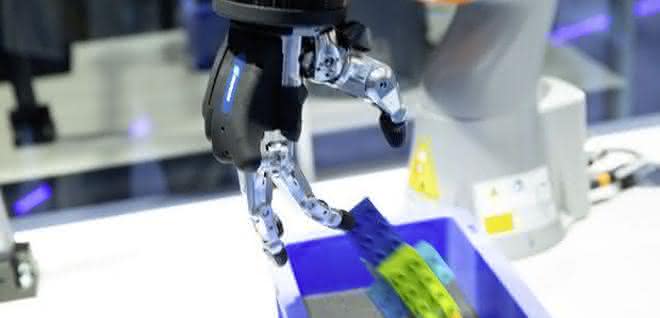
In a first use case, which uses machine learning approaches for workpiece and gripping process classification, pluggable building blocks are combined as required and presented to a lightweight robot in any arrangement on a work surface for removal. In combination with 2D or 3D cameras, the self-learning system achieves a rapid increase in gripping reliability after just a few learning cycles: with every grip, the gripper learns how the workpiece can be successfully picked up and transported.
After just a few training rounds, the network classifies how to deal with the value pool of workpieces and the resulting combination options. In doing so, the gripper relies on learned empirical values on how to pick up and transport the workpiece. The intelligent performance of the algorithm is that future combinations and arrangements of the workpieces can be classified independently after just a short training period. This enables the system to handle parts independently and according to the situation. By continuously adapting the algorithms using AI methods, it is possible to identify previously unrecognized correlations and further refine the handling process. as


You might also be interested in
Basler acquires 76% of Indian image processor
Basler, supplier of image processing components for computer vision solutions, has acquired 76% of the Indian sales partner Alpha TechSys Automation.
 read more...
Process monitoring and fault detection
Cameras ensure quality during laser melting
Powder bed-based laser melting (PBF-LB/M) opens up new possibilities in additive manufacturing. Modern camera systems provide crucial process data to further increase quality and efficiency.
read more...Vision Sensor is three times faster than its predecessor
The 'CS-62' vision sensor from di-soric is around three times faster than its predecessor, the 'CS-60'. In combination with the 'nVision-i 25.1' software, it enables image processing solutions that were previously reserved for smart cameras.
read more...Thermal imaging cameras for quality control
Automated thermal imaging cameras are often suitable for quality control applications where temperature plays a role. However, while there are various solutions on the market for slow processes, it is challenging to select a camera that reliably...
read more...Easy entry into industrial VGA thermography
Reliable temperature measurement is a prerequisite for the success of many industrial processes. Berlin-based manufacturer Optris presents the Xi 640 infrared camera, a new member of its Compact Line, which enables non-contact temperature...
read more...Powder bed-based laser melting optimized
Aconity3D has set itself the goal of optimizing the stability of the manufacturing method of powder bed-based laser melting and thereby promoting its use in a wide range of industries. By using high-speed industrial cameras from SVS-Vistek, the...
read more...INDUSTRIAL Production Products of the year...
2nd place, category handling, assembly and production logistics: SICK
safeVisionary2 is the first 3D time-of-flight camera with Performance Level c safety certification. It enables safe three-dimensional environmental detection and won 2nd place in the competition for Product of the Year 2024 in the handling, assembly...
read more...Nomination Products of the Year 2024
SICK: Camera systems safeVisionary2
safeVisionary2 is the first 3D time-of-flight camera with Performance Level c safety certification. It enables safe three-dimensional environmental detection and has been nominated in the 2024 Product of the Year competition in the handling,...
read more...AI vision brings additional opportunities
The seamless integration of AI into the consumer sector has helped to improve our quality of life and make interactions with technology more efficient. In industry, AI vision with machine learning opens up new possibilities that are not covered by...
read more...