
Collaborative handling system
The rope balancer becomes IoT-capable
With the collaborative rope balancer, Schmalz has developed a new lifting system. It is ergonomically designed, easy to operate and equipped with intelligent functions for controlling and monitoring the handling process and for networking the device.
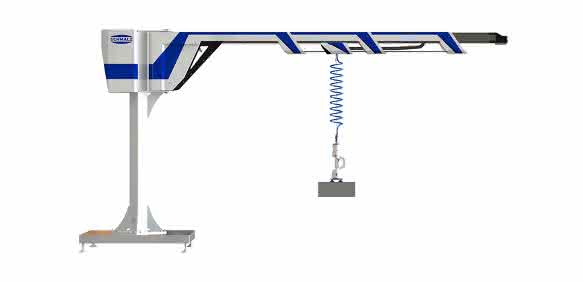
The collaborative rope balancer enables both fast handling and precise positioning of workpieces. Manual lifting tasks can also be partially automated. The intelligent handling system enables fast pick-ups and travel paths as well as precise placement, for example during joining or assembly processes. Loads of up to 80 kilograms can be moved and braked with little effort, without the risk of the load overshooting.
Software can be used to define pick-up and deposit points as well as workspaces and travel speeds. The user can guide the collaborative handling system intuitively and with one hand in all spatial dimensions using the operating handle. In "load guidance mode", the rope balancer can be guided directly on the load. The operator can set different system properties directly on the operating handle, for example one of three different speeds. Rotating LEDs show the current operating status at a glance. The rope balancer is available with a jib length of three to 4.5 meters and a crane column height of two to four meters.
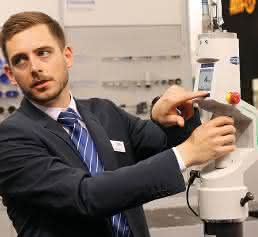
Thanks to automatic gripper detection, the rope balancer knows which type of gripper is connected. It automatically reads out the relevant parameters - for example, operating hours, maximum load or specified safety limit values for the grippers. Schmalz has designed the new handling system to meet the growing demands of digitalization: Equipped with various sensors, it records status and performance data that can be made available in the future when integrated into a digital process landscape. This will enable condition monitoring, predictive maintenance, remote monitoring and the reading of operating data and statuses to optimize the overall system. The system reports any errors directly on the display in the operating handle. as


You might also be interested in
Sicheres Einkaufen im Schmalz-Online-Shop
Schmalz erhält für seinen Online-Shop das E-Commerce-Gütesiegel von Trusted Shops. Mit der Auszeichnung würdigt das Kölner Zertifizierungs-Unternehmen unter anderem den sehr guten Kundenservice, den einfachen Bestellprozess sowie die hohen Standards...
 read more...
Sensible Elektronikbauteile sicher handhaben
Die automatisierte Handhabung von empfindlichen Elektronikbauteilen muss schnell und schonend erfolgen. Für diese Aufgabe hat der Vakuum-Spezialist Schmalz den Strömungsgreifer SCG entwickelt. Er sorgt dafür, dass Kunststoffteile und Leiterplatten...
read more...Bei Schmalz lässt es sich gut arbeiten
Schmalz ist beim Wettbewerb „Deutschlands Beste Arbeitgeber“ ausgezeichnet worden. Bereits zum fünften Mal freut sich der Vakuum-Spezialist über den Preis des Kölner Great-Place-to-Work-Instituts.
read more...Soft grippers for delicate foods
Irregularly shaped, fragile, and varying in size and weight: products such as potatoes, baked goods, and dairy products push mechanical grippers to their limits.
read more...Development Collaboration for Humanoid Robotic Hands Launched
Schunk is entering into a new development partnership with Robert Bosch Robotics. Their shared goal is to develop an industrial-grade robotic hand that can be integrated into various humanoid robot systems.
read more...Robot-controlled packaging of rolls
Koch Robotersysteme, a company specializing in the integration of robotic systems, has developed a complete, automated packaging line for packaging rolls based on Tentoma’s RoRo StretchPack packaging machine.
read more...Robotics and autonomous order picking
Locus Robotics acquires Nexera Robotics and expands autonomous warehouse logistics
Locus Robotics takes over Nexera Robotics and may have taken a decisive step towards truly universal warehouse automation. A new gripping technology should now make possible what was previously considered difficult to automate.
read more...Gentle wheel handling
The newly founded Eisenmann Robotics division develops new robotics concepts to increase the level of automation in modern production facilities.
read more...Gripping systems and vacuum generators
Schmalz is presenting new gripping systems and vacuum generators at Automatica. Exoskeletons, which allow employees to move heavy workpieces effortlessly, will also be on display.
read more...