
Picking, packing, palletizing
Handling heat shields in record time
Picking, packing and palletizing heat shields: Martin Mechanic demonstrates how to handle parts in record time with a new solution for the automotive industry. The MEV23196 work cell can handle 60 parts per minute - neatly placed in mesh boxes.
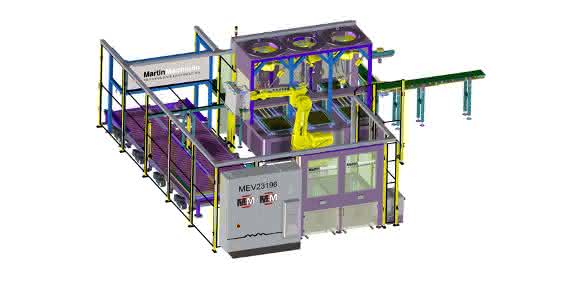
For this purpose, four trays are placed directly from the upstream press onto the conveyor belt of the work cell every four seconds. Depending on one of the four possible variants, they are between 20 and 30 centimetres long and between ten and 20 centimetres wide. The conveyor belt has a total length of nine meters, so that the operator of the system has enough time to place the parts manually if necessary - this can be the case, for example, when the press is being serviced or when material that does not come from the press needs to be fed in. To ensure that the press can remain in operation at all times, there are mesh boxes available into which finished sheets can be deposited as required to avoid a backlog in the material supply.
There are two switches at the end of the input conveyor belt. The first directs the scrap to a chute. The scrap is mainly produced when the press restarts. The second switch was installed for statistical process control (SPC). These parts, which are requested by the operator via a control panel, are checked for quality.
Four-axis robot at the center
At the heart of the MEV23196, however, are three four-axis robots from Fanuc, which are suspended from the cell ceiling above the conveyor belt, have a reach of 1,350 millimetres and a payload of twelve kilograms. These M-3iA delta robots remove the components from the conveyor belt using the line-tracking method. To do this, their predefined belt speed is transferred to the robot controller.
A camera above the conveyor belt records the part orientation of the delivered heat shields in order to signal to the three robots where they need to pick up the parts. For such applications, Martin Mechanic uses the iRPicktool from Fanuc, which controls the communication for the fast robot interactions. They can then place these in the requested setting patterns on the six shuttle tables. Depending on the product variant, there are between nine and 25 parts in this case. Eight placement patterns were created for this purpose.
No downtimes during parts supply
As one robot serves two tables at the same time, downtimes during parts feeding are prevented. When a setting pattern is full, the shuttle table automatically moves to the side to insert the next delivery into the setting pattern of the next table.
The six-axis robot R-2000iB/185L from Fanuc now picks up the entire plane from the shuttle table. It is equipped with a multi-gripper. This includes its magnetic gripper measuring 600 by 600 millimeters. It picks up all the parts at once and places them in their entirety in the mesh box provided by a conveyor belt. Martin Mechanic opted for this type of robot because of its high versatility. It can lift a payload of up to 185 kilograms and has a reach of three meters.
The individual pallet cages are manually placed on the infeed conveyor by the worker using a forklift truck. At the end of the belt, a cross pusher moves them to the side so that the robot can load them. Once the pallet cages have been filled, they are transported back out of the work cell via the discharge conveyor. At the end of the conveyor belt, the worker picks up the multi-layer filled pallet cages with the forklift truck. For safety reasons, the work cell would only stop automatically when three loaded pallet cages were in the buffer zone.
A 120-centimeter-long and 80-centimeter-wide lattice box can hold two adjacent typesetting pictures. A total of six layers can be stacked on top of each other. Depending on the type of part, they are protected by a cardboard or plastic clipboard. The robot picks these up from the storage holder with the help of its two vacuum grippers, which can be folded out to the side, in order to place them carefully in the mesh box. as


You might also be interested in
Plagiarius 2024 negative prize
On January 26, 2024, the Plagiarius campaign awarded its dreaded "Plagiarius" negative prize for the 48th time to manufacturers and retailers of particularly brazen counterfeits and fakes.
 read more...
Ivalua honors winners of the Generative AI...
AI-supported "add-ons" for buyers within 48 hours
Ivalua, provider of cloud-based spend management solutions, announced the winners and innovations of the first Generative AI Innovation Cup. The competition took place in December 2023. It was open to all Ivalua partners and employees - more than...
read more...Efaflex celebrates 50 years of high-speed...
The emphasis is on "fast"
Since day one, Efaflex has wanted to use new technologies as early as possible and drive progress in the industry. This year, the family business is celebrating its 50th anniversary under the motto "Fast Forward".
read more...Security of supply even during power outages
In the winter of 2022, Germany was worried about energy shortages. The drugstore retailer dm did not paint any horror scenarios, but nevertheless saw the possibility of controlled, temporary, regional power cuts (brownouts).
read more...Safety technology in mechanical engineering
Modules with new functions
Euchner's product highlights at EMO 2023 include the communication-capable solenoid interlocks.
read more...Transforming the paper industry towards climate neutrality
Together with partners from industry and research, Voith is developing a project for the optimization of energy and material flows in paper production. The aim of the research project is to develop a digital framework that enables effective process...
read more...Up to 95 percent less flue gas thanks to direct extraction
The requirements for occupational safety measures and safety technology are also constantly increasing in welding technology. The Technical Rules for Hazardous Substances (TRGS) stipulate that welding fumes and harmful substances must be extracted...
read more...Competitive advantages with large machines
Whether 3D-printed components for machines and systems, prototypes or aids for design: additive manufacturing is almost indispensable for modern companies in mechanical and plant engineering and automation if they want to play in the premier league.
read more...Transport technology from the modular system
Many transport tasks can be realized with the help of linear technology. Pre-configured solutions are available to simplify the interaction between the linear unit, motor, gearbox and controller. This minimizes the effort required for research and...
read more...