
Manipulators, robotics and system solutions
handling award for small parts handling using machine vision
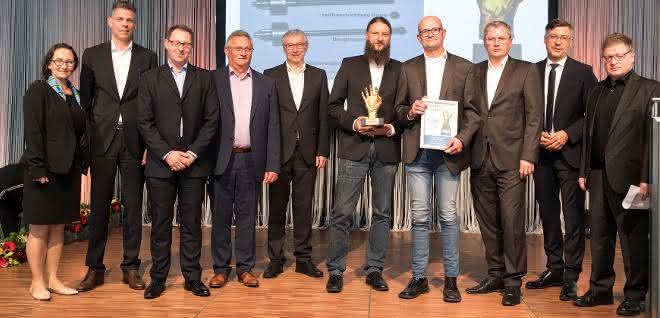
An image processing system enables the fully automated alignment of partially coated valve seat balls for directional laser welding. The handling award jury awarded this solution from Robert Bosch first place in the Manipulators, Robotics and System Solutions category.
In the production of modern high-pressure petrol injectors, sealing seat balls with small diameters (three millimetres) are spatially aligned and laser-welded onto a needle pin with a high degree of angular accuracy. Some of the balls are covered with a coating, which is important for a stable and durable injector function.
Image processing-supported handling of the ball ensures the correct position of the uncoated surface in the area of the weld seam as well as the functional area of the coating within the injector seal seat. The combination of image processing and handling technology makes it possible to feed and align partially coated balls fully automatically in a short cycle time of less than six seconds.
During handling, alignment is carried out using an integrated rotation or projected translation concept, which is controlled step-by-step via an image processing system to detect the current ball orientation and calculate the position corrections. The balls are then fed into the laser welding process in the correct position with high angular accuracy and welded onto the needle pin in a reliable process.
To ensure production quality, additional image processing systems are used after each process step (alignment, positioning, laser welding), which are embedded in a smart factory environment and enable the measurement and inspection results obtained to be assigned to the product in a partially specific manner.
The fully automated interaction of fast handling with intelligent image processing offers cost and quality advantages over a production sequence in which the finished welded assembly is coated outside the automated value stream. The main benefits are a simplified and more productive coating process and savings in logistical effort. With this solution, balls and needles are not handled together as an assembly; instead, the ball is handled and coated as a bulk material. The camera and lighting are standardized components.
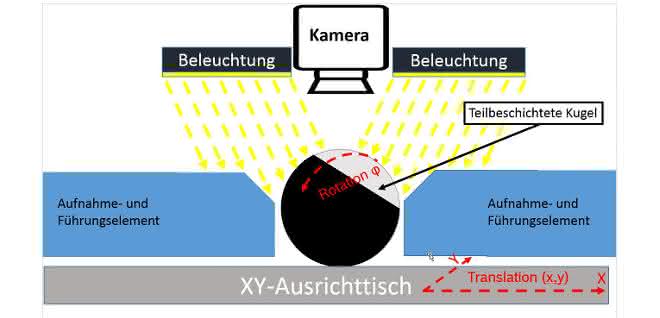
The alignment station consists of a base plate, which is mounted on a cross table that can be moved dynamically in two perpendicular directions and on which the partially coated sphere rests, as well as a transparent plastic guide. This guide serves as a holder and as a passive lighting element for the correct illumination of the sphere. The translational movement of the base plate rotates the sphere held in the guide hole to align its position. The camera and lighting of the machine vision system are mounted coaxially to the guide bore above the ball in order to detect the ball orientation and process it further via a PC-based image processing system. The position of the uncoated ball surface detected by the image processing system is used to calculate the translational alignment movements required to correct the angular deviation. pb


You might also be interested in
Fraunhofer IOSB Opens Humanoid Robots Lab
The Fraunhofer IOSB is opening a Humanoid Robots Experience Lab in Karlsruhe, Lemgo, and Ilmenau. Companies and organizations can use these facilities to test potential applications for humanoid robots and develop pilot projects.
 read more...
Artificial Intelligence in Manufacturing
Trumpf and IPAI Are Expanding a European AI Network for Industry
The high-tech company Trumpf is an official partner of the IPAI AI network in Heilbronn. Together, the partners aim to exchange experiences, develop new AI applications for industrial use, and advance the development of artificial intelligence in...
read more...Case Study: Networked Manufacturing Platform for Toolmaking
Using a networked manufacturing platform, Escha GmbH & Co. KG, a manufacturer of industrial fastening technology, has comprehensively modernized its toolmaking operations.
read more...Barcelona Declaration on Robotics and...
Robotics Associations Adopt Global Automation Strategy
The global robotics industry is stepping up its collaboration. The associations AER Automation, A3, IFR, and VDMA Robotics + Automation have formed a long-term alliance by signing the “Barcelona Declaration on Robotics and Automation 2026.” The...
read more...Jane Heffner is the new president of the International Federation of Robotics
Jane Heffner is the new president of the International Federation of Robotics. Adrien Brouillard has been appointed vice president of the global federation.
read more...Greater Transparency in the Robotics Market
RoboFinder Launches as an Independent Comparison Platform
Launch at Gitex Europe: 'RoboFinder' aims to bring more transparency to the professional service robotics market. In this interview, founder and CEO Brian Engels discusses market potential, challenges, and the goals of the new platform.
read more...Artificial Intelligence for the Physical Space
Alibaba Expands Qwen Model Family with a Robotics Suite for Physical AI
Alibaba is expanding its Qwen model family with a robotics suite for Physical AI. The three models—for manipulation, navigation, and simulation—are designed to assist autonomous robots with complex tasks in real-world environments.
read more...International Federation of Robotics
U.S. Robotics Industry Sees Double-Digit Growth
In the U.S., sales of industrial robots rose by 11% compared to the previous year: 38,000 units were newly installed in 2025. This significant recovery is driven by robust growth in the food industry and other non-manufacturing sectors. However, the...
read more...Development Collaboration for Humanoid Robotic Hands Launched
Schunk is entering into a new development partnership with Robert Bosch Robotics. Their shared goal is to develop an industrial-grade robotic hand that can be integrated into various humanoid robot systems.
read more...