
Gripper technology
The chameleon among the grippers
Bionic gripper. The operating principle of the DHEF adaptive shape gripper from Festo is based on the function of a chameleon's tongue. The gripper can grasp, collect and release objects with different shapes without the need for manual conversion.
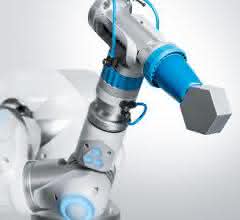
The silicone cap of the adaptive form gripper fits over almost any shaped gripping object. This creates a firm form fit. The elastic silicone adapts precisely to many different geometries. In combination with a pneumatic drive, the adaptive form gripper grips safely and with low energy consumption.
Unlike the jaw grippers currently available on the market, which can only grip certain components, the adaptive shape gripper is highly flexible. It can even handle components with free shapes and round geometries. As it has no sharp edges, it is also suitable for use with sensitive objects such as air nozzles or application strips. In principle, the gripper can pick up several parts such as nuts from a tray in a single movement.
The bionic gripper can therefore be used, for example, for handling small parts in traditional mechanical engineering, in the electronics or automotive industry, in feed units for packaging systems, for human-robot interaction in assembly tasks or for prosthesis additions in medical technology.
Equipped with an elastic silicone membrane that is flexible and compliant and is pressurized with compressed air, as well as a standardized robot interface with integrated air connections, the gripper becomes a practical automation component. The sensor groove for standard sensors for position monitoring and the bayonet lock for easy replacement of the cap also play their part.
The combination of force and form closure of the chameleon's tongue can be observed when hunting insects. When the chameleon has its prey in its sights, it lets its tongue flick out like a rubber band. Shortly before the tip of the tongue reaches the insect, it retracts in the middle while the edges continue to move forward. This allows the tongue to adapt to the shape and size of the prey and enclose it tightly. The prey sticks to the tongue and is reeled in as if on a fishing line. The Festo Bionic Learning Network and researchers from the University of Oslo made use of these observations when developing a prototype called the "Flex Shape Gripper". as
Hall 15, Stand D11


You might also be interested in
Soft grippers for delicate foods
Irregularly shaped, fragile, and varying in size and weight: products such as potatoes, baked goods, and dairy products push mechanical grippers to their limits.
 read more...
Development Collaboration for Humanoid Robotic Hands Launched
Schunk is entering into a new development partnership with Robert Bosch Robotics. Their shared goal is to develop an industrial-grade robotic hand that can be integrated into various humanoid robot systems.
read more...Robot-controlled packaging of rolls
Koch Robotersysteme, a company specializing in the integration of robotic systems, has developed a complete, automated packaging line for packaging rolls based on Tentoma’s RoRo StretchPack packaging machine.
read more...Robotics and autonomous order picking
Locus Robotics acquires Nexera Robotics and expands autonomous warehouse logistics
Locus Robotics takes over Nexera Robotics and may have taken a decisive step towards truly universal warehouse automation. A new gripping technology should now make possible what was previously considered difficult to automate.
read more...Gentle wheel handling
The newly founded Eisenmann Robotics division develops new robotics concepts to increase the level of automation in modern production facilities.
read more...Gripping systems and vacuum generators
Schmalz is presenting new gripping systems and vacuum generators at Automatica. Exoskeletons, which allow employees to move heavy workpieces effortlessly, will also be on display.
read more...Smart universal gripper for power electronics
The power electronics manufacturer Semikron Danfoss uses the EGU 50 mechatronic parallel gripper from Schunk in a robotic cell. It handles different components and feeds them to a measuring line. With its functionalities, it meets all requirements...
read more...Schmalz takes over finger gripper from Soft Robotics
The vacuum specialist Schmalz is expanding its gripper portfolio and acquiring the mGrip product family from the US company Soft Robotics (SRI), including all finger gripper configurations, patents and the associated know-how.
read more...Soldering with special gripper
In order to make the mini wave soldering of large panels stable and reproducible, Eutect developed a special gripper that prevents the panel from bending, among other things.
read more...