
Gripper and lid closing system
Plug-and-play to South Africa
Bowler Plastics in South Africa automated two Arburg injection molding machines and put an end to the monotonous manual closing of plastic caps for food or cosmetic bottles. Gripper systems and an automatic cap closing machine from Gimatic are used here.

Bowler Plastics from Cape Town once started producing plastic parts with an Arburg machine. Currently, Bowler Metcalf as a group with around employees in four individual companies produces more than 500 million parts per year, including injection molding, silk screen printing, digital printing and hose extrusion for a good 200 customers. In the injection molding sector, 54 machines are in use, 49 of which are Arburg machines. Previously, in this application, a machine operator continuously closed the caps (fliptops) ejected from the injection molding machine by hand. Four lids come out of the machine at a time with a cycle time of 13 seconds. Six different cap variants are possible. Bowler decided to automate this process, not least to ensure consistent quality. The main challenge was to maintain the flexibility of the machine operator while improving quality and reducing costs.
With the automation solution from Gimatic, it should be possible to use the existing 3D negative molded parts. Bowler wanted to cover six different lid types. The fliptops are now removed from the machine immediately and in the same time frame, which improves thermostability and reduces waste. Of course, the machine works more efficiently than an employee - and 24 hours a day, seven days a week. The removal unit is equipped with four vacuum grippers adapted to the shape of the lid. It removes the identically aligned plastic lids from the injection molding machine and places them on four corresponding 3D negative molded parts in the lid closing system. This consists of two synchronized linear axes, each of which closes two lids. For structural reasons, the linear axes were set up mirror-inverted. The removal unit must therefore rotate the two lower components during the removal process so that they can then be deposited in the correct position. The linear axis then moves over the deposited lids. To prevent the lids from being damaged, a so-called flock first closes them by 90 degrees before a pneumatic cylinder presses them firmly shut. While the removal gripper moves out again to pick up the next components, the closed lids are rotated 180 degrees one after the other and ejected into a waiting container by means of an air blast.
Two different lid closing systems, each with three grippers, were developed to suit three lids. To make it easier to change over to the individual formats, the components that need to be replaced are color-coded. Replacement is simple: loosen the screws, disconnect the pneumatic and electrical plugs and the complete unit can be removed. Both systems are built almost exclusively with Gimatic components. The components of the removal gripper, such as vacuum suction cups, spring-loaded suspensions and the "MSI-A41" quick-change system, were attached to the company's own profile rail system.
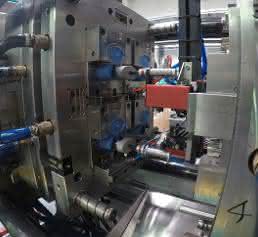
The lid closing system is based on a profile frame and is bolted to the floor using adjustable feet. The compressed air connection is made via the injection molding machine or via the robot handling. A special interface in the form of a valve terminal was generated for this purpose. The control system is also taken over by the injection molding machine. Two linear units type LP07 with two guide carriages, driven by a pneumatic cylinder, are used for the linear axes. Small OFC cylinders fix the lids on a 3D-printed negative mold.
The cylinders are equipped with a thermally high-strength rubber with a high friction property so that the component does not slip or become damaged during the closing process. An OFL cylinder presses the lids closed from above. The pressure can be adjusted depending on the component. RT 25 rotary units finally eject the lids. These rotary units have an integrated air feed-through and are around 20 percent smaller than comparable products on the market with the same force. The entire system is scanned, evaluated and monitored by magnetic sensors in communication with the injection molding machine.
Commissioning went smoothly. Gimatic was able to produce a genuine plug-and-play system and did not have to travel to South Africa for the commissioning. The system was manufactured and assembled in Hechingen. Representatives for Arburg in South Africa approved it on site before it was shipped to Africa. pb


You might also be interested in
Soft grippers for delicate foods
Irregularly shaped, fragile, and varying in size and weight: products such as potatoes, baked goods, and dairy products push mechanical grippers to their limits.
 read more...
Development Collaboration for Humanoid Robotic Hands Launched
Schunk is entering into a new development partnership with Robert Bosch Robotics. Their shared goal is to develop an industrial-grade robotic hand that can be integrated into various humanoid robot systems.
read more...Robot-controlled packaging of rolls
Koch Robotersysteme, a company specializing in the integration of robotic systems, has developed a complete, automated packaging line for packaging rolls based on Tentoma’s RoRo StretchPack packaging machine.
read more...Robotics and autonomous order picking
Locus Robotics acquires Nexera Robotics and expands autonomous warehouse logistics
Locus Robotics takes over Nexera Robotics and may have taken a decisive step towards truly universal warehouse automation. A new gripping technology should now make possible what was previously considered difficult to automate.
read more...Gentle wheel handling
The newly founded Eisenmann Robotics division develops new robotics concepts to increase the level of automation in modern production facilities.
read more...Gripping systems and vacuum generators
Schmalz is presenting new gripping systems and vacuum generators at Automatica. Exoskeletons, which allow employees to move heavy workpieces effortlessly, will also be on display.
read more...Smart universal gripper for power electronics
The power electronics manufacturer Semikron Danfoss uses the EGU 50 mechatronic parallel gripper from Schunk in a robotic cell. It handles different components and feeds them to a measuring line. With its functionalities, it meets all requirements...
read more...Schmalz takes over finger gripper from Soft Robotics
The vacuum specialist Schmalz is expanding its gripper portfolio and acquiring the mGrip product family from the US company Soft Robotics (SRI), including all finger gripper configurations, patents and the associated know-how.
read more...Soldering with special gripper
In order to make the mini wave soldering of large panels stable and reproducible, Eutect developed a special gripper that prevents the panel from bending, among other things.
read more...