

New AI methods for picking robots
Better gripping with intelligent picking robots
Production, storage, shipping - wherever goods are manufactured, stored, sorted or packed, they are also picked. This means that several individual goods are removed from storage units such as boxes or cartons and reassembled.
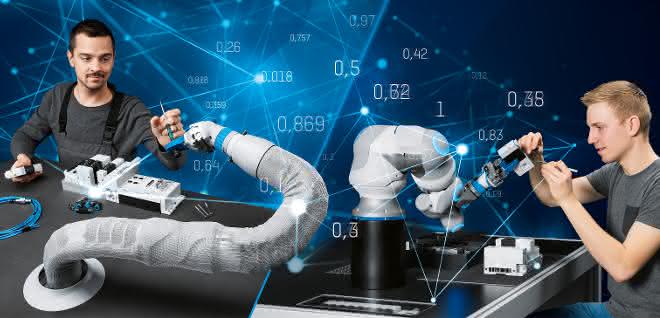
Festo is conducting research in the Flairop project together with the Karlsruhe Institute of Technology (KIT) and partners from Canada to make picking robots more intelligent using distributed AI methods. To this end, they are investigating how training data from several stations, several plants or even companies can be used without participants having to disclose sensitive company data.
"We are investigating how the most versatile possible training data from multiple locations can be used to develop more robust and efficient solutions with the help of artificial intelligence algorithms than with data from just one robot," says Jonathan Auberle from the Institute of Materials Handling and Logistics Systems (IFL) at KIT. Autonomous robots process items at several picking stations by gripping and moving them. The robots are trained with very different articles at the various stations. In the end, they should be able to pick items from other stations that they have not yet learned to pick. "With the distributed learning approach, also known as federated learning, we manage the balancing act between data diversity and data security in an industrial environment," says the expert.
Powerful algorithms for Industry and Logistics 4.0
Until now, federated learning has mainly been used in the medical sector for image analysis, where the protection of patient data is naturally a particularly high priority. Therefore, there is no exchange of training data such as images or grasping points for training the artificial neural network. Only parts of stored knowledge - the local weights of the neural network, which indicate how strongly one neuron is connected to another - are transferred to a central server. There, the weights are collected from all stations and optimized using various criteria. The improved version is then sent back to the local stations and the process is repeated. The aim is to develop new, more powerful algorithms for the robust use of artificial intelligence for Industry and Logistics 4.0 while complying with data protection guidelines.
"In the Flairop research project, we are developing new ways for robots to learn from each other without sharing sensitive data and company secrets. This has two major advantages: We protect our customers' data and we gain speed because the robots can take on many tasks more quickly in this way. For example, the collaborative robots can support production workers with repetitive, heavy and tiring tasks," says Jan Seyler, Head of Advanced Develop. Analytics and Control at Festo SE & Co. KG.
During the project, a total of four autonomous picking stations will be set up to train the robots: two at the KIT Institute for Materials Handling and Logistics Systems (IFL) and two at Festo, based in Esslingen am Neckar.
The start-up DarwinAI and University of Waterloo from Canada are additional partners in the project. "DarwinAI is pleased to provide our Explainable (XAI) platform for the Flairop project and to collaborate with such prestigious Canadian and German research organizations as well as our industry partner Festo. We hope that our XAI technology will enable high-quality human-in-the-loop processes for this exciting project, which represents an important facet of our offering alongside our novel federated learning approach. With our roots in academic research, we are excited about this collaboration and the industrial benefits of our new approach for a wide range of manufacturing customers," says Sheldon Fernandez, CEO of DarwinAI.
"The University of Waterloo is thrilled to partner with the Karlsruhe Institute of Technology and a global leader in industrial automation like Festo to bring the next generation of trustworthy artificial intelligence to manufacturing. By leveraging DarwinAI's Explainable AI (XAI) and Federated Learning, we can create AI solutions that support factory workers in their daily production tasks to increase efficiency, productivity and safety," says Dr. Alexander Wong, Co-Director of the Vision and Image Processing Research Group, University of Waterloo, and Chief Scientist at DarwinAI.
The Flairop research project
The FLAIROP (Federated Learning for Robot Picking) project is a partnership between Canadian and German organizations. The Canadian project partners focus on object recognition through deep learning, explainable AI and optimization, while the German partners contribute their expertise in robotics, autonomous grasping through deep learning and data security.
- KIT-IFL: Consortium leadership, development of grasp determination, development of automatic learning data generation
- KIT-AIFB: Development of Federated Learning Framework
- Festo SE & Co KG: Development of picking stations, piloting in real warehouse logistics
- University of Waterloo (Canada): Development of object recognition
- Darwin AI (Canada): Local and global network optimization, automated generation of network structures
The project is funded by the Canadian National Research Council (NRC) and the German Federal Ministry for Economic Affairs and Energy (BMWi).


You might also be interested in
AI supports skilled workers during assembly
Kimoknow, a KIT spin-off, is developing a digital assembly assistant based on automated AI-supported object recognition.
 read more...
Fraunhofer IOSB Opens Humanoid Robots Lab
The Fraunhofer IOSB is opening a Humanoid Robots Experience Lab in Karlsruhe, Lemgo, and Ilmenau. Companies and organizations can use these facilities to test potential applications for humanoid robots and develop pilot projects.
read more...Artificial Intelligence in Manufacturing
Trumpf and IPAI Are Expanding a European AI Network for Industry
The high-tech company Trumpf is an official partner of the IPAI AI network in Heilbronn. Together, the partners aim to exchange experiences, develop new AI applications for industrial use, and advance the development of artificial intelligence in...
read more...Case Study: Networked Manufacturing Platform for Toolmaking
Using a networked manufacturing platform, Escha GmbH & Co. KG, a manufacturer of industrial fastening technology, has comprehensively modernized its toolmaking operations.
read more...Barcelona Declaration on Robotics and...
Robotics Associations Adopt Global Automation Strategy
The global robotics industry is stepping up its collaboration. The associations AER Automation, A3, IFR, and VDMA Robotics + Automation have formed a long-term alliance by signing the “Barcelona Declaration on Robotics and Automation 2026.” The...
read more...Jane Heffner is the new president of the International Federation of Robotics
Jane Heffner is the new president of the International Federation of Robotics. Adrien Brouillard has been appointed vice president of the global federation.
read more...Greater Transparency in the Robotics Market
RoboFinder Launches as an Independent Comparison Platform
Launch at Gitex Europe: 'RoboFinder' aims to bring more transparency to the professional service robotics market. In this interview, founder and CEO Brian Engels discusses market potential, challenges, and the goals of the new platform.
read more...Artificial Intelligence for the Physical Space
Alibaba Expands Qwen Model Family with a Robotics Suite for Physical AI
Alibaba is expanding its Qwen model family with a robotics suite for Physical AI. The three models—for manipulation, navigation, and simulation—are designed to assist autonomous robots with complex tasks in real-world environments.
read more...International Federation of Robotics
U.S. Robotics Industry Sees Double-Digit Growth
In the U.S., sales of industrial robots rose by 11% compared to the previous year: 38,000 units were newly installed in 2025. This significant recovery is driven by robust growth in the food industry and other non-manufacturing sectors. However, the...
read more...