
Know-how
Eccentrics among the grippers
The simple jaw gripper can be regarded more or less as a standard gripper. It clamps the objects to be gripped. You can grip many things with it, but not everything. Things get exciting when you want to implement another technological process.
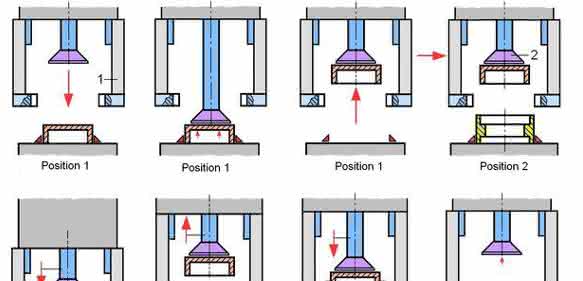
The workpiece shapes have the greatest influence on the design, especially the fingers. However, grippers have also been designed as assembly devices. The gripper picks up the components one by one, brings them together as they move on and places them at the destination as a joined assembly. The gripper must have a corresponding number of individually controllable gripping elements. It is then a special gripper and is not often available in this design. A first example is shown in Figure 1. The joining forces are small. However, powerful pressing operations would only be possible with specially equipped grippers, which do exist.
The task is technically quite simple, the volume output is limited and whether the solution makes sense at all depends on a holistic view of the assembly task, the expected volume output and the planned environment. But: It can be done. The size and mass of a gripper upgraded in this way should not be underestimated. This can lead to restrictions in the fast handling process.
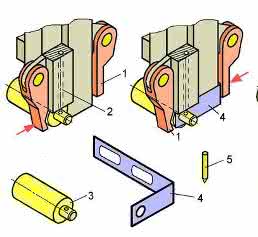
Now to another example: In Figure 2, the gripper and pin device merge to form an assembly unit. Here too, the gripper moves to several positions to pick up assembly parts. The jaws are specialized. First, the shaft is gripped and clamped. This is done directly at the drilling device to ensure that the orientation of the hole is sufficiently accurate. The sheet metal bracket is picked up in such a way that it is already precisely positioned on the shaft. Clamping jaws hold it in this position. Finally, a pin is pressed into the shaft and the three-part assembly is deposited. The integrated pinning device with automatic feeding of the pins is only indicated in the picture. Pinning is not considered to be automation-friendly. Perhaps the design of the assembly can be made more assembly-friendly before automation is introduced.
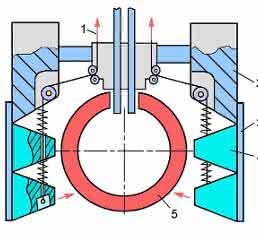
Figure 3 shows a special gripper that grips a finely machined open ring with its segmented gripper jaws. Parts with atypical outer contours can also be considered as gripping objects. It is not a special gripper, but a mechanical clamping gripper. The gripping segments apply themselves to the gripping object with the same clamping force. Release is achieved by means of compression springs between the segments and the spring band as the base. Two independent actuators are required. These can be pneumatic cylinders, for example. However, cable pulls, small springs and deflection pulleys do not indicate that the gripper is very robust.
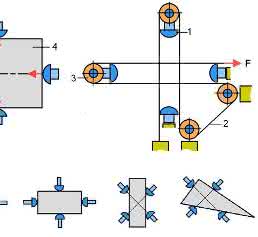
Figure 4 shows the principle of a gripper for different object shapes. It is a four-point gripper. Two fingers are fixed, the other two move towards the object to be gripped. It is driven by a single traction cable and reset by springs (not shown) that act on the moving fingers. A working cylinder can serve as an actuator. Apples, for example, can be used as gripping objects because larger deviations from the shape and size of the object can be handled well. This is actually the biggest advantage of this four-point mechanism. This is also shown by the other gripping examples. However, special accuracy requirements should not be made.
Stefan Hesse


You might also be interested in
Soft grippers for delicate foods
Irregularly shaped, fragile, and varying in size and weight: products such as potatoes, baked goods, and dairy products push mechanical grippers to their limits.
 read more...
Development Collaboration for Humanoid Robotic Hands Launched
Schunk is entering into a new development partnership with Robert Bosch Robotics. Their shared goal is to develop an industrial-grade robotic hand that can be integrated into various humanoid robot systems.
read more...Robot-controlled packaging of rolls
Koch Robotersysteme, a company specializing in the integration of robotic systems, has developed a complete, automated packaging line for packaging rolls based on Tentoma’s RoRo StretchPack packaging machine.
read more...Robotics and autonomous order picking
Locus Robotics acquires Nexera Robotics and expands autonomous warehouse logistics
Locus Robotics takes over Nexera Robotics and may have taken a decisive step towards truly universal warehouse automation. A new gripping technology should now make possible what was previously considered difficult to automate.
read more...Gentle wheel handling
The newly founded Eisenmann Robotics division develops new robotics concepts to increase the level of automation in modern production facilities.
read more...Gripping systems and vacuum generators
Schmalz is presenting new gripping systems and vacuum generators at Automatica. Exoskeletons, which allow employees to move heavy workpieces effortlessly, will also be on display.
read more...Smart universal gripper for power electronics
The power electronics manufacturer Semikron Danfoss uses the EGU 50 mechatronic parallel gripper from Schunk in a robotic cell. It handles different components and feeds them to a measuring line. With its functionalities, it meets all requirements...
read more...Schmalz takes over finger gripper from Soft Robotics
The vacuum specialist Schmalz is expanding its gripper portfolio and acquiring the mGrip product family from the US company Soft Robotics (SRI), including all finger gripper configurations, patents and the associated know-how.
read more...Soldering with special gripper
In order to make the mini wave soldering of large panels stable and reproducible, Eutect developed a special gripper that prevents the panel from bending, among other things.
read more...