
Brake solutions for industrial applications
Quiet azimuth brake
The maintenance of wind turbines is about maintaining efficiency and reliability as well as system-specific conditions. An increasingly frequent complaint is that, in addition to the wind noise emitted by the rotor blades, the turbines in the nacelle also emit noise. Brake expert Svendborg Brakes has addressed this issue and developed a solution that works for most turbines.

Traversing noises at the azimuth brakes of the wind tracking system make up a significant proportion of the noise emissions from wind turbines and are caused by the grinding of the brake pads on the brake disk when the nacelle turns into the wind. The brakes are released to such an extent that the azimuth motors can turn the nacelle into the optimum position. The brakes are then fully applied again to maintain the position.
Root cause analysis
The investigation of the travel noise has revealed a direct correlation between the noise level and the "glazing" of the brake pads. As long as the nacelle is correctly positioned in the wind, the azimuth brakes are pressurized with approx. 160 bar. As soon as the nacelle is tracked, this pressure is reduced to approx. 30 bar. This is sufficient to allow the azimuth motors to track the nacelle in a controlled manner.
As the brakes are always applied, small amounts of powdery friction material or particles are created between the pads and the disc. At the reduced pressures during tracking, some of the powder sticks to the surface of the pads and gives them a glass-like appearance. This phenomenon does not only occur in wind turbines, but can also be observed in other applications. As "glazing" is a slow process, it does not occur in new wind turbines, but can become a problem over time.
Development of a solution
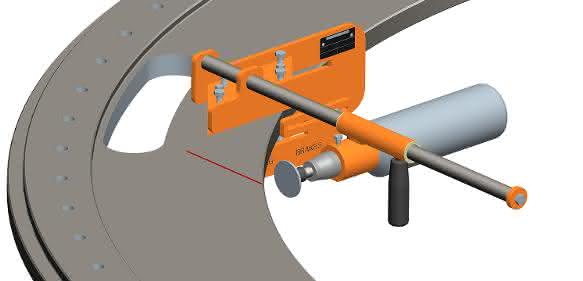
International brake expert and part of Altra Industrial Motion Corporation Svendborg Brakes has analyzed the phenomenon in depth to support equipment manufacturers and independent maintenance companies. The result is a patented innovation, i.e. a permanent solution that can be implemented by Svendborg Brakes engineers or maintenance companies. By milling a specially shaped groove into the brake disc, existing glazing can be removed and the formation of new glazing prevented. The groove increases brake pad wear insignificantly, but in combination with the simultaneously installed brush it helps to remove adhering powdery material.
The tests have shown that the groove in the brake disk can remove the brake pad glazing, with wear increasing by only 3.5 percent at an operating pressure of 30 bar. These tests were carried out using brake pads from Svendborg Brakes with a slot in the friction material, which also helps to keep the braking surface free of dirt. What became very clear during the tests was the importance of the size and shape of the slot. Therefore, a practical system had to be developed to produce the most efficient groove design.
Provision of the solution
This resulted in a mounting kit for the installation of a total of eight grooves: four on the upper side and four on the underside of the brake disk. The assembly kit contains a template for correctly positioning the grooves in the disk. Reworking takes about three hours per installation. After Svendborg Brakes had developed the necessary equipment and the optimum process for applying the grooves, the company successfully applied for a patent for the solution. Since then, manufacturers and maintenance companies have been able to use this system for noise reduction on the azimuth brake under a license agreement.
In any case, it is important to correctly diagnose the source of the noise during wind tracking, as it does not necessarily have to be a glazing problem on the brake pads. It is particularly important to check for oil leaks from the hydraulic units and the azimuth bearing, as oil or grease on the brake disk is always problematic. The main bearing itself, incorrect engagement of the azimuth gearbox or a geared motor brake that is not being released are also possible sources of noise. Such faults can usually be rectified as part of routine maintenance and without special equipment or knowledge that goes beyond the normal procedures for wind turbines.
Over a period of 18 months, 25 wind turbines from various manufacturers were modified using the Svendborg Brakes groove method. Since then, none of these turbines have experienced any noise from the azimuth brake. In addition, turbines not equipped with Svendborg Brakes components have also been successfully modified using the patented process. This means that a solution is now available for the majority of wind turbines. am


You might also be interested in
Predictive maintenance in retrofit
Predictive maintenance pays off. This is because early detection of impending failures means that systems can be serviced in a targeted manner before production downtime occurs. But how complex is it to integrate such a maintenance concept into an...
 read more...
Maintenance instead of replacement
The circular economy starts with the machinery
Sustainability in industry starts with machines, says our guest author from Deguma: How maintenance, modernization and the 5R strategy save resources, energy and CO₂.
read more...3D printing for unplanned requirements
The material fails and the machine suddenly stops? Then you need to take the right measures to be able to resume production quickly. Material failure in the form of faulty components or material wear in the frame are a risk for any production.
read more...High demands in terms of safety, application and robustness
Demanding work in the electrical trade and energy supply as well as smooth processes in production require innovative and customized measurement technology that scores points for safety, ease of use and resilience.
read more...Car meets e-bike: riding with lubrication-free polymer bearings
Studies show that the proportion of pedestrian and bicycle traffic is increasing in urban areas. With the JetBike, JetBike GmbH from Braunschweig presents a mixture of e-bike and car and relies on lubrication-free polymer bearings from Igus.
read more...Hydraulic hub for more efficient servicing
Bosch Rexroth presents a digital toolbox for service and maintenance. With a comprehensive range of digital services, the Hydraulic Hub simplifies and accelerates the service and maintenance of hydraulic products and increases machine availability.
read more...Arnold Umformtechnik expands after-sales...
Faster help with VR glasses
Arnold Umformtechnik is expanding the after-sales service for its machines to include digital remote services. The focus is on data security, simple operation and clear processes.
read more...147,000 euros per hour: high costs for German companies due to unplanned downtime
According to the "Value of Reliability" study, 67% of industrial companies in Germany experience unplanned downtime at least once a month. This costs the German economy 147,000 euros per hour. Nevertheless, reactive maintenance concepts are not...
read more...Maintenance starts with a maintenance planner
Legal requirements stipulate that machines and systems must be serviced regularly. The maintenance work serves to ensure occupational safety and economic efficiency.
read more...