

Integration of robot-based production cells
Clamping technology for robot processing
The ISW at the University of Stuttgart researches the use of industrial robots for machining tasks and develops automation concepts that support the integration of robot-based production cells in companies. One focus is on the fully automated clamping of large thin-walled components.
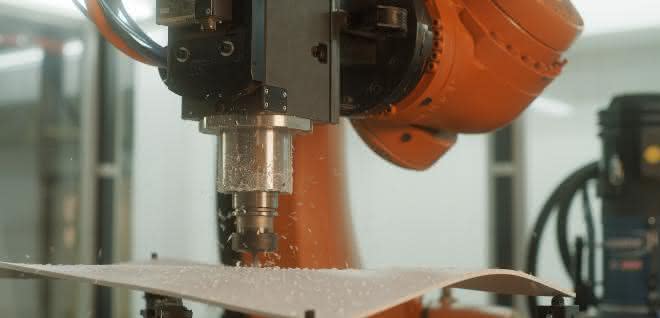
Industrial robots that guide a tool are increasingly competing with machine tools when it comes to processing large-volume components due to their good ratio of investment costs to working space. Good results can already be achieved, particularly when machining wood, plastics and composite materials. Furthermore, industrial robots with their flexible articulated arm kinematics are characterized by their compatibility with a range of different manufacturing processes. In addition to traditional milling, these include sawing, hot wire cutting and surface processing with lasers. The ISW is therefore investigating how industrial robots can be used as universal machines in production cells and how the integration of these systems can be implemented in SMEs that process wood and composite materials.
If flexible production systems are to be implemented with industrial robots for machining tasks, in which free-form components are manufactured in small series through to individual pieces, support processes must also have a high degree of automation. One task that currently still involves a high level of personnel and, in some cases, material expenditure in companies due to the low level of automation is the fixing of the component. If an industrial robot can guide different types of tools and also process free-form surfaces thanks to its flexible kinematics, this places great demands on workpiece clamping. Due to the positioning of the component, the clamping has a direct influence on the achievable component quality and must always safely absorb any process forces that occur without colliding with the robot or tool and prevent component deformation at the point of machining.
Reconfiguration prevents deformation
Automated reconfigurable clamping systems are one approach to solving this problem. These systems are usually characterized by complex kinematics in which contact elements are attached to the component by a large number of electromechanically, hydraulically or pneumatically moved axes. These can be, for example, support contacts, collets or, as in most cases, vacuum grippers. The controllable axes can adapt to different components or adapt the clamping configuration to the machining progress during the process.
The purpose of the clamping is to prevent deformation of the component during machining. In order to achieve this goal, an optimization problem based on finite element modelling with the maximum component deformation at the machining location as the objective function is solved to determine the position of the contact elements. The positions of the contact elements are adjusted iteratively until the deformations occurring are sufficiently small to achieve the desired machining quality. As contact elements are only taken into account in a simplified form in FE modeling, an exact contact calculation must then be carried out at the points where the component and clamping system come into contact before the target values for the individually controllable axes are calculated using the inverse kinematics transformation. As the rigidity of thin-walled components changes significantly during machining, this must be taken into account in the planning algorithm via a material removal simulation of the CAD data. Furthermore, measurement data from various sensors of the clamping system can help with planning and monitoring.
To enable the integration of automated free-form clamping systems in systems, their complexity must not affect the operating and commissioning effort. Practical suitability can be ensured through complete integration into an industrial CAD-CAM chain. In addition, integration into an end-to-end process data management system makes sense, as data from different phases of process planning and execution are required for the planning algorithm. In future work, the ISW will extend and optimize the previous results for other products and materials with higher accuracy requirements.
Andreas Schütz, M. Sc., and Univ.-Prof. Dr.-Ing. Dr. h.c. mult. Alexander Verl, ISW


You might also be interested in
Schunk shows flexible systems for electronics production
Schunk Electronic Solutions will be exhibiting modular, flexible systems for electronics production at Productronica 2025 - from stand-alone depaneling systems to fully integrated inline solutions.
 read more...
Digital and without staff
Kasto promised a world first for its trade fair appearance at the EMO in Hanover. The sawing and storage technology specialist presented a fully automated system for pre-processing.
read more...Digital and without staff
Kasto is promising a world first for its trade fair appearance in Hanover. The sawing and storage technology specialist will be presenting a fully automated system for pre-processing at EMO. The unmanned concept enables 24/7 operation.
read more...Production, machine tools and robots
High-precision welding for perfect sawing
Stihl uses Nimak's portal projection welding systems to manufacture guide rails for chainsaws.
read more...Prevent damage and save energy
CG Drives & Automation presents a new range of Emotron TSA soft starters from 5.5 to 1000 kW (16-960 A and 200-690 V). This includes the new sizes TSA 5 and 6 for high power applications (470-960 A).
read more...Robot tool for more efficient heating systems
Together with the Chair of Production Systems (LPS), Schmöle is developing a new process for manufacturing spiral finned tubes for heat exchangers. In addition to an ergonomic improvement for the employees, the manufacturing process is to become...
read more...MES solutions in mechanical engineering
A medium-sized machine tool manufacturer successfully networked its production facilities with the company software.
read more...For use in heavy industry
The KASTObbs block and panel bandsaw from Kasto was specially developed for heavy industry and is used in steelworks and steel trading companies, among others.
read more...Now new at ACE: configure and order oil brakes and hydraulic brake cylinders online
ACE Stoßdämpfer GmbH is expanding its range of online configurators. It is now possible to configure and order oil brakes and hydraulic brake cylinders for a wide range of applications online at any time on the ACE homepage.
read more...