
Assembly workstation
Robot assists with parts provision
The development of a new integration approach for a robot in manual assembly is a new research topic at the Chair of Production Systems (LPS) at Ruhr-Universität Bochum (RUB). The aim is for the robot to support humans by providing parts so that they can focus more on assembly.
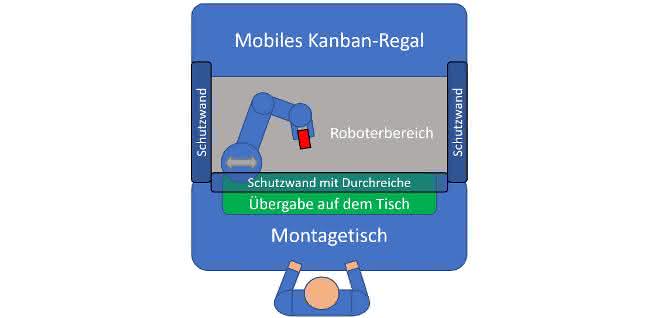
The LPS is currently pursuing a new approach of integrating an assistance robot into an assembly workstation. The robot's tasks focus on logistics, in particular the handling of parts containers. The economic efficiency of the hybrid assembly workstation is to be achieved by allowing the human to concentrate on the haptically demanding tasks while the robot assists with the non-value-adding ancillary activities. The robot takes over the intralogistics at the workstation by transporting the parts containers into the gripping area of the worker, who performs the value-adding activities. This makes it possible to carry out very extensive assembly processes with a large number of parts containers at an assembly workstation, as the worker only has the components for the current and some subsequent work steps in front of him in the ergonomically optimized gripping area. Search times, during which the worker has to select the next components from a large number of parts containers, are therefore eliminated and the focus is more on value-adding assembly.
While many assembly workstations consist of a combination of assembly table and Kanban rack, in the new approach these are separated and connected by a robot area.
The structure of the assembly workstation
The robot knows the assembly sequence and always provides the worker with the required components through a pass-through. Parts for subsequent work steps are also provided so that the worker does not have to wait for the robot. Once the worker has completed a work step, the robot sorts the parts container back onto the shelf. This means that instead of the entire shelf, the worker only has a few boxes in front of him in his ergonomically optimized gripping area. As the worker and the robot have no contact with each other apart from a small monitored pass-through, it is possible to use powerful industrial robots instead of HRC robots. As a result, there should be no waiting times in the parts supply and heavier parts containers are also possible. Furthermore, the rack with the parts containers does not have to be adapted to a human user, but to the robot's gripping space. This makes it possible to use larger shelves that are filled to the floor, for example. By using an additional linear axis for the robot, the gripping space can be extended or the robot can supply additional assembly tables with parts containers. The system is therefore flexible and scalable, as is usual in the field of manual assembly.
First test runs
An initial demonstrator has already been set up at the LPS and is currently being used to test how the new concept works. A small control unit consisting of 22 components serves as an assembly example. The assembly steps range from a few seconds to around 1.5 minutes. In total, the assembly process takes 15 to 20 minutes. A comparison between conventional manual assembly and the new robot-assisted variant shows a time saving of up to 3 minutes in this specific application example. This results from the reduction in search times for the next component, as the worker no longer has to choose from the 22 component containers, but only from five. The particular advantage of this new approach is that the search times do not increase, even for more complex assembly tasks with significantly more individual parts, as the worker is only supplied with the necessary boxes. It was also shown that the robot's speeds are sufficient to ensure that the worker never comes to a standstill. In addition, all test persons involved find the new assembly process very pleasant, as they are not distracted by the search process and can concentrate better on the value-adding assembly. M. Krampe, L. Penczek, B. Kuhlenkötter
Briefly explained: The LPS

The Chair of Production Systems (LPS) is headed by Prof. Dr. Bernd Kuhlenkötter. The scientific focus of the LPS covers the fields of production management, production automation and industrial robotics. The LPS operates a learning and research factory (LFF) in which the theoretical concepts are implemented and evaluated. By demonstrating the results, the LPS promotes the transfer of technology to industry.
Briefly explained: The MHI e.V.

The Wissenschaftliche Gesellschaft für Montage, Handhabung und Industrierobotik e.V. (MHI e.V.) is a network of renowned university professors - institute directors and chair holders - from German-speaking countries. The members conduct both fundamental and application-oriented research on a wide range of current topics in the fields of assembly, handling and industrial robotics. Further information on the society, its members and activities: http://www.wgmhi.de


You might also be interested in
Fraunhofer IOSB Opens Humanoid Robots Lab
The Fraunhofer IOSB is opening a Humanoid Robots Experience Lab in Karlsruhe, Lemgo, and Ilmenau. Companies and organizations can use these facilities to test potential applications for humanoid robots and develop pilot projects.
 read more...
Artificial Intelligence in Manufacturing
Trumpf and IPAI Are Expanding a European AI Network for Industry
The high-tech company Trumpf is an official partner of the IPAI AI network in Heilbronn. Together, the partners aim to exchange experiences, develop new AI applications for industrial use, and advance the development of artificial intelligence in...
read more...Case Study: Networked Manufacturing Platform for Toolmaking
Using a networked manufacturing platform, Escha GmbH & Co. KG, a manufacturer of industrial fastening technology, has comprehensively modernized its toolmaking operations.
read more...Barcelona Declaration on Robotics and...
Robotics Associations Adopt Global Automation Strategy
The global robotics industry is stepping up its collaboration. The associations AER Automation, A3, IFR, and VDMA Robotics + Automation have formed a long-term alliance by signing the “Barcelona Declaration on Robotics and Automation 2026.” The...
read more...Jane Heffner is the new president of the International Federation of Robotics
Jane Heffner is the new president of the International Federation of Robotics. Adrien Brouillard has been appointed vice president of the global federation.
read more...Greater Transparency in the Robotics Market
RoboFinder Launches as an Independent Comparison Platform
Launch at Gitex Europe: 'RoboFinder' aims to bring more transparency to the professional service robotics market. In this interview, founder and CEO Brian Engels discusses market potential, challenges, and the goals of the new platform.
read more...Artificial Intelligence for the Physical Space
Alibaba Expands Qwen Model Family with a Robotics Suite for Physical AI
Alibaba is expanding its Qwen model family with a robotics suite for Physical AI. The three models—for manipulation, navigation, and simulation—are designed to assist autonomous robots with complex tasks in real-world environments.
read more...International Federation of Robotics
U.S. Robotics Industry Sees Double-Digit Growth
In the U.S., sales of industrial robots rose by 11% compared to the previous year: 38,000 units were newly installed in 2025. This significant recovery is driven by robust growth in the food industry and other non-manufacturing sectors. However, the...
read more...Development Collaboration for Humanoid Robotic Hands Launched
Schunk is entering into a new development partnership with Robert Bosch Robotics. Their shared goal is to develop an industrial-grade robotic hand that can be integrated into various humanoid robot systems.
read more...