
ZEW and London School of Economics
Studies: Robots create jobs
According to studies, equipping companies with industrial robots has led to a positive job balance. The ZEW estimates that further automation and digitalization in companies will trigger processes that will lead to a 1.8% increase in employment by 2021.
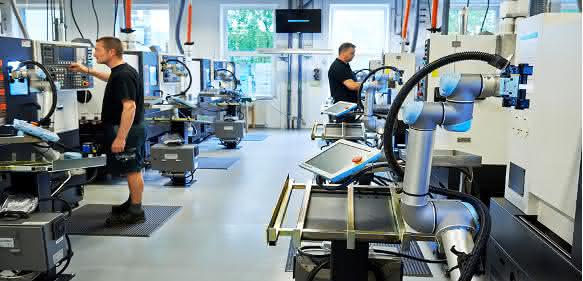
At 309 units per 10,000 employees, the robot density in the German manufacturing industry ranks third in the world. At the same time, the number of people employed in Germany reached its highest level since reunification in 2017, at around 44 million. The rapid expansion of industrial robots has led to a positive job balance in companies: in addition to tasks that are now performed by machines, new jobs have been created for employees. These are the findings of the latest study conducted by the Center for European Economic Research (ZEW) on behalf of the Federal Ministry of Education and Research (BMBF).
"The results of the ZEW study for the labor market confirm what we are seeing in the leading industrial nations worldwide in terms of automation with industrial robots," says Junji Tsuda, President of the International Federation of Robotics. "The modernization of production means that dangerous, unhealthy and monotonous work in particular is being taken over by machines. In the vast majority of cases, the new division of labor between humans and machines only affects individual activities in a workplace and not the entire range of work performed by an employee." However, if there are job cuts - according to the ZEW, five percent of employees have been replaced within five years - these are offset in the overall balance by new jobs.
In Germany, the increased use of machinery has led to an overall increase in the number of jobs of one percent. This trend is likely to continue in the future: Based on the information provided by the companies surveyed, the ZEW estimates that further automation and digitalization in companies will trigger processes that will lead to a 1.8 per cent increase in employment by 2021.
This development is in line with the historical experience gained from the 1990s onwards with the triumph of the computer. Although the mass use of IT in companies has made traditional clerical jobs redundant, according to ZEW calculations, employment rose by just under 0.2 percent per year between 1995 and 2011.
Robots at Work" study
The London School of Economics (LSE) recently examined the use of industrial robots in 17 developed economies between 1993 and 2007 in its "Robots at Work" study. At a press conference at Automatica 2018 at Messe München, LSE research director Guy Michaels summarized the most important results: "The use of industrial robots has improved the productivity of work by around 15 percent. At the same time, the proportion of low-skilled employment has fallen and wages have risen slightly. The use of industrial robots had no significant effect on the total number of employees," said Guy Michaels. as


You might also be interested in
Plagiarius 2024 negative prize
On January 26, 2024, the Plagiarius campaign awarded its dreaded "Plagiarius" negative prize for the 48th time to manufacturers and retailers of particularly brazen counterfeits and fakes.
 read more...
Ivalua honors winners of the Generative AI...
AI-supported "add-ons" for buyers within 48 hours
Ivalua, provider of cloud-based spend management solutions, announced the winners and innovations of the first Generative AI Innovation Cup. The competition took place in December 2023. It was open to all Ivalua partners and employees - more than...
read more...Efaflex celebrates 50 years of high-speed...
The emphasis is on "fast"
Since day one, Efaflex has wanted to use new technologies as early as possible and drive progress in the industry. This year, the family business is celebrating its 50th anniversary under the motto "Fast Forward".
read more...Security of supply even during power outages
In the winter of 2022, Germany was worried about energy shortages. The drugstore retailer dm did not paint any horror scenarios, but nevertheless saw the possibility of controlled, temporary, regional power cuts (brownouts).
read more...Safety technology in mechanical engineering
Modules with new functions
Euchner's product highlights at EMO 2023 include the communication-capable solenoid interlocks.
read more...Transforming the paper industry towards climate neutrality
Together with partners from industry and research, Voith is developing a project for the optimization of energy and material flows in paper production. The aim of the research project is to develop a digital framework that enables effective process...
read more...Up to 95 percent less flue gas thanks to direct extraction
The requirements for occupational safety measures and safety technology are also constantly increasing in welding technology. The Technical Rules for Hazardous Substances (TRGS) stipulate that welding fumes and harmful substances must be extracted...
read more...Competitive advantages with large machines
Whether 3D-printed components for machines and systems, prototypes or aids for design: additive manufacturing is almost indispensable for modern companies in mechanical and plant engineering and automation if they want to play in the premier league.
read more...Transport technology from the modular system
Many transport tasks can be realized with the help of linear technology. Pre-configured solutions are available to simplify the interaction between the linear unit, motor, gearbox and controller. This minimizes the effort required for research and...
read more...