
Agricultural machinery manufacturer automates pallet transport
The raw material supplier
The MiR500 autonomous transport robot from Mobile Industrial Robots supports intralogistics at the Kverneland plant in Kerteminde, Denmark.
The labor and maintenance-intensive use of forklift trucks could thus be reduced.
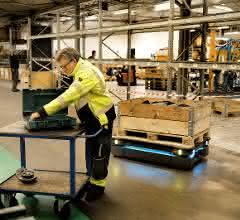
Founded in 1879 as a small forging company in Norway, Kverneland is now an agricultural machinery manufacturer with 2,440 employees in 17 countries. The company, which is now listed on the stock exchange, has been part of the Japanese Kubota Corporation since 2012. The machines for tillage, sowing and crop protection enable users to optimize their agricultural processes. There is great competitive pressure in the highly developed agricultural technology industry; Kverneland recognized the need to improve its own production processes. In Kerteminde, 500 employees assemble high-quality plows, seed drills and other products in the 55,000 square meter factory building. Around 100,000 pallets of raw material arrive here every year. Previously, manual pallet trucks or manned forklift trucks were used to transport the pallets; the material flow and work processes were not always efficient. Some employees spent most of the day moving pallets from A to B with the forklift truck. The necessary maintenance of the machines also tied up valuable working time.
Mobile robot replaces forklift truck
In order to gradually move away from labor-intensive solutions, Kverneland decided to automate the internal pallet transports. The right solution came from Odense, where Mobile Industrial Robots (MiR) develops autonomous transport robots that can navigate independently and move freely - ideal for the dynamic production layout in Kerteminde. The MiR500 model was chosen specifically for transporting heavy goods. It can perform the tasks of a forklift truck, but ties up fewer resources thanks to its autonomy. At the plant, a MiR500 of this type now transports pallets of heat-treated parts to and from the paint shop. For this purpose, it is equipped with a lifting device which, in conjunction with a stationary rack installation, enables it to load and unload the pallets without human intervention.
A typical route takes the robot from the welding hall to the paint shop, the warehouse and back again - that's around 500 meters. At a speed of up to 7.2 kilometers per hour, it can complete four such laps in an hour. As it works non-stop, it can cover around 48 kilometers in the course of a day. The robot saves one employee at least five hours of transport work per week, which can be used elsewhere in planning and production.
MiR500 for industrial environments
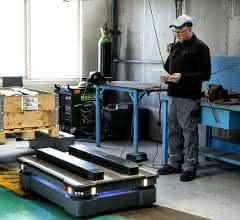
The size of a Euro pallet and with a load capacity of 500 kilograms, the MiR500 is robust and suitable for use on the busy factory floor. Puddles of water or oil often form on the floor, for example, and dust sometimes accumulates - but this doesn't bother the robot. It can also cope with uneven surfaces or ramps and can deliver to the Kverneland employees on time. It also works almost silently.
Commissioning the MiR technology was straightforward: Before its first use, the robot travels around its future operating environment to map it precisely. Alternatively, CAD files of the plant can also be imported into its system. This enables the transporter to calculate the fastest route to its destination. There is no risk of accidents: in contrast to the forklift trucks commonly used by Kverneland to date, the MiR500 recognizes obstacles in good time and automatically avoids them. This is ensured by two 3D cameras and two laser scanners, which allow a 360-degree view. Proximity sensors in each of its corners also help to ensure that the robot can be used directly next to people without hesitation. If it encounters an obstacle, it recalculates its route so that the logistics process does not come to a standstill - essential for Kverneland to ensure timely deliveries in the internal order program. The robot can also open and pass through gates independently via WLAN or Bluetooth.
Employees benefit in many ways
The MiR500 doesn't take work away from anyone. Rather, it takes care of tiresome transport aisles and makes work more pleasant for employees, as they no longer have to be constantly on the lookout for forklifts. This also eliminates the risk of collisions and accidents. In the long term, Kverneland would like to do away with forklifts at this plant in order to provide employees with maximum safety. Workers also benefit from the ease of use of the robot: it can be controlled intuitively via a web-based user interface, which the worker can access via cell phone, tablet or PC. Jobs can be loaded without any special programming knowledge: The worker taps an icon on the tablet and the robot follows the instruction.
Kverneland wants to expand the use of mobile transport robots in the future in order to automate routine journeys and give staff more productive time. This would probably require ten to twenty transport robots in the factory. In the future, these could also take on other tasks and, for example, supply the employees on the assembly lines with materials. pb


You might also be interested in
Basler acquires 76% of Indian image processor
Basler, supplier of image processing components for computer vision solutions, has acquired 76% of the Indian sales partner Alpha TechSys Automation.
 read more...
Process monitoring and fault detection
Cameras ensure quality during laser melting
Powder bed-based laser melting (PBF-LB/M) opens up new possibilities in additive manufacturing. Modern camera systems provide crucial process data to further increase quality and efficiency.
read more...Vision Sensor is three times faster than its predecessor
The 'CS-62' vision sensor from di-soric is around three times faster than its predecessor, the 'CS-60'. In combination with the 'nVision-i 25.1' software, it enables image processing solutions that were previously reserved for smart cameras.
read more...Thermal imaging cameras for quality control
Automated thermal imaging cameras are often suitable for quality control applications where temperature plays a role. However, while there are various solutions on the market for slow processes, it is challenging to select a camera that reliably...
read more...Easy entry into industrial VGA thermography
Reliable temperature measurement is a prerequisite for the success of many industrial processes. Berlin-based manufacturer Optris presents the Xi 640 infrared camera, a new member of its Compact Line, which enables non-contact temperature...
read more...Powder bed-based laser melting optimized
Aconity3D has set itself the goal of optimizing the stability of the manufacturing method of powder bed-based laser melting and thereby promoting its use in a wide range of industries. By using high-speed industrial cameras from SVS-Vistek, the...
read more...INDUSTRIAL Production Products of the year...
2nd place, category handling, assembly and production logistics: SICK
safeVisionary2 is the first 3D time-of-flight camera with Performance Level c safety certification. It enables safe three-dimensional environmental detection and won 2nd place in the competition for Product of the Year 2024 in the handling, assembly...
read more...Nomination Products of the Year 2024
SICK: Camera systems safeVisionary2
safeVisionary2 is the first 3D time-of-flight camera with Performance Level c safety certification. It enables safe three-dimensional environmental detection and has been nominated in the 2024 Product of the Year competition in the handling,...
read more...AI vision brings additional opportunities
The seamless integration of AI into the consumer sector has helped to improve our quality of life and make interactions with technology more efficient. In industry, AI vision with machine learning opens up new possibilities that are not covered by...
read more...