

Increased efficiency through simulation software
Assembly lines optimized for automotive displays
Schnaithmann Maschinenbau has planned and implemented three assembly lines for the automated production of automotive displays. Together with Schnaithmann's customer, a German automotive supplier, various system concepts were simulated, validated and compared with each other.
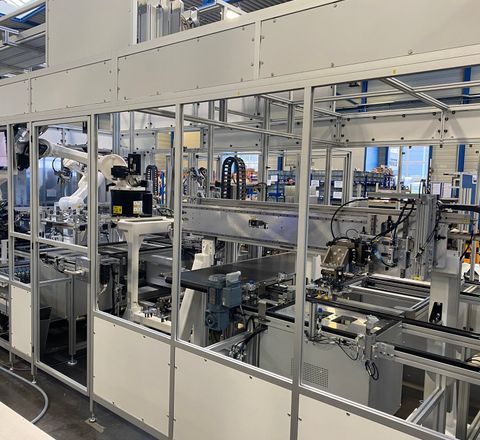
Based on the already known or assumed process parameters, the assembly line was optimally designed using the Visual Components simulation software with regard to the required buffer spaces and workpiece carriers, among other things. The digital twin created during the design phase was adapted to the actual design as the project progressed. It can be further optimized after commissioning with the help of the real process sequences and times.
The three assembly lines for the automated assembly of automotive displays comprise two lines for individual displays and one line for assemblies consisting of a central display and a passenger display. The display assembly lines consist of 14 stations, including two manual workstations and one station with four robots. The housing is prepared for the display and the gluing process in the first conveyor belt circuit (Loop 1). A transfer module connects Loop 1 with Loop 2, the second conveyor circuit. Here, the display is glued into the prepared housing: the "marriage" of display and housing. Further assembly steps include the curing of the adhesive and the insertion and screwing of the circuit board. At the end of Schnaithmann's assembly line, there is an interface to the end-of-line test of another machine manufacturer, which has also been integrated into the material flow simulation.
The right timing is crucial
"The challenge with gluing processes in particular is that every component has to be ready at the right time. If there are delays, the adhesive hardens prematurely and requires the affected components to be ejected," says Thomas Wahl, Project Planning Team Leader at Schnaithmann. "Another exciting question is the involvement of workers. Does an interruption, for example due to a short break, disrupt the entire process? These potential and irregular interruptions can also be stored and simulated in the workers' process times."
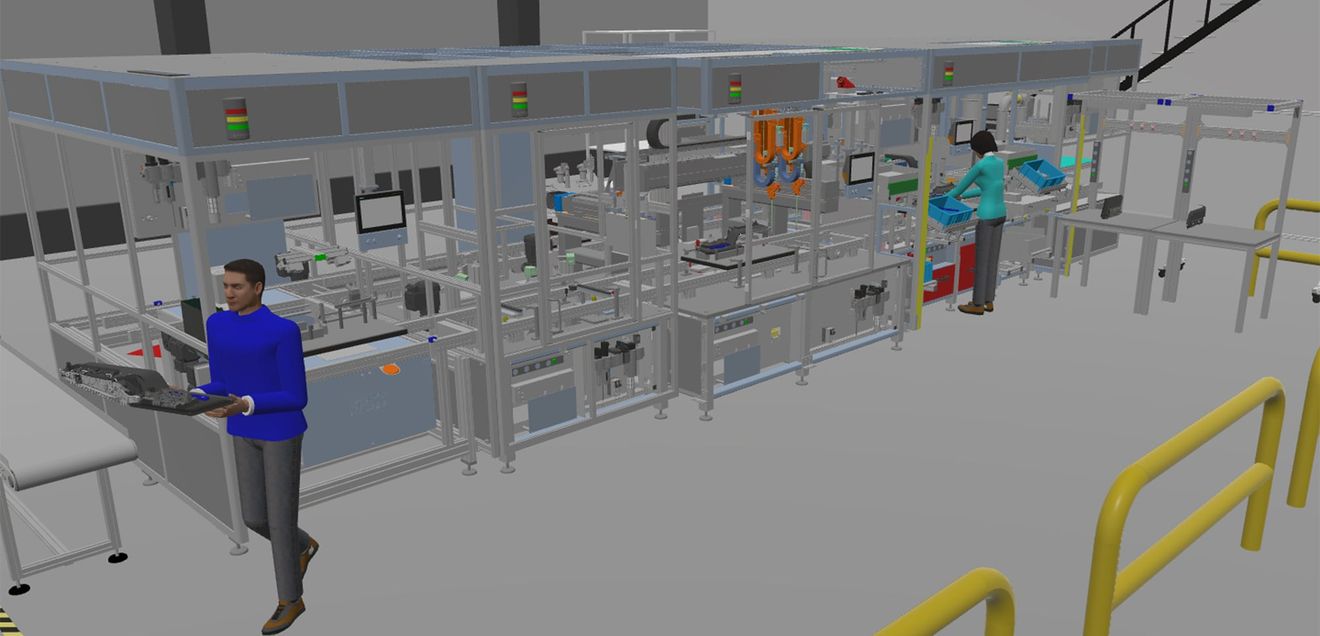
Schnaithmann has been using the Visual Components simulation software to plan and simulate assembly systems for three years now. The use of the software promises increased efficiency, savings in production costs and less time spent on project planning and design. Thanks to the extensive model library, which includes over 3,000 components from different manufacturers, visually appealing simulations can be created in the early project planning phase - even if detailed CAD files and information on all processes are not yet available. In the subsequent project phases, CAD data from the design and other detailed product and process information can complete the simulation.
At the beginning of the simulation process, the focus was on the following questions, as Wahl explains: "How many workpiece carriers are needed? Are there bottleneck stations and critical nodes in the chain? What are the effects of interruptions due to set-up work, maintenance or employee breaks? Where do buffer spaces need to be planned? How do the assembly lines influence the overall system effectiveness and system availability? And which work models, i.e. manual activities in connection with the line, are optimal?" Other points that had to be clarified with the customer as input for the simulation included the expected or estimated process times of the individual process modules, real process times from tests or reference systems and a worst-case scenario for failures or downtimes in individual processes.
Optimum number of workpiece carriers
On this basis, the simulation was used to determine the optimum number of workpiece carriers. In view of the desired diversity of variants - each line is to enable four different product variants - this is important to ensure that neither too many nor too few of the sometimes cost-intensive workpiece carriers are used later on. In addition, the necessary buffer spaces for a smooth material flow were determined and planned. "These optimizations result in the best possible availability of the system, even with short interruptions in individual processes, because buffers are built up and reduced again in a targeted manner," says Wahl. "In addition to the expected basic scenario, both a best-case and a worst-case simulation were carried out. On this basis, reliable statements can be made about system availability and the overall effectiveness of the system."
The digital twin, which was created from the simulation during the design phase, was adapted to the actual design as the project progressed. Extended requirements, additional findings and reliable data regarding the process sequences and times were added to the simulation software and the system was re-simulated in parallel. After commissioning, the digital twin can be further improved, for example with regard to the actual process times. "This means that even more reliable statements can be made regarding expected process or throughput times for subsequent optimizations or additional stations - in the spirit of simultaneous engineering," says Wahl.


You might also be interested in
Industry 4.0 in miniature format
Industry 4.0 places new demands on qualification and process understanding. An industry-oriented production simulation illustrates agile production and networked automation and enables complex processes to be analyzed and optimized in a practical...
 read more...
Florence Verzelen becomes Executive Vice President for EMEA
Dassault Systèmes has appointed Florence Verzelen as Executive Vice President for Europe, Middle East and Africa (EMEA). She will report directly to Pascal Daloz, CEO of Dassault Systèmes.
read more...Efficient energy for the process industry
The 'Mistral' research project, coordinated by TU Darmstadt, is developing a methodology that supports companies in planning their site-specific transformation. The aim is to systematically link measures at different levels in order to find the best...
read more...Simulation and industrial software
Billion-euro deal: Siemens takes over Altair
Siemens wants to strengthen its software business with a billion-dollar takeover. The Munich-based company intends to take over the US company Altair Engineering for around 10 billion US dollars (around 9.2 billion euros), as Siemens announced.
read more...Data management for digital twins as a service
Simus Systems is launching the "Interoperable data for the digital twin" initiative for companies that want to make their data fit for the digital twin. The service includes a data check in a pilot phase, individual optimization workshops and...
read more...No more complex test systems
In order to prevent faults during commissioning in advance, KEB Automation offers detailed firmware simulation models of its own inverters for download in the Twinstore.
read more...Additive and subtractive processing simultaneously
At Formnext, Open Mind will be presenting the benefits of the Hypermill CAD/CAM system for users of additive manufacturing processes. The Best Fit concept will also be explained: a technique for reducing the effort involved in post-processing.
read more...At high speed to the digital twin
Software tools for creating a digital twin can significantly improve the engineering workflow.
read more...Digital twins are the key to sustainability
Altair has published the results of an independent survey that shows a high level of acceptance of digital twin applications in the automotive industry. Furthermore, the use of these technologies is expected to increase as a means of achieving...
read more...