
Improve engineering workflow
At high speed to the digital twin
Software tools for creating a digital twin can significantly improve the engineering workflow. Shorter lead times, process validation in the design phases and time and cost savings thanks to virtual commissioning are just some of the benefits.
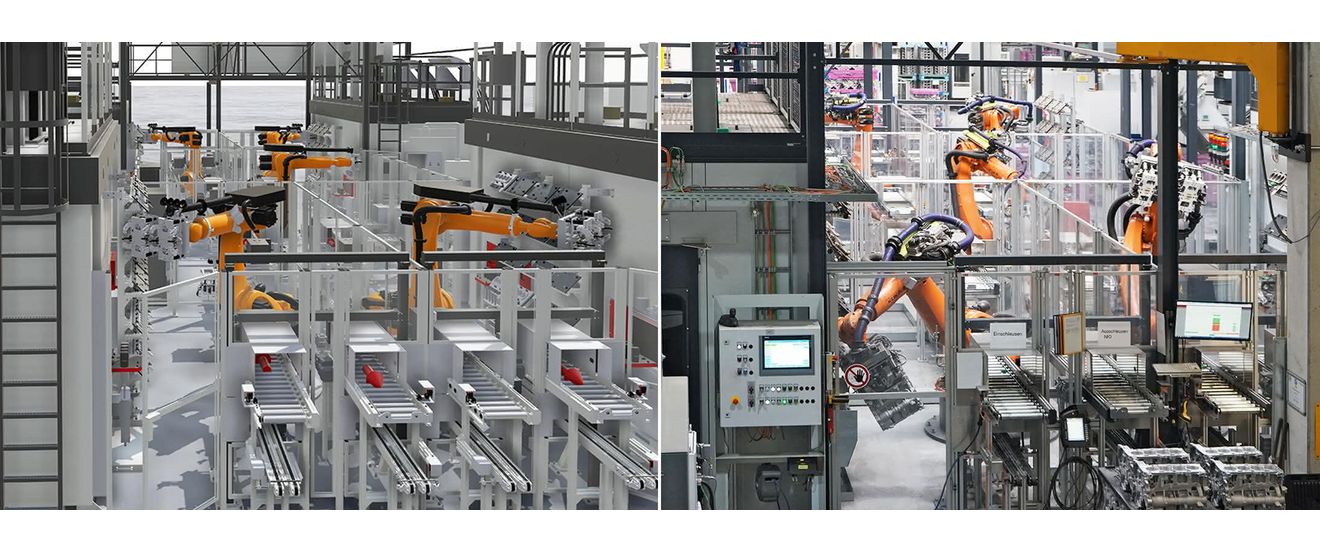
In many companies, the engineering process follows a classic workflow: a system is first planned and designed before the circuit diagrams and system electrics, software development, assembly, electrical wiring and commissioning follow. The developed PLC and robot software is then tested and finalized manually on the real system. In view of the advancing "digital engineering" and the associated workflow and data structure optimization, however, a rethink will have to take place in order to continue to be successful on the market.
Opportunities of virtual commissioning
By using a software tool for creating a digital plant twin - such as "fe.screen-sim" from F.EE - the engineering workflow is changed from the sequential workflow described above to parallel processing. The advantages are obvious: shorter throughput times, process validation at an early stage of the design and a commissioning process that - based on software tested offline with the digital twin - shines with significant time and cost savings. "We often find that - due to the coordination of the departments involved in the engineering process - internal communication in the companies also changes for the better during the implementation of virtual commissioning," says Dipl.-Ing. Peter Meier, Head of Software Development Simulation and Virtual Commissioning at F.EE.
And although many companies have already recognized the advantages of virtual commissioning, they still fear the supposedly associated effort and ask themselves how the simulation tool can be integrated into their engineering workflow. "There are also excellent opportunities here in terms of using existing data and automated model creation," explains Meier.
Mastering the flood of data
In order to achieve the goal of virtual commissioning - namely the creation of a model that largely corresponds to the physical system - a large amount of information and data is required. This ranges from the system layouts to technology diagrams of the conveyor elements as well as complete robot offline programs. And, of course, the 3D model must be provided in a format that can be read by the simulation software.
In addition to handling large volumes of data, the frequent lack of data consistency in the systems used, including information loss and media disruptions, poses a challenge. Nevertheless, it makes sense to use data that is already available in the process when creating digital twins, as this saves enormous amounts of time, among other things. The efficient use of this data for model creation therefore depends largely on the functional scope of the simulation software used. "Another important optimization factor is consistent data preparation and structuring throughout the entire engineering process," adds Peter Meier.
If no data that can be used for modelling is available at an early stage of the engineering process, an idealized model is first created - for example to initially validate the PLC programming - which becomes increasingly detailed as the project implementation progresses.
Use design data
The flexible and direct integration of existing CAD data from the mechanical design into a simulation tool is a key component in increasing efficiency when creating the digital twin, thanks to the time savings this brings. To avoid loss of information, a native connection of common CAD systems to the simulation software is advantageous. This eliminates the often lossy conversion to an intermediate format and ensures that the digital twin contains all the data of the later real system. Other positive side effects of direct data import are the associated optimization of internal processes and the reduction of interdepartmental coordination effort while ensuring the best possible flow of information.
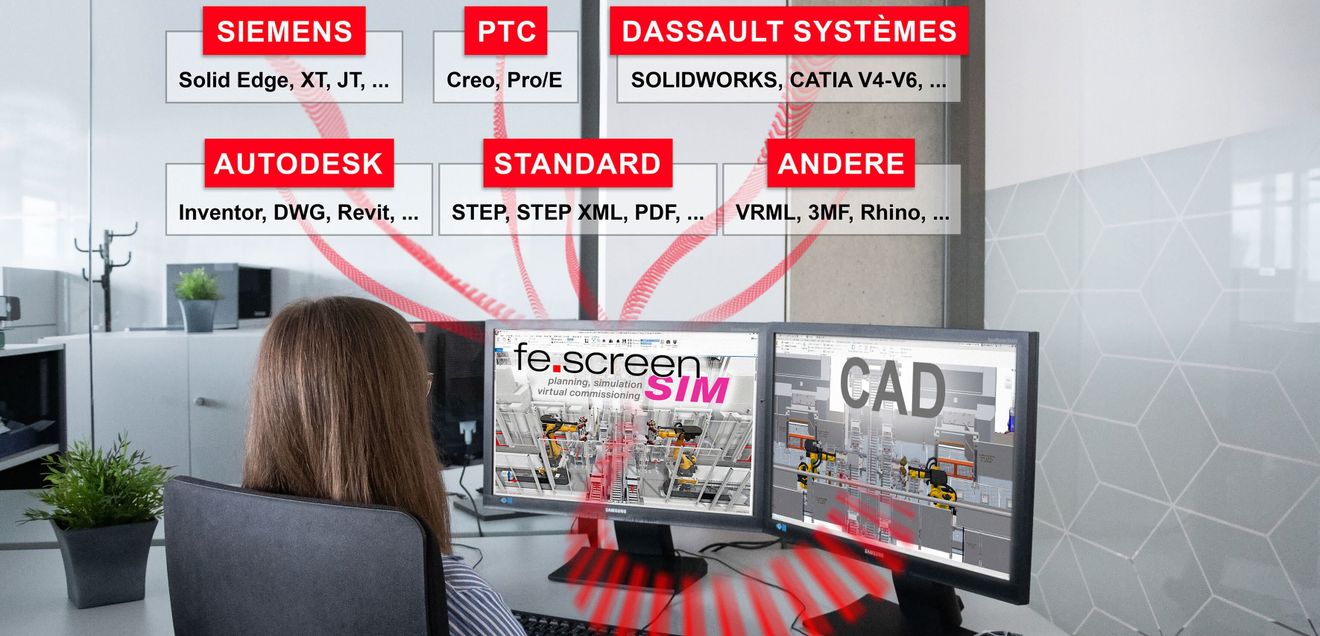
To connect the components used to the PLC controller, the I/O configuration of the electrical design is transferred to the PLC and from there to the model. A meaningful naming system makes mapping the PLC variables with the model much easier and also enables the implementation of automatic processes here.
An application programming interface (API), such as that provided by the fe.screen-sim software tool, is also an important factor in the automation of virtual commissioning.
Most programs used in the engineering workflow today have a macro interface that enables data exchange via the API - not by means of file transfer, but via bidirectional communication between two different programs. "The API allows you to integrate your own macros, applications, tools and information into the simulation solution and create models automatically," explains the virtual commissioning expert from F.EE.
In addition to the direct macro-based data transfer from a CAD system to fe.screen-sim, the interface in Excel can also be integrated using VBA code. This enables the fully automatic execution of repetitive work steps in the simulation. If, for example, a designation system has been established that enables the creation of an algorithm between mechanical design and electrical planning, models can also be created automatically based on this.
This article appeared in issue 6/23


You might also be interested in
More than 900 exhibitors already registered
Around six months before the start of the trade fair, more than 900 companies have registered for SPS 2026 in Nuremberg. The trade fair focuses on industrial AI, cyber security and digital transformation.
 read more...
Virtual PLCs in practice: How vPLCs make production systems more flexible and scalable
The increasing networking of IT and OT is fundamentally changing industrial automation. The IT/OT Integration Summit shows how modern technologies can make production environments more efficient, flexible and future-proof. The event will focus on...
read more...Sales growth in a turbulent market environment
Thanks to innovations and a focus on strategic industrial markets, Sick was able to moderately increase its sales in the 2025 financial year. In a turbulent market environment, the company was able to maintain its position and gain market share with...
read more...Siemens presents new AI agent
Siemens is launching 'Eigen Engineering Agent', an AI for automation technology. The solution is integrated into the TIA Portal, has been tested with over 100 companies and is designed to significantly accelerate engineering processes.
read more...Schaeffler keeps sales almost stable
Schaeffler generated revenue of EUR 23.5 billion in 2025 and increased EBIT before special items to EUR 936 million. At 266 million euros, free cash flow was significantly above the prior year and forecast. Net income remained negative due to high...
read more...Advancing artificial intelligence together
Helukabel is stepping up its activities in the field of artificial intelligence and is now a member of the IPAI. The innovation and collaboration platform for companies, research facilities, institutions and administration has set itself the goal of...
read more...New impetus for ifm sales
Two new positions were filled at ifm at the start of 2026: Markus Wolf becomes Managing Director Sales Germany, Sven Quant takes over the position of Central Managing Director in the Process Sensors division within the ifm Group.
read more...Digital twin meets product passport
Future-proof end-to-end solution at SPS 2025
At SPS, conplement and R. STAHL will present how the digital twin works end-to-end along the entire value chain: from creation and provision to productive use.
read more...Changes in the management of Endress+Hauser
Endress+Hauser strengthens its management team: Mirko Lehmann, Katja Windt and Helena Svensson take on central management roles. What is changing in technology, production and personnel.
read more...