
Be More Open to Machines
Industry Survey on Robotics in Germany
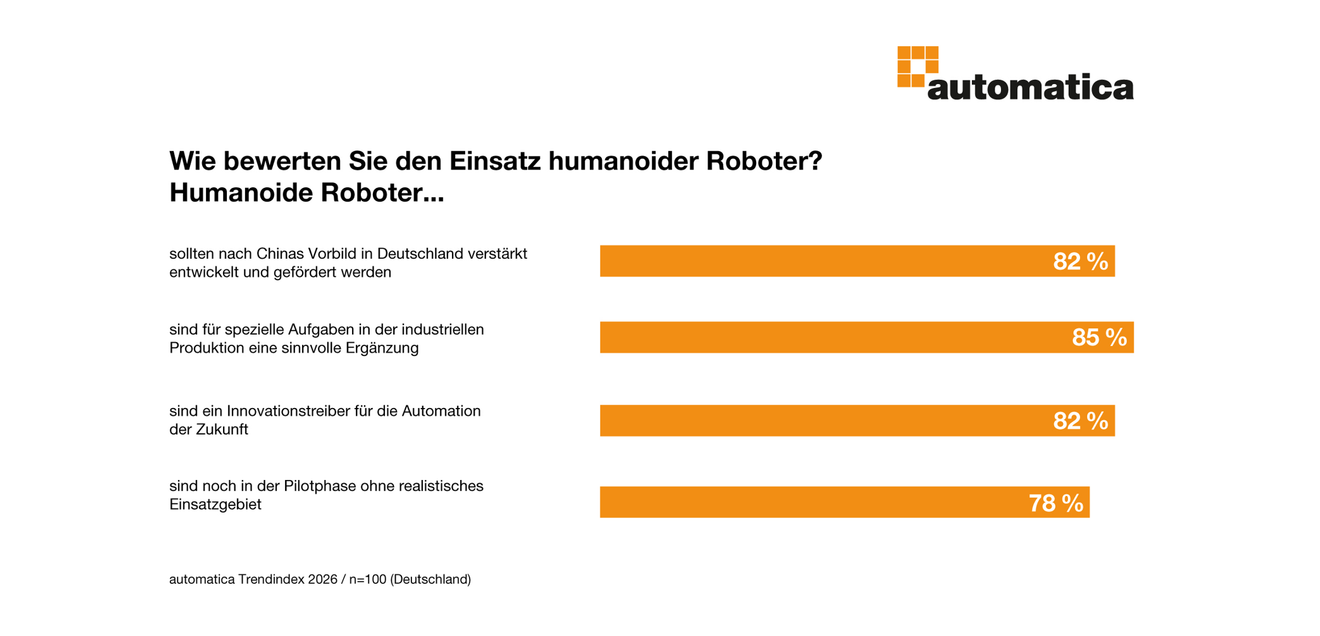
82 percent. That is the percentage of industrial decision-makers surveyed in Germany who view humanoid robots as one of the key drivers of innovation for the automation of the future. And the call for action is just as clear: Germany should develop and promote humanoid robotics more consistently, following the Chinese model. These are the findings of the automatica Trend Index 2026. On behalf of automatica, 100 specialists and executives who are responsible for robotics and automation decisions in their companies were surveyed for this study.
According to the analysis, China is showing how industrial policy in this field can look. “For years, China has been consistently pursuing a national robotics strategy to systematically capitalize on the opportunities offered by modern automation,” says Patrick Schwarzkopf of the VDMA’s Robotics + Automation Division. “The five-year plan recently unveiled by Beijing now places intelligent robotics at the center of its development goals. Humanoid robots are opening a new chapter in this effort: The goal is to develop ‘embodied intelligence,’ in which AI software is integrated with physical robotics. Entirely new practical applications of AI for automation in industry and the economy are planned.”
Between Theory and Practice
Here in Germany, too, the direction is clear. 78 percent of respondents consider the use of AI in robotics and automation to be indispensable when it comes to the competitiveness of German industry. At the same time, the data reveals a certain transitional phase: 85 percent already view humanoid robots as an important addition to industrial manufacturing, but 68 percent of respondents say they are still primarily used in pilot projects—without widespread implementation.
“Humanoid robotics is certainly a particularly compelling example of Physical AI, because here, AI in human-like form interacts with the real world,” says Anja Schneider. “We can already say that Physical AI and humanoid robotics will be the top topics at automatica 2027.”
A Good Starting Point, but Questions Remain
The technological logic behind this is less science fiction and more like a modular system: mechanical engineering, sensor technology, control systems, and AI software are converging. A key component of what is known as “Physical AI” is real-world manufacturing data, which is collected and processed via sensors.
And what is the current situation? According to the study, it is quite good. With its highly developed manufacturing facilities, Germany ranks among the countries with the best conditions. With 449 industrial robots installed per 10,000 employees, it has one of the highest robot densities in the world. According to the International Federation of Robotics (IFR), this puts Germany in third place, behind South Korea and Singapore.
The question that remains between the lines: How quickly will this pilot project become standard practice?


You might also be interested in
Environmental technology as the industry of...
Ifat reports record figures for its 60th anniversary
Ifat Munich 2026 records record numbers with 3,400 exhibitors and 142,000 visitors The circular economy and water technologies are becoming key global industries.
 read more...
Peak visitor numbers
From June 24 to 27, Automatica 2025 in Munich demonstrated the solutions that intelligent automation and robotics offer for the challenges of the future. A total of around 47,500 visitors from more than 90 nations gathered information from around...
read more...International Federation of Robotics
U.S. Robotics Industry Sees Double-Digit Growth
In the U.S., sales of industrial robots rose by 11% compared to the previous year: 38,000 units were newly installed in 2025. This significant recovery is driven by robust growth in the food industry and other non-manufacturing sectors. However, the...
read more...Development Collaboration for Humanoid Robotic Hands Launched
Schunk is entering into a new development partnership with Robert Bosch Robotics. Their shared goal is to develop an industrial-grade robotic hand that can be integrated into various humanoid robot systems.
read more...International Federation of Robotics
The 2026 IERA Award was presented
The 2026 “Award for Innovation and Entrepreneurship in Robotics & Automation” (IERA) goes to the Swiss deep-tech company Verity for its fully autonomous indoor drone system. The flying robots support the logistics and retail sectors by...
read more...Humanoid robotics from Germany
Igus launches service robots for everyday industrial use
Humanoid robotics: With the Iggy Rob Home, igus presents a service robot for industry and everyday life. What's behind it.
read more...Siemens uses humanoid robots in its plant
Humanoid robots working in factories has long been considered a vision of the future. Siemens, Nvidia and the British start-up Humanoid have now brought this moment a little closer - with a tangible practical test under real conditions.
read more...6 Criteria for the objective comparison of humanoid robots in industry
A new benchmark from Fraunhofer IPA is intended to enable the first standardized and neutral analysis of humanoid robots for industrial use based on six key criteria.
read more...New sales and service unit in Gurugram
Yamaha Motor expands robotics business in India
Yamaha Motor is opening a new Robotics Business Support Division in India to strengthen sales and service in the growing robotics market. The unit will support SMT systems and industrial robots, among other things, and will be complemented by a...
read more...