

Cable production
How a cable is made
The production of power cables follows a largely standardized process. An earthing or protective conductor, a neutral conductor and a current-carrying wire are located under a protective plastic sheath. The conductors consist of several copper strands twisted together. But how exactly are these cables made?
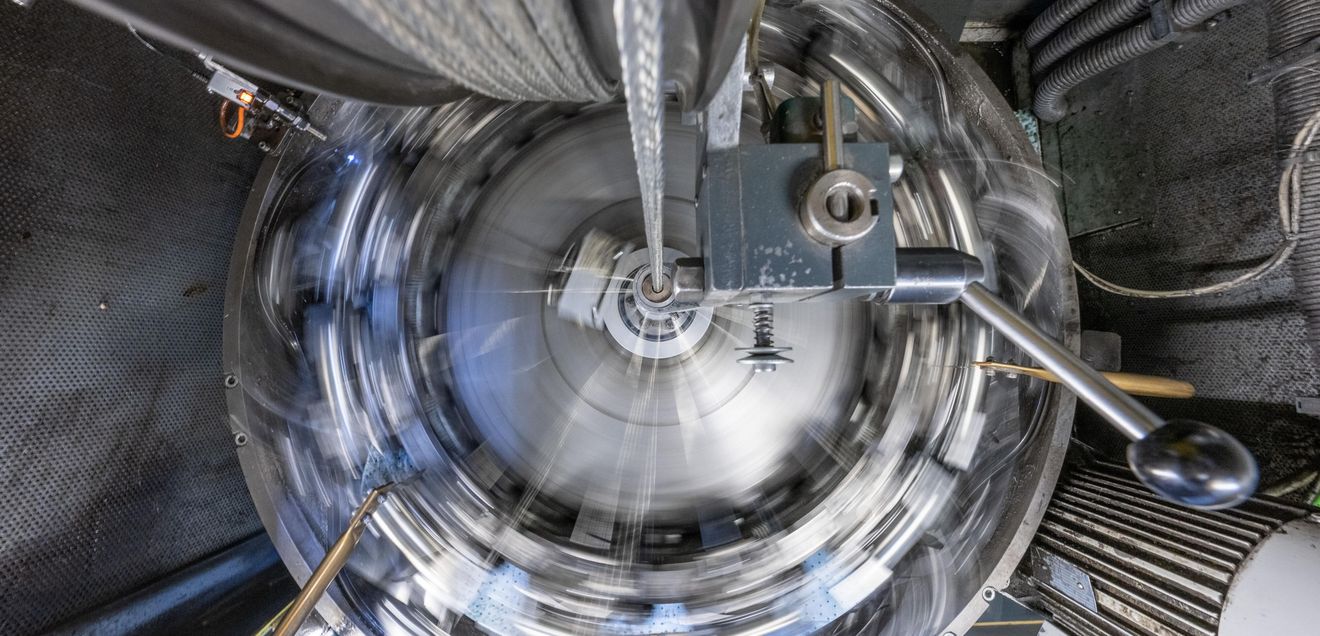
Lapp has been producing high-quality cables, wires, connectors and drag chains for over 60 years. The Stuttgart-based company produces thousands of kilometers of different types of cables every day. The largest plant in Forbach, France, produces around 130,000 km of cable every year. The plant in Stuttgart concentrates on connection and control cables in smaller quantities. Lapp also has plants in France, Italy, India, Korea and the USA.
But how exactly do we get to the end result, a durable and flexible cable? "First of all, we select the right raw materials for the cable to be produced," explains Joachim Schmid, Managing Director of Stuttgarter Kabelwerke. "We then use them to set up the system." Depending on the planned end result, the prescribed parameters are set on the machines. Cable production is highly individual - plastics can react very differently to heat, cold or humidity. This is why the machine and system operators' sensitivity and expertise are essential right from this first step.
Copper as a conductor
The copper strands are just as important. Copper is an excellent and durable conductor. Its soft nature also makes it an easily workable, resistant and ductile metal. Before the finished strand drums are delivered to Stuttgart, copper blocks must first be drawn over drawing machines. Diamond drawing irons are used to grind the blocks into thin wires that can be further processed at Lapp. Different strand classes can be defined during the stranding process. These determine the flexibility of the cable. Lapp has its own copper drawing line at its production facility in Forbach. This saves costs during production and ensures that this production step also meets the high quality standards of the products.
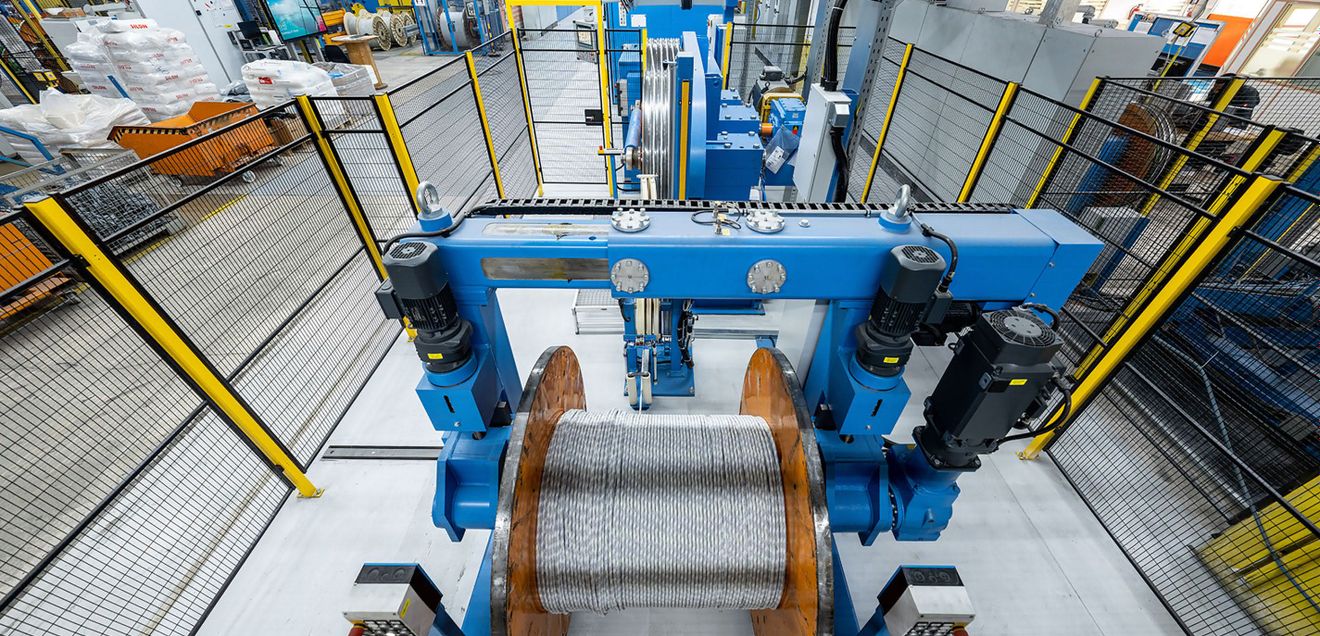
The first production step begins on the core lines. First, plastic and color granules as well as any additives, for example to protect the plastic from the effects of heat later on, are filled into hoppers, after which the single-screw extruder takes over the next step. A plasticizing screw rotates inside the extruder - you can think of the system a bit like a heated meat grinder. Along this screw, the granules are first mixed in from the hopper and compacted, then melted and processed into a homogeneous mass in the third stage. Depending on the type of plastic used, the temperature in the extruder can be up to 240 °C, in some cases even 300 °C.
Producing the insulation
The homogenized melt is conveyed at the end of the screw in the extruder to the extruder head. There, the copper strand runs through the appropriate tool and the melt is formed around it. Once the strand has its insulating plastic layer, it cools down in a water bath. The hot insulation is now cooled down to the core of the wire. This prevents the cores from sticking together when they are wound onto the iron coils. This process is almost identical for inner and outer sheath extrusion.
After wire extrusion, the individual wires are stranded into a flexible wire bundle in the stranding shop. The individual cores are inserted into the stranding machines in sequence by color or numerically or alphanumerically. When the machine operator starts the stranding machine after set-up, it automatically brings the individual cores together with a rotary movement to create a kind of cord. The finished product is referred to in technical jargon as a wire bundle, stranding or cable core. Stuttgarter Kabelwerke recently acquired a new tube stranding machine for this production step, which at 50 m long is the largest and most modern of its kind. "This purchase was necessary in order to achieve our output of more than 35,000 km of cables per year in accordance with our 2027 strategy in the cable plant. It will increase our capacity enormously," says Joachim Schmid.
Solutions for different environments and conditions
Lapp's numerous connection solutions also include cables and wires that have to withstand different conditions and environments. Servo or control cables that need to be protected against electromagnetic influences or mechanical loads, for example, are given an additional braid before the outer sheath insulation. According to the Lapp standard, this braid made of tinned copper has a degree of coverage of 80 to 85 %. Special foils are used for data cables that are only to be protected against electromagnetic influences. To prevent the braid from damaging the cable core, an inner jacket is added between the core and the braid, depending on the product.
Last but not least, the cable is given a protective plastic outer sheath - this process is similar to core insulation. A separate fleece winding under the jacket prevents the cable core from sticking to the outer jacket. The cable can now be printed; Lapp has a specially defined print legend for this purpose. This serves various legal and normative requirements. For example, it ensures the traceability of the cables and lists various specifications that may be relevant for electricians.
Last step: the high-voltage test
In the final step of the production process, high-voltage tests are carried out in special Faraday cages. This tests whether the cables can withstand the stresses of wire against wire or wire against shield. Simulated short circuits with voltages of up to 6,000 V test the electrical insulation capability and dielectric strength. After successful testing, the cable is rewound from the iron drum onto wooden reels and then transported to the logistics warehouses and distribution centers.
The production residues are then stored separately. Plastic waste and surplus copper strands from cable production cannot be used again in production. Lapp therefore sells this production waste so that it can be recycled and reused in other areas.


You might also be interested in
New loyalty program at Conrad
With its platform economy, Conrad Electronic enables simple and fast procurement from a single source and acts as a solution provider to make it as smooth as possible for business customers to cover their technical needs.
 read more...
Sales growth and future investments in anniversary year
In the past 2025 financial year, the Wago Group achieved an eight percent increase in turnover compared to the previous year. The company is also expanding its product portfolio and entering the smart home market.
read more...VDE Association for Electrical, Electronic...
Christoph Kutter is the new President of the VDE
Change at the top of one of Europe's largest technology organizations: Prof. Dr. Christoph Kutter replaces the previous VDE President Alf Hendryk Wulf as VDE President. His presidency will focus on young people and the microelectronics of the future.
read more...New servo cables for cable drag chains
Helukabel is expanding its range of 'Heluchain' cables for highly dynamic use in energy supply chains to include the 'Heluchain Topserv 201-PVC UL/CSA' and 'Heluchain Topserv 211-PUR UL/CSA' servo cables, which are particularly suitable for gliding...
read more...Modular plant construction for corrugated board
Insight into the production of corrugators at BHS Corrugated: Automated, modular and equipped with Helukabel components.
read more...50 years of productronica - A trade fair preview
From November 18 to 21, 2025, the international electronics industry will meet in Munich for Productronica, which is celebrating its 50th anniversary this year. A preview of the trade fair.
read more...For the new Ecodesign Regulation
At SPS, ebm-Papst will be presenting innovative and energy-efficient fans for ventilation and air-conditioning technology, especially for control cabinet and electronics cooling.
read more...Automation, robotics and industrial networks
At SPS 2025, Rosenberger will be showcasing a broad portfolio of connectors and system solutions for reliable data and power transmission in automated production environments.
read more...More endurance in the chain
Tight bending radii, vibrations and aggressive environments put a strain on cables in energy supply systems. Helukabel presents specially designed drag chain cables that ensure long-term reliability, reduce downtimes and protect machine processes in...
read more...