

Timo Göbel, Head of BMW Additive Manufacturing
"Clearly on course for broad industrialization"
The BMW Group's Additive Manufacturing Campus (AMC) is setting the course for the next stage of industrialization. Under the leadership of Timo Göbel, additive manufacturing is being further integrated into all stages of the vehicle life cycle, with a high degree of automation and a clear focus on quality. In this interview, Göbel explains how the Campus is driving forward the scaling of the technology, further developing the range of components and process integration and how the BMW Group is strategically aligning itself in the field of additive manufacturing.
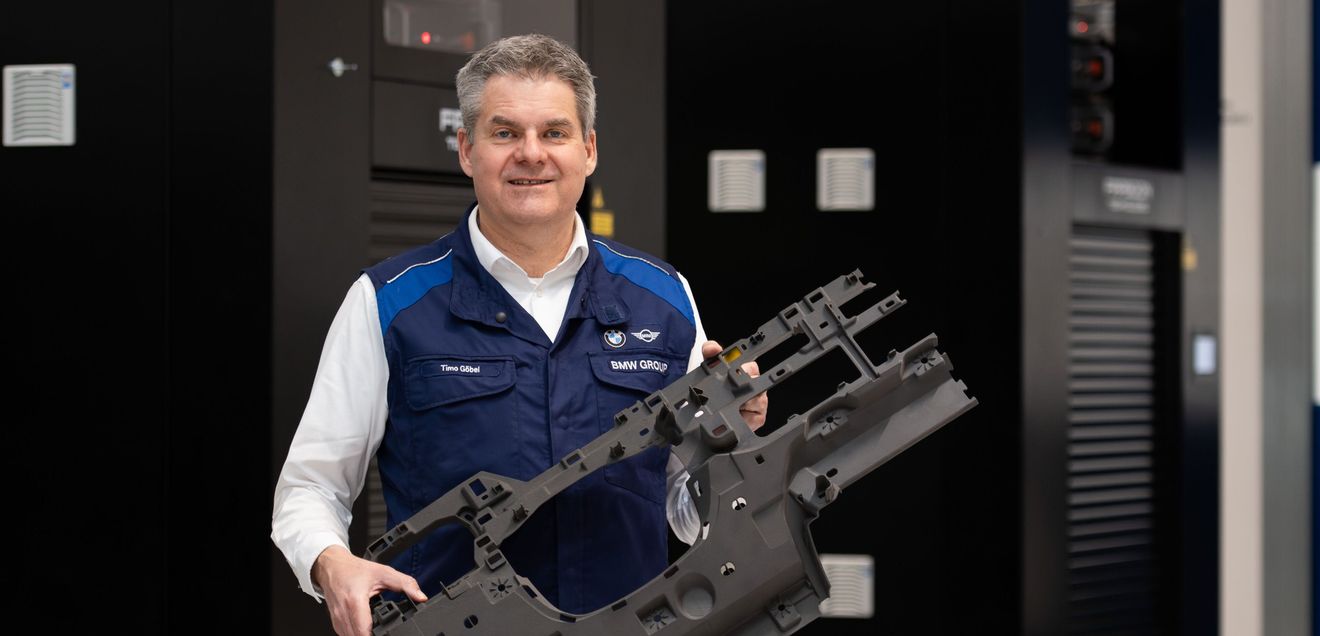
Mr. Göbel, what experiences have shaped your view of additive manufacturing?
My professional background is materials engineering and application-oriented, particularly through my time at Rolls-Royce. There, I saw early on how powerful additive manufacturing processes can be if they are used correctly. This experience still shapes my view today. Even back then, I was clearly in favor of the technology and am now very much looking forward to shaping the next development steps for the BMW Group.
How is additive manufacturing developing at the BMW Group? What strategy are you pursuing?
Additive manufacturing is now firmly integrated into all phases of the BMW Group's product life cycle. 3D-printed components are used from early development through prototype production to series production and to support the global production network.
Additive processes are constantly evolving in prototype construction. Today, we can depict functional requirements that were not possible just a few years ago. As a result, AM is becoming an increasingly important tool for fast, flexible and technically high-quality development processes and is making a decisive contribution to further shortening development cycles. For example, AM supports the development and validation of new class vehicles. 3D-printed components were also used in the development of the latest generation of electric drive technology.
AM is present in the production system at every BMW Group plant worldwide. The technology supports our colleagues in the production network and allows them to quickly and easily manufacture additive components to optimize work steps and production processes. This area is currently growing particularly dynamically.
In the area of end customer components, such as individual and edition components, series parts and after-sales components, the technology opens up both technical and economic advantages and creates unique customer experiences. As we are seeing strong growth and broader areas of application in all phases of the product life cycle, we are continuing to invest in this key technology.
How do you intend to further scale additive manufacturing in the BMW Group and what are you doing specifically?
The major pre-development projects IDAM and Polyline were an important precursor to the scaling of AM applications. In these projects, the BMW Group actively helped shape the basis for scaling in the automotive sector by defining requirements, developing solutions and piloting system-integrated structures.
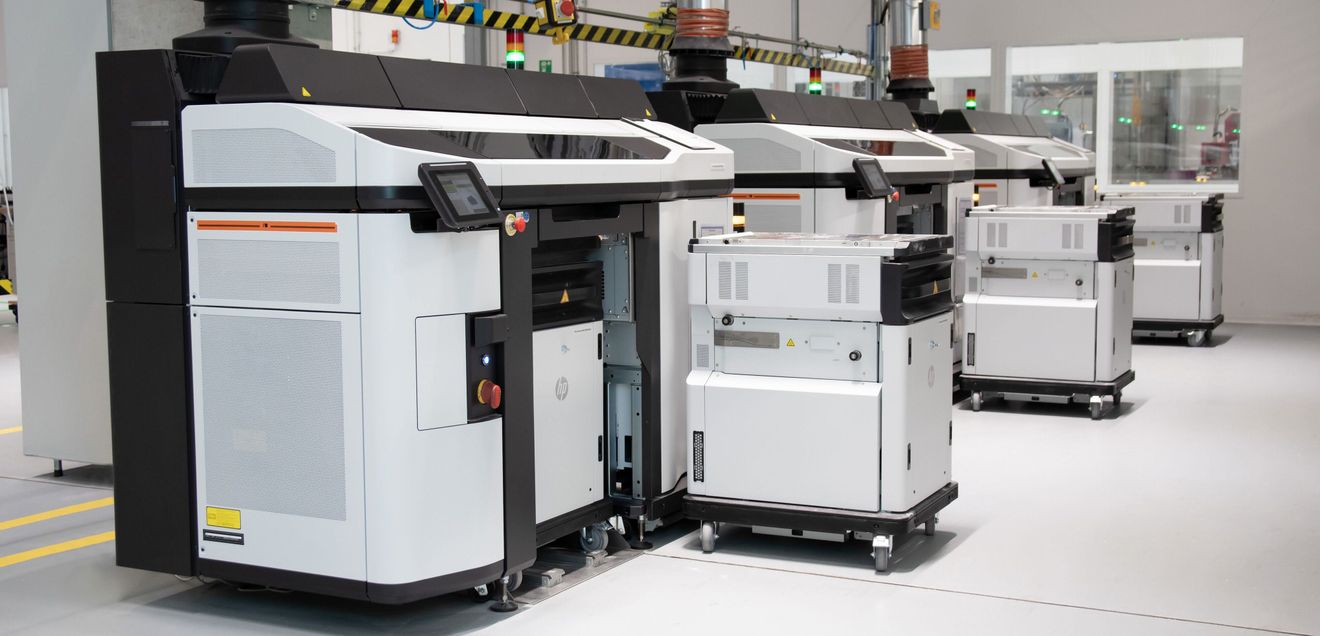
Automated, digitally networked process chains, open material systems and open interfaces that enable smooth integration into our existing production structures are key components of our scaling. We are therefore investing in an expanded technology portfolio with precisely these requirements and in systems with larger installation spaces.
In the plastics sector, we rely on fully production-ready systems wherever possible. Where the market does not yet offer these, we procure systems that are manufactured precisely to our requirements. In future, we will make greater use of systems that reliably meet the high requirements of our plants.
In the metal sector, we have already integrated key sub-processes from the IDAM project into our campus infrastructure. The next step will be the introduction of a completely new generation of metal 3D printers. We are also scouting intensively on campus and testing new technologies, materials and processes, which we are gradually transferring to the BMW Group process landscape. A current example of this is the integration of new production technologies such as Wire Arc Additive Manufacturing (WAAM) into the BMW Group production network.
Another decisive factor is the qualification of our development and production employees worldwide. By broadly anchoring AM expertise, we create the basis for sustainable scaling throughout the company.
Where is this leading? Which components are the focus?
Scaling will enable us to produce larger components with significantly improved properties across the entire product development process - and with a much shorter lead time. This means we no longer need tools for many applications, which significantly increases flexibility and speed.
In development, additive processes are already enabling highly functional components that can be used in dynamic functional runs and even crash tests, with qualities that could previously only be achieved using test tools. The new generation of highly productive, automated systems at the AM Campus leads to significantly faster and more efficient production. The larger installation spaces enable the production of large, one-piece and highly functional components. As a result, we are opening up significantly more applications in prototype construction and increasing the use of the technology.
In series production, we expect larger components in higher quantities in the coming years thanks to highly productive systems. WAAM significantly accelerates the production of large-format components and can be optimally integrated into our existing systems. In the production system itself, fast, robust and user-friendly systems ensure that our plants worldwide can manufacture additive production aids independently, quickly and decentrally. This increases efficiency throughout the entire development and production network.
Your outlook: What happens next?
In the short term, we are concentrating on integrating the new generation of systems. This puts us clearly on course for the broad industrialization of additive manufacturing. In terms of technology, we are in the process of fully transferring WAAM to series production. The process is already firmly established in prototype development, vehicle testing has been underway since 2025 and we will start series production of the first components in 2027.


You might also be interested in
3D Printing in the Defense Sector
Formnext Launches 2026 Defense Summit
Formnext is expanding its program to include the security and defense sector and will host the first Formnext Defense Summit in 2026. The event will focus on the potential of additive manufacturing for resilient supply chains, industrial...
 read more...
UltiMaker Doubles Speed in Industrial 3D Printing
With the Factor 4 Plus, UltiMaker is introducing a new version of its industrial desktop 3D printing platform, which operates at up to twice the print speed of the standard model. The platform is designed for use in manufacturing and defense...
read more...Stratasys takes over MarkForged
Stratasys is acquiring MarkForged from Nano Dimension for USD 42.5 million, thereby expanding its portfolio in the field of fiber-reinforced composites. The acquisition also strengthens the company's software and materials expertise in industrial 3D...
read more...Real-time control to make recycling materials economical
The Fraunhofer IAPT is researching AI-based closed-loop processes for industrial 3D printing with recycled plastics. The aim is to achieve less waste, greater process stability and profitable printer farms.
read more...Forum Solutions 4AMIndustry shows ways into industrial application
Additive manufacturing has developed dynamically in recent years and has long outgrown its status as a purely innovative technology in many industries. Nevertheless, companies still face the challenge of integrating AM into their production...
read more...Alliance aims to drive forward industrial 3D printing
Machine components, electrostatically shielded transport containers, large components for the automotive, rail and aviation industries or specific medical products straight from the printer - the potential applications of additive manufacturing are...
read more...Photonic microchips with 3D connector
How a 3D system makes photonic chips industrially viable
A research team from Heidelberg is developing a 3D-printed "connector" for photonic microchips. The solution promises a low-loss, standardized coupling of glass fibre and chip - and could fundamentally simplify the production of photonic integrated...
read more...Stratasys simplifies post-processing for 3D printing
Stratasys has launched a partner program for post-processing solutions to facilitate the creation of end-to-end AM workflows. The first partner is PostProcess Technologies, whose automated systems for FDM, PolyJet, SLA and P3 can now be purchased...
read more...Formnext 2026 puts UK and key industries in the spotlight
Formnext 2026 will focus on the United Kingdom as the official partner country. At the same time, the leading trade fair for additive manufacturing is further expanding its involvement in key user industries, including orthopaedics, aerospace and...
read more...