
OT Meets IT
Virtualized Control Technology in Practice
Software determines functionality—in TVs, cars, and smartphones, as well as in industry and the industrial control systems used there. This leads to the virtual PLC. What do such control systems look like in practice, and how can they be used?
Today, everyone uses virtual machines and drives created by software in data centers. Virtualization enables independent configurations for different applications and enhances system data security through sensible access restrictions. Even in common industrial control systems, software determines the range of functions—virtualization is clearly the way to go here as well.
Although physical devices are also required to run virtual controllers (vPLCs), their underlying hardware is abstracted. The control project is executed via a runtime environment—that is, software—that is agnostic to the specific hardware. These can be dedicated industrial devices such as industrial PCs and edge computing platforms, or even server systems (HCI). Software containers utilize the abstracted hardware. If you create a container using a pre-configured image with an integrated vPLC, the virtual PLC is immediately up and running. Essentially, only parameters such as Ethernet ports for the fieldbus need to be configured. This deployment can be carried out in various ways: IT administrators use Linux commands, scripts, or tools like Kubernetes, while automation engineers use PLC tools such as the Codesys Development System. If necessary—and provided the underlying infrastructure has sufficient capacity—multiple instances can be created in parallel for different control tasks, similar to microservices in IT. Physical inputs and outputs are operated via preconfigured Ethernet ports using fieldbus protocols such as EtherCAT or Profinet. Physical ports can even be virtualized via VLANs in suitable switches. The controllers inherit their real-time behavior from the Linux operating system, including the RT-Preempt real-time kernel.
Having multiple independent PLCs on a single piece of hardware reduces the costs of purchasing, wiring, and maintaining the physical devices. Fewer PLCs and power supplies in the control cabinet mean more space and less wiring effort. vPLCs are much easier to manage and update with new applications. An important consideration in the era of the Cyber Resilience Act: By distributing the PLC application across vPLCs—similar to microservices—IT security is strengthened. This allows the entire system to continue running even if one vPLC has been compromised. It can be replaced with a new vPLC without any hardware costs. And, of course, it’s much easier to install updates on centrally managed vPLCs than on their physical counterparts located somewhere in the control cabinet. This makes systems more resilient against cyberattacks.
Virtualization of Safety PLCs
EU regulations and national laws require that potentially hazardous machinery and equipment be safeguarded to protect people throughout their entire life cycle through design measures and safe control technology. IEC 61508, as the foundational standard, defines, among other things, basic concepts and general aspects for the use of electronic controls in machines and systems. Depending on the risk situation, manufacturers of systems with potential hazards must have their products certified according to safety integrity levels (SIL 1 through SIL 4)—including all components used as well as safe control applications. Stationary machines with SIL3 require two independent processing channels for the control application. Until now, certified, dual-channel hardware systems had to be used for this purpose. Now, this can also be achieved using software. In the “Coded Processing” method, which has been in use for more than 30 years, the safe PLC application is split into two independent channels via a special data transformation known as “Diversified Encoding.” Comparisons and checks of data and control flows, safe inputs, and data streams from network and fieldbus protocols enable the reliable detection of potential errors. This concept achieves the same safety level as dual-channel hardware. This also makes it possible to use secure virtual controllers (vSafePLCs).
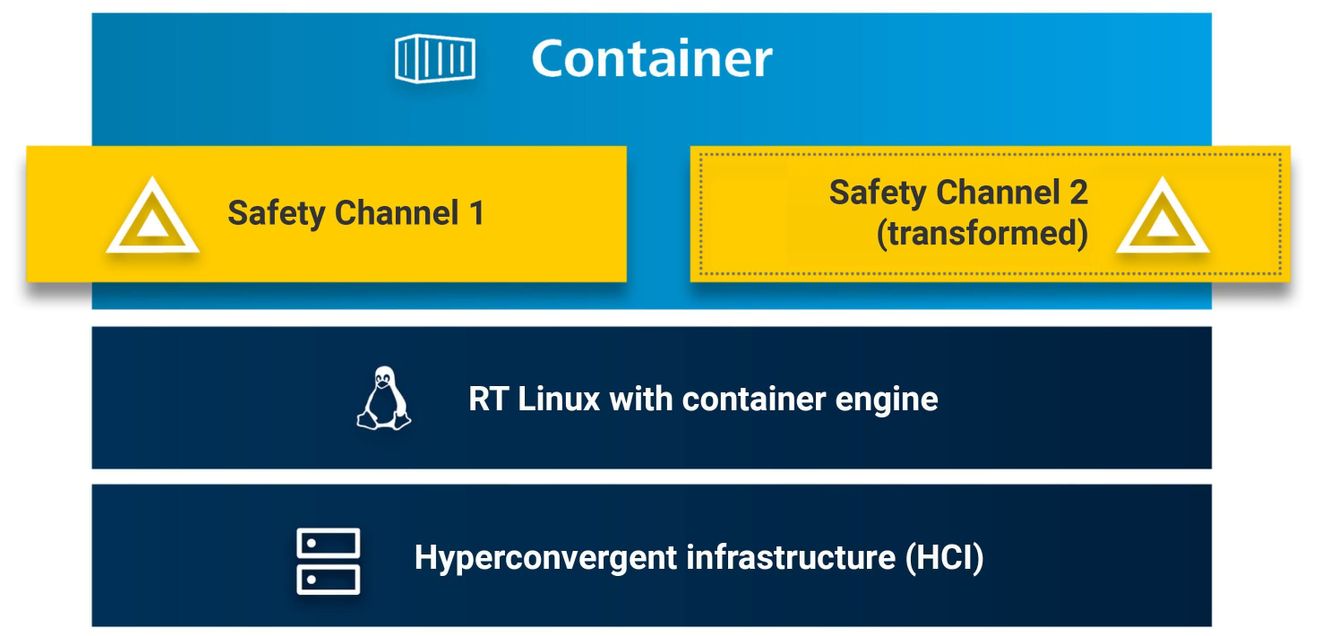
While the first products using coded processing in the early 2000s were still too slow for industrial applications, today’s versions—with significantly more powerful processors and optimized software algorithms—are ideally suited for such applications. Although such a system is slower than one without transformation, the difference is only by a factor of 5 to 15. At the same time, the elimination of synchronization points as well as CPU and memory tests significantly reduces the load on the processor, in contrast to discrete safety controllers. And because the method is hardware-independent, it is possible to switch to a more powerful computer architecture at any time if necessary—something that is not possible with physical safety controllers.
Using vPLCs and vSafePLC
Using both functional and safety controllers virtualized in a container provides a twofold benefit. A vPLC such as Codesys Virtual Control SL already offers new flexibility—simply through the freedom it provides regarding the underlying hardware and the ability to instantiate it independently on that hardware. Codesys Virtual Safe Control SL additionally covers the safety function. The patented SIListra Safety Transformer has been integrated for code processing. vSafePLCs can also be deployed as often as needed and with fine granularity—on the same platforms as the vPLCs. Here, too, I/O access occurs in real time via Ethernet protocols. For safety-critical applications, secure protocols such as Profisafe (F-Host / F-Client) and FSoE (Fail Safe over EtherCAT) are available and can be configured directly within the Codesys Development System.
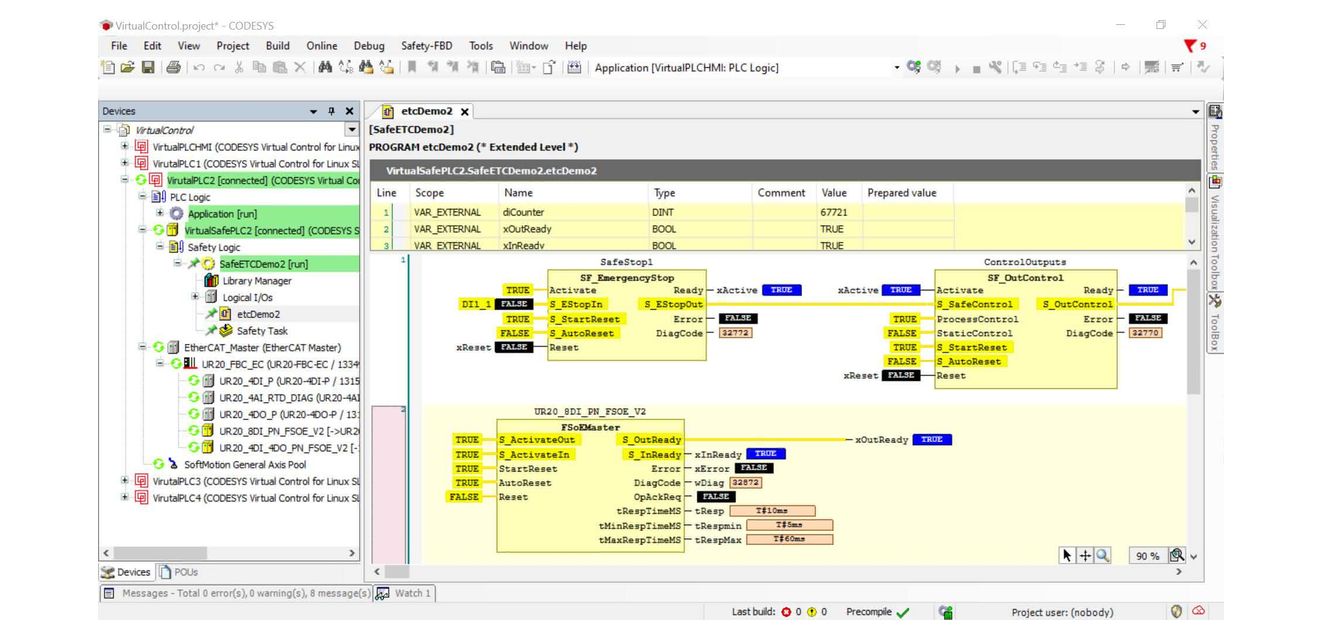
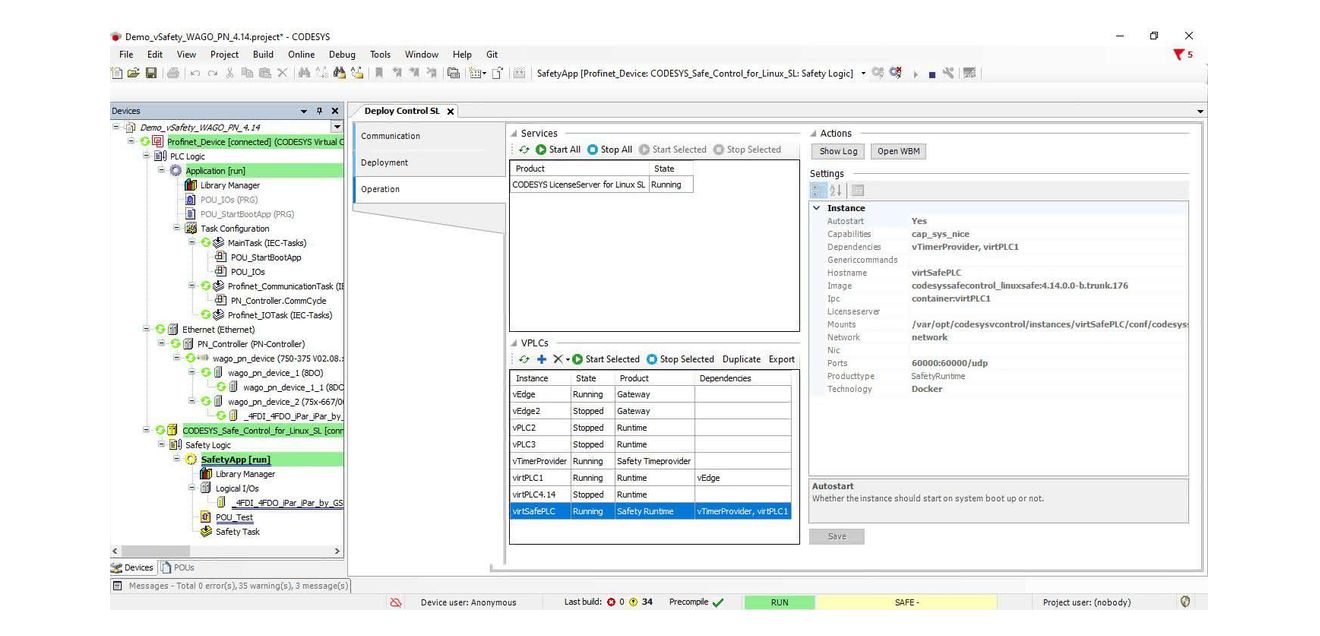
Virtual controllers can be deployed on the target system and managed ("orchestrated") using IT tools or simply with the Deploy Control SL add-on included in the Codesys Development System. The virtual controllers are included in the prepared image. For safety-critical applications, an additional image with integrated vSafePLC is available. The system automatically handles the division into the two independent channels as well as the execution and monitoring of the safety application in the background. Functional and safety applications are programmed directly in the Codesys Development System, typically within a single project. This allows data to be easily exchanged between the two PLCs. The purely functional part is expanded by an additional, certified add-on featuring a safety-compliant IEC 61131-3 editor for the safety application. A process certified by TÜV Süd monitors the download of the generated code to the virtual safety controller. The administration of virtual functional and safety controllers is thus largely standardized.
With regard to safety certification under the Machinery Directive, the procedure for vSafePLCs is identical to that for physical safety PLCs, with the exception that certified safety hardware is no longer required. TÜV Süd certified the base software of Codesys Virtual Safe Control SL for SIL3 applications on x86-based architectures as early as January 2025—specifically independent of the executing hardware. An extension to ARM-based systems is even planned for the middle of this year. As a result, Codesys Virtual Safe Control SL offers manufacturers—and especially operators—of machines and systems additional freedom—now even for safety-critical applications. The virtual controllers Codesys Virtual Control and Codesys Virtual Safe Control are already being used successfully in automotive production lines.
vPLCs in the Field of Motion, CNC, and Robotics
Even time-critical applications involving coordinated motion sequences can be implemented using virtual controllers. Motion applications programmed in tools such as CodeSys are executed using servo drives that are controlled via a fieldbus, typically EtherCAT. If vPLCs are used as PLCs, motion controllers can also be virtualized and executed within a single software environment. Even long distances between the target hardware and the drives—for example, in robots or gantry systems—can be bridged via Ethernet. vPLCs located on very distant servers can be connected via fiber-optic cables and appropriate converters. An application-specific integrated circuit (ASIC) from Missing Link Electronics, which bundles multiple protocols and transmits them without loss, is nearing series production. A patented method tunnels the data in such a way that all properties and information of the original system are preserved. This means that functionally safe protocols such as FSoE or ProfiSafe can also be used. Importantly for users of motion and PLC systems such as Codesys, unlike other fiber-optic systems, this type of data tunneling does not change the operation or configuration of the system. The circuit behaves like a standard Ethernet card within the system.
Virtual controllers offer numerous advantages and can be used in a wide variety of applications, including safety projects and complex motion applications. All requirements are addressed in software, independent of hardware. The way they are used does not differ from physical controllers, because tools like Codesys provide a unified configuration platform. Ultimately, it is up to companies to test these new possibilities for themselves and realize their full potential.


You might also be interested in
From Theory to the Factory Floor
IT and OT are converging, thereby laying the foundation for the smart factory. Only through seamless data integration can AI, digital twins, and flexible production processes become a reality. Why IT/OT convergence is becoming a competitive...
 read more...
Virtual PLCs in practice: How vPLCs make production systems more flexible and scalable
The increasing networking of IT and OT is fundamentally changing industrial automation. The IT/OT Integration Summit shows how modern technologies can make production environments more efficient, flexible and future-proof. The event will focus on...
read more...Experience with virtual control systems in real production environments
The end-to-end networking of IT and OT is considered one of the key levers for industrial transformation. The IT/OT Integration Summit addresses precisely this area of tension and brings together experts from production, automation and IT. The focus...
read more...Increased demand for control and drive...
Sieb & Meyer expands production capacities in Lüneburg
Sieb & Meyer AG is expanding its production space in Lüneburg by 1,800 m² in response to continued high demand in the wake of strong sales growth in the 2025 financial year and increasing investment in AI infrastructure.
read more...Hanover Fair starts
Topics such as digitalization and sustainable production will shape Hannover Messe 2026, and a number of prizes will also be awarded during the trade fair.
read more...Strike at the start of the Hannover Messe
On the occasion of the strike announced by ver.di on the first two days of Hannover Messe 2026 (20 and 21 April), which will paralyze public transport in Hanover, the organizer, Deutsche Messe, is expressing clear criticism and great concern about...
read more...Use data consistently and uniformly
New connectors and an app solution for the IIoT framework from PLCnext Technology make it easier to collect data from controllers, sensors and field devices - especially in existing systems.
read more...Beckhoff at the Light + Building 2026
Interdisciplinary building automation
At Light + Building from March 8 to 13, Beckhoff will be demonstrating PC-based control as a universal lever for sustainable building automation. Visitors can experience on site how the integration of all systems on an open platform can lower...
read more...Control platform for dynamic safety
Flexible and dynamic production environments place high demands on automation technology in terms of functional safety. At SPS, Phoenix Contact will be presenting approaches for functional safety in dynamic production areas - including systems for...
read more...