

Artificial intelligence
Beckhoff simplifies AI training
An evolutionary development every year, a revolutionary leap every five to seven years - this is how Beckhoff aims to secure its technological leadership. At the press conference at the Hanover trade fair, the company from Verl also presented some technological highlights.
Things are going well for Beckhoff: last year, the company increased its turnover by 16% to 1.75 billion euros. The technology leader invests part of this, namely around 90 million euros per year, in research and development. The company presented the results in Hall 9, including further developments of TwinCAT and the MX system automation system as well as a new generation of EtherCAT analog terminals.
Everyone is talking about AI. However, it is difficult for many companies to implement it in an industrial environment - there is a lack of AI experts. Beckhoff has therefore set itself the goal of enabling everyone to successfully implement AI. The company is therefore expanding the workflow in TwinCAT 3 to include the automated creation of AI models. With the TwinCAT Machine Learning Creator no-code development platform, users can take over the entire process from data acquisition to the trained model themselves. Open standards, interfaces and best practices are used and the trained models are provided in the open standard format ONNX. These latency-optimized AI models for control applications are adapted for execution on Beckhoff IPCs and with TwinCAT products, but can also be used as ONNX models outside the Beckhoff product world.
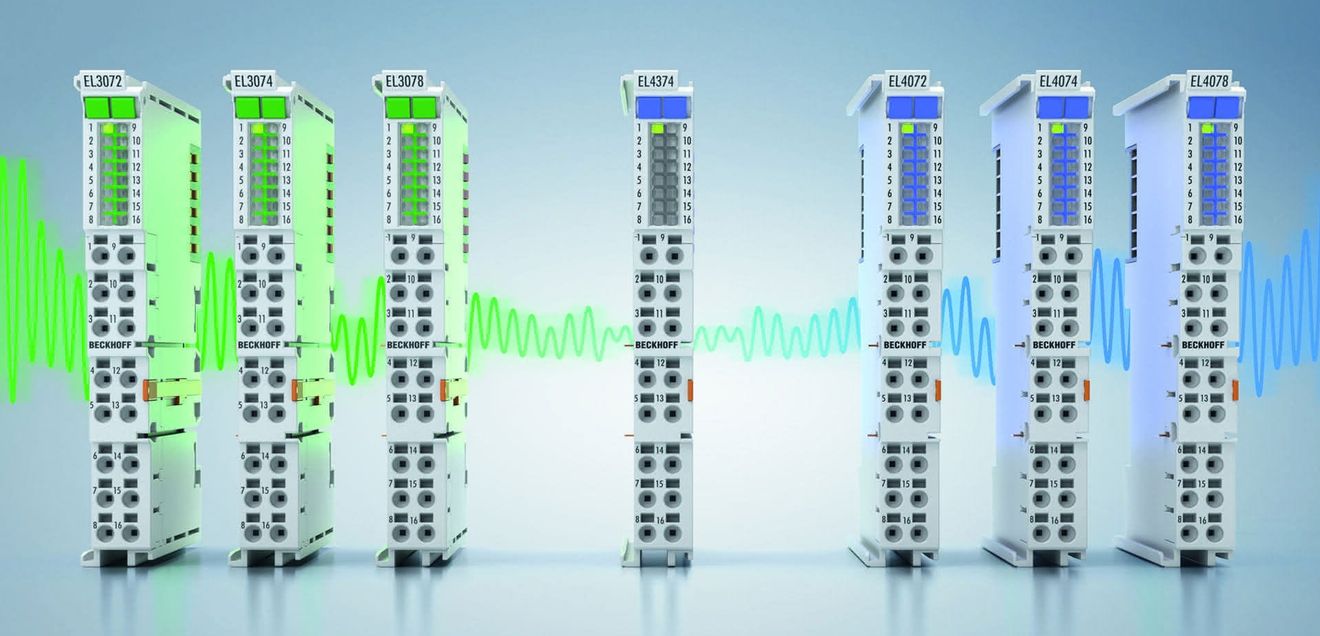
The new generation of EtherCAT analog terminals (Fig.) in an HD (high-density) housing comprises seven terminals and covers a wide range of applications with up to eight channels and 16-bit resolutions. These include the EL4374, the first combined input/output analog terminal (10 V/20 mA or -20/0/+4 to +20 mA), with which a conversion rate of 2 kSps per channel can be used. The two inputs and two outputs can be individually parameterized for current or voltage operation via TwinCAT (via CoE). With a technical measuring range of ±107 % of the nominal range, the terminal also supports commissioning with sensor values in the limit range as well as evaluation in accordance with NAMUR NE43. The outputs can provide up to 107 % of the nominal value. Added to this is the high output power, which allows a load of up to 750 Ω at 20 mA.
With the MX modular automation system, Beckhoff is replacing the traditional control cabinet. The function modules can simply be plugged onto the baseplate and then only need to be screwed into place. A special application is the use of a higher-level DC power supply. The DC supply for complete production halls is based on the strategy of providing electricity from renewable energies in combination with storage technologies for machines and systems as a mains voltage of 600 V(DC). The MX system is already designed to be DC-ready in that it can distribute DC voltages and can also be used directly for protective extra-low voltage power supply lines or modules for controlling synchronous and asynchronous motors.


You might also be interested in
Cybus Brings in Siemens Executive Stefan Schwab to Lead the Company
The Hamburg-based software provider Cybus will have a dual leadership structure going forward: Stefan Schwab will join co-founder Peter Sorowka as co-CEO.
 read more...
5 Challenges for AI Projects in Manufacturing
Manufacturing companies have high hopes for AI. IFS highlights the five most common reasons why AI projects fail.
read more...Record funding for accelerated development of a physical AI platform
Neura Robotics has announced a Series C funding round worth up to $1.4 billion. This will help the company accelerate its mission to build the world’s leading physical AI platform.
read more...Vertiv and Nvidia link physical infrastructure with digital twins
Digital twins instead of a flood of documents: Vertiv integrates 'SmartRun' into 'Nvidia Omniverse DSX' to accelerate the planning and implementation of AI factories.
read more...Ionos and Q.ANT cooperate on AI
Ionos and Q.ANT want to jointly advance photonic processor technologies for AI and high-performance computers. The aim of the partnership is to build energy-efficient and sovereign AI infrastructures in Europe.
read more...Siemens uses humanoid robots in its plant
Humanoid robots working in factories has long been considered a vision of the future. Siemens, Nvidia and the British start-up Humanoid have now brought this moment a little closer - with a tangible practical test under real conditions.
read more...AI 'CheckMate' optimizes industrial processes
With 'CheckMate', the University of Klagenfurt has developed an AI system that independently creates algorithms for complex combinatorics and optimization problems. The technology is designed to make industrial planning and logistics processes more...
read more...Machine Vision" conference in Baden-Baden
The VDI conference "Machine Vision - From Inspection to Smart Revolution" on June 17-18, 2026 in Baden-Baden will provide a comprehensive practical insight into current applications of machine vision. One focus will be on the use of AI and the use...
read more...European companies prioritize security over growth
With the integration of artificial intelligence (AI) into business-critical processes, European companies are shifting their priorities. Instead of pure innovation projects, the focus is increasingly on security, governance and scalability.
read more...