

Physical AI
Humanoid Robotics at BMW in Spartanburg
"Physical AI" combines digital AI with real machines and robots. This allows intelligent systems, such as humanoid robots, to be integrated into real-world production processes. Following the successful deployment of the Figure 02 humanoid robot at the BMW Group plant in Spartanburg, USA, its successor, the Figure 03, is now being introduced there.
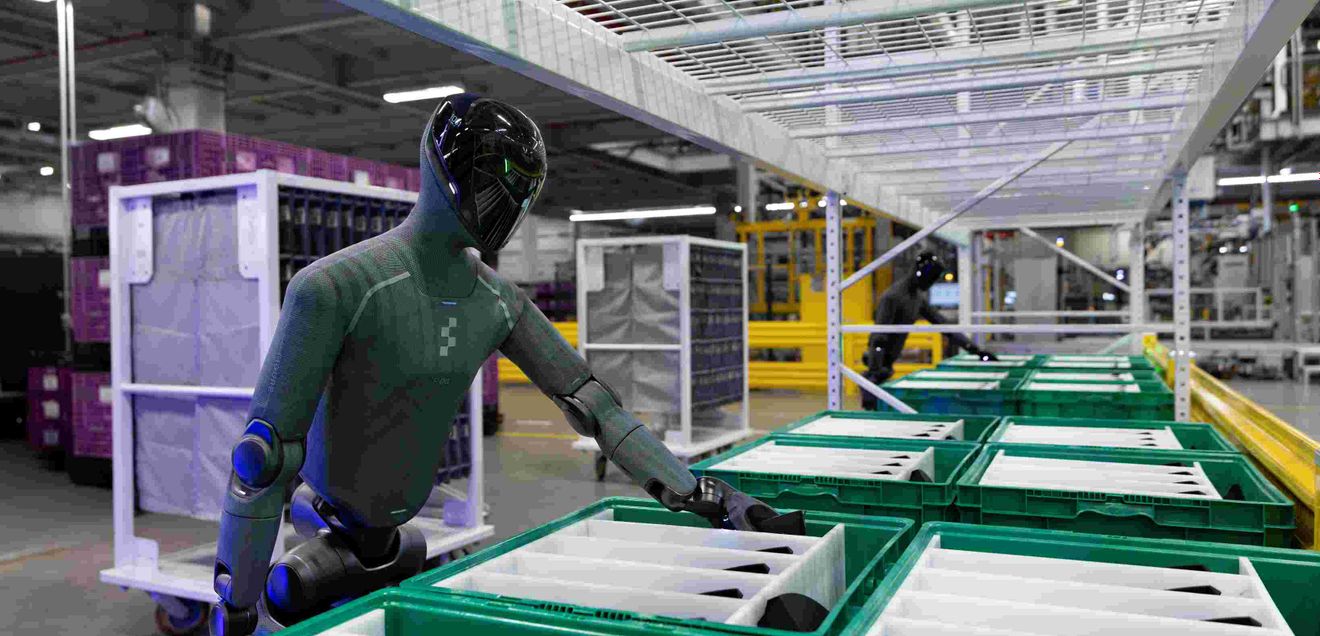
There, it will perform complex sequencing tasks in logistics. “The Spartanburg plant is the cradle of humanoid robotics in the BMW Group’s day-to-day operations. “Having already successfully completed a pilot project with the Figure 02 in our body shop, we are now looking forward to deploying the Figure 03 for a sequencing application in logistics,” says Ulrich Wieland, Vice President of Production Control and Logistics at BMW Manufacturing.
TheBMW Group gained experience with humanoid robotics as early as 2025 at its Spartanburg plant. In collaboration with the technology company Figure AI, the Figure 02 robot supported the production of more than 30,000 BMW X3 vehicles over a period of ten months. In the body shop, the robot positioned sheet metal parts for the welding process. The insights gained from this project now form the basis for the next step with the successor model, Figure 03.
Scalable Solution for Sequencing
In the new sequencing use case, delivered components arrive unsorted in large containers. Figure 03 picks them up and sorts them into a sequencing cart. The cart is then transported to a designated collection point for further transport. An automated guided vehicle or a smart transport robot then transports the parts to the installation site, where they are made available to assembly line workers “just in sequence.” This use case is common in logistics within automotive production and offers potential for further development and scalability.
Relief from monotonous and physically demanding tasks
The use of humanoid robots is part of the BMW Group’s strategy to expand its automation portfolio with Physical AI. Humanoid robotics is intended to complement existing automation. The company sees the potential of Physical AI particularly in monotonous, ergonomically demanding, or safety-critical tasks. The goal is to protect employees and deploy them optimally, while at the same time further improving the workplace.


You might also be interested in
5 Challenges for AI Projects in Manufacturing
Manufacturing companies have high hopes for AI. IFS highlights the five most common reasons why AI projects fail.
 read more...
From Theory to the Factory Floor
IT and OT are converging, thereby laying the foundation for the smart factory. Only through seamless data integration can AI, digital twins, and flexible production processes become a reality. Why IT/OT convergence is becoming a competitive...
read more...HIMA Is Growing Despite Challenging Markets
The HIMA Group will increase its revenue to 190.5 million euros in 2025. International business, digitalization, and partnerships are driving this growth.
read more...International Federation of Robotics
U.S. Robotics Industry Sees Double-Digit Growth
In the U.S., sales of industrial robots rose by 11% compared to the previous year: 38,000 units were newly installed in 2025. This significant recovery is driven by robust growth in the food industry and other non-manufacturing sectors. However, the...
read more...In-house exhibition Bielefeld 2026
How DMG Mori thinks about the factory of the future
DMG Mori will be showcasing turning and milling expertise, automation solutions and additive manufacturing along the Machining Transformation (MX) at the Bielefeld 2026 in-house exhibition.
read more...Benoît Thooris takes over the presidency
Benoît Thooris takes over the management of UniversalAutomation.Org and the organization expands its Board of Directors with two new members.
read more...Five security risks and how companies can protect themselves
Physical AI in industry: NTT DATA explains five critical security risks in sensor technology, AI models and networking as well as suitable countermeasures.
read more...Vertiv and Nvidia link physical infrastructure with digital twins
Digital twins instead of a flood of documents: Vertiv integrates 'SmartRun' into 'Nvidia Omniverse DSX' to accelerate the planning and implementation of AI factories.
read more...From sensor to intelligent system
Sensors, measurement technology and artificial intelligence are merging to form intelligent systems. From June 9 to 11, 2026, Sensor+Test in Nuremberg will showcase the most important trends in a changing industry.
read more...