
Industrial Imaging System
Checking the Quality of Packaged Goods in Real Time Using Millimeter-Wave Imaging
With the 'R&S IMAGER,' Rohde & Schwarz is expanding its portfolio for real-time millimeter-wave inspection. The new system is designed to simplify the industrial inspection of packaged products by scanning common packaging materials at production speeds without the use of X-rays. The high-contrast 3D images generated serve as digital twins of the products and can be automatically integrated into AI-based defect detection systems.
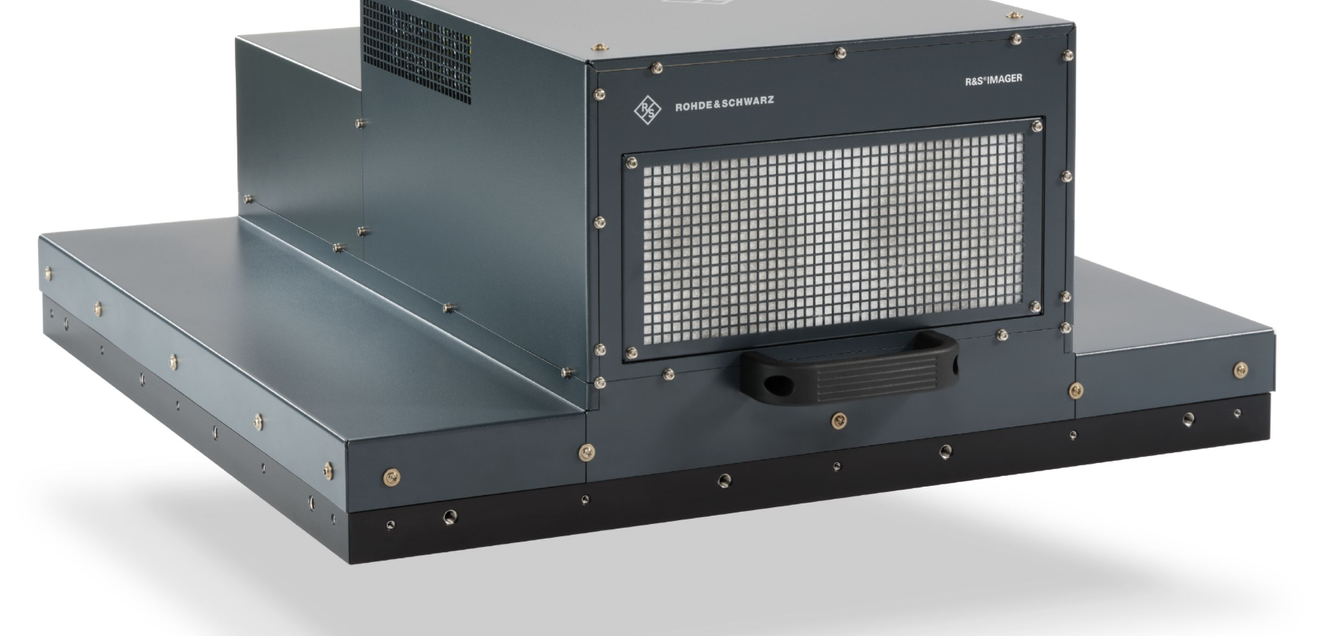
Millimeter waves make hidden structures visible
The 'R&S IMAGER' uses millimeter-wave imaging technology. Invisible millimeter waves penetrate the packaging materials, while the return signals are detected by a sensor array and processed into high-resolution images. This makes it possible to visualize hidden structures and material defects.
Quality Control for Pharmaceutical Packaging
In the pharmaceutical industry, the system is intended to fill a gap that camera- or weight-based inspection methods have so far left unaddressed. Since the radiation used is non-ionizing, the manufacturer states that the efficacy of pharmaceutical substances is not compromised. At the same time, multi-layer secondary packaging, cardboard boxes, and laminated seals are permeable to millimeter waves, allowing syringes, needles, or autoinjectors inside to be detected.
The system generates three-dimensional representations of each individual package at production speed, thereby enabling a complete inspection of all components and their correct assembly. Based on the volumetric image data, AI algorithms can automatically detect missing or misaligned parts without affecting the production line’s throughput. According to the manufacturer, eliminating the use of ionizing radiation also eliminates the risk of radiation-related damage to sterile products. At the same time, the system is designed to help meet regulatory requirements and reduce the likelihood of costly product recalls.
Applications in Logistics
Rohde & Schwarz also sees advantages for millimeter-wave imaging in logistics. While checkweighing and conventional surface inspections cannot reliably confirm whether the correct, high-quality product is inside a sealed package, the device projects millimeter waves through plastics, cardboard, and composite materials to generate an internal view of the package. This makes it possible to detect missing items, misplaced objects, or damage.
Integrated into a conveyor belt system, the device provides a continuous stream of images that are analyzed by AI algorithms to inspect contents and detect anomalies in real time. This is intended to reduce the need for manual inspections, increase inventory accuracy, and enable seamless documentation throughout the supply chain. At the same time, the technology supports the use of sustainable packaging materials, the contents of which can be reliably inspected despite potentially opaque materials.
Applications in the Food and Beverage Industry
The manufacturer also sees potential applications in the food and beverage sector. The system enables non-invasive monitoring of sealed cartons, multipacks, and glass containers. Since millimeter waves penetrate standard packaging, the system can detect missing items, damaged products, or sealing defects that would remain hidden during a surface-only inspection. According to the company, even the smallest deviations—such as a loss of vacuum in glass bottles—can be identified.
This is intended to ensure that safety and quality standards can be maintained even at high production speeds. Since the non-ionizing radiation used does not affect either food quality or employee health, the solution complies with applicable safety regulations, according to the manufacturer. Early defect detection is also intended to reduce waste, extend shelf life, and strengthen the brand image.
Integration into existing production lines
According to Rohde & Schwarz, the system architecture also supports integration into existing production control systems. This is intended to enable companies to expand their inspection capabilities without having to fundamentally redesign their manufacturing environment.
The transition from surface-based inspection to volumetric millimeter-wave imaging marks a significant advance in quality assurance. Against the backdrop of increasingly complex supply chains and rising regulatory requirements, the ability to quickly inspect every single product unit could become a decisive competitive advantage.


You might also be interested in
"Image processing is evolving from a monitoring tool to an active production aid."
How Image Processing and Digital Worker Assistance Optimize Manufacturing Processes: In this interview, Michael Kunze, Managing Director of MKey Solution GmbH, explains how companies can reduce scrap, improve quality, and control processes in real...
 read more...
Quality controls in production
Robots check car floor pans fully automatically
How can complex components in automotive production be inspected fully automatically and in real time with the help of machine vision and robotics? The case study shows how floor pans are measured and inspected fully automatically.
read more...Quality inspection with fast measurement workflows
Hexagon's Stationary Division presents Maestro, a next-generation coordinate measuring machine (CMM) that transforms quality inspection with fast, networked measurement workflows. The solution has been developed from the ground up with the...
read more...Greenhouse gas strategy with substance
Energy-intensive industries are facing major challenges: Complex supply chains, fossil raw materials and processes that are difficult to decarbonize make the path to greenhouse gas neutrality more difficult. A guest article by Dr. Gabriela Espinosa...
read more...Process monitoring and fault detection
Cameras ensure quality during laser melting
Powder bed-based laser melting (PBF-LB/M) opens up new possibilities in additive manufacturing. Modern camera systems provide crucial process data to further increase quality and efficiency.
read more...Vision Sensor is three times faster than its predecessor
The 'CS-62' vision sensor from di-soric is around three times faster than its predecessor, the 'CS-60'. In combination with the 'nVision-i 25.1' software, it enables image processing solutions that were previously reserved for smart cameras.
read more...Thermal imaging cameras for quality control
Automated thermal imaging cameras are often suitable for quality control applications where temperature plays a role. However, while there are various solutions on the market for slow processes, it is challenging to select a camera that reliably...
read more...Zoom-capable structured light scanner
Hexagon will be presenting products from its range of measuring machines and measuring robots at Control. These include SmartScan VR800 (image), the first zoom-capable structured light scanner with optical zoom projection and two stereo cameras,...
read more...Precise 3D surface inspection and defect detection
Reflectcontrol sensors from Micro-Epsilon use phase-measuring deflectometry to precisely analyze reflective surfaces.
read more...